Jun 1 2009
Sleep disturbances increase as we age. Some studies report more than half of seniors 65 years of age or older suffer from chronic sleep disturbances. Researchers have long believed that the sleep disturbances common among the elderly often result from a disruption of the body's circadian rhythms - biological cycles that repeat approximately every 24 hours.
In recent years, scientists at Rensselaer Polytechnic Institute's Lighting Research Center and elsewhere have demonstrated that blue light is the most effective at stimulating the circadian system when combined with the appropriate light intensity, spatial distribution, timing, and duration. A team at the Lighting Research Center (LRC) has tested a goggle-like device designed to deliver blue light directly to the eyes to improve sleep quality in older adults.
"Light and dark patterns are the major synchronizer of circadian rhythms to the 24-hour solar day," said Mariana Figueiro, Ph.D., Lighting Research Center Light and Health Program director and principal investigator on the project. "Light stimulus travels through the retina, the light-sensitive nerve tissue lining the back wall of the eye, to reach the master clock in the brain. However, a combination of age-related changes in the eye and a more sedentary lifestyle may reduce the amount of light stimulus reaching an older person's retina, therefore reducing the amount of light for the circadian system."
As we age, the lens in the eye thickens and the pupil shrinks, reducing the amount of light passing through to the retina. Making matters worse, in some cases, such as with persons with Alzheimer's disease, the circadian system may require a stronger light stimulus due to deteriorating neural processes in the brain. These physical and neural changes can lead to muted signals to the circadian system. Factor in environmental influences, such as an indoor lifestyle with less access to daylight, and you have a perfect scenario for the development of irregular sleep-activity patterns, according to Figueiro.
The research team explains that a marked increase in daytime lighting levels can counteract the age-dependent losses in retinal light exposure by providing a stronger signal to the circadian system. However, the color and intensity of commercially available lighting systems, like those used in senior residences, assisted-living facilities, and nursing homes, are designed for visual effectiveness and minimal energy use and not necessarily efficacious for generating light to stimulate the older circadian system.
Commercially-available "white" light sources advertised to treat circadian-related sleep disorders are usually very bright light and can cause glare and compromise compliance.
In this project, the light-treatment prototype tested by Figueiro's team was developed by Topbulb.com, LLC, based on prior LRC light and health research. The device offers an alternative approach using specially designed goggles that deliver blue light spectrally tuned for optimum circadian response. 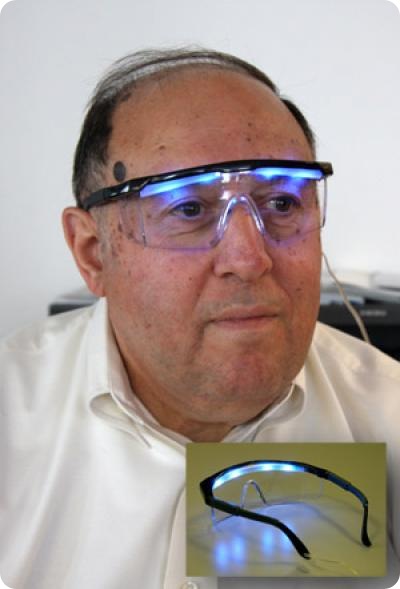
"The goal of this phase of the development project was to create a device in a smaller form factor or envelope that allowed for social inclusion and end-user mobility, while still delivering the required dose of light," said Topbulb.com Senior Developer Philip H. Bonello, Ph.D.
The device was worn by eleven subjects between the ages of 51 and 80 years of age. Each subject was exposed to two levels of blue light (about 50 lux and 10 lux) from the personal light-treatment device for 90 minutes on two separate nights. Blood and saliva samples were collected at prescribed times to assess levels of nocturnal melatonin, a hormone used as a marker for the circadian clock, with high levels at night when a person is in a dark environment and low levels during the day.
After only one hour of light exposure, the light-induced nocturnal melatonin suppression level was about 35 percent for the low light level and about 60 percent for the high light level. In addition, the higher level of blue light suppressed nocturnal melatonin more quickly, to a greater extent over the course of the 90-minute exposure period, and was maintained after 60 minutes.
Having demonstrated its stimulation effect on the circadian system, the researchers believe the device could be subsequently used to increase sleep consolidation and efficiency in older subjects when worn for a prescribed duration at an appropriate time.
"The study suggests that the light goggles might be a practical, comfortable, and effective way to deliver light treatment to those suffering from circadian sleep disorders. The next steps are to conduct field studies where we will be testing the effectiveness of this personal light-treatment device on those suffering from circadian-related sleep disorders, while also verifying the acceptance of the a device among the test groups," said Figueiro.
 AI model can predict a person's disease risk using sleep data