Ovulation is the phase in the female menstrual cycle when an egg or ovum, also known as an ovule or oocyte, is released from the ovaries. The ovum matures within a fluid-filled space in the ovaries which ruptures at the time of ovulation to allow it to pass out.
Ovulation is a result of the periodic hormonal changes in the female body after puberty. This is the most fertile period of the menstrual cycle. Thus, if a woman has sexual intercourse in the days immediately surrounding ovulation, she will be more likely to conceive.
When a woman is eager to conceive, or on the contrary, to avoid pregnancy, it is useful for her to recognize the signs of ovulation. This can allow intercourse to be timed so as to facilitate the achievement of the desired outcomes.
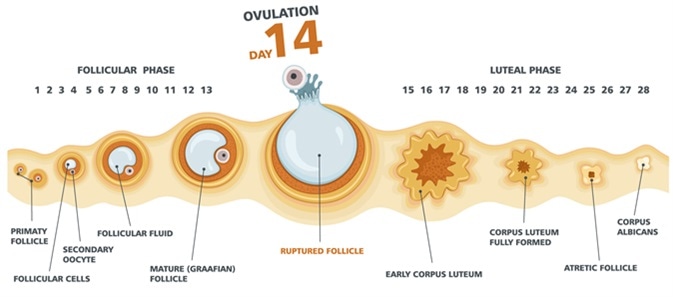
Ovulation chart. Female menstrual cycle. Image Credit: logika600 / Shutterstock
Female Menstrual Cycle
The menstrual cycle is the name given to the whole cycle of hormonal fluctuations that results in ovulation and conception, or failing that, in the monthly periodic bleeding called menstruation.
The first part of the cycle is the follicular stage, when the ovarian follicles mature. In this stage the early egg is surrounded by a protective cloud of cells, which will also be essential in achieving fertilization later on.
The follicular cells produce various female hormones that produce a positive feedback on the maturation process, building up to ovulation.
Ovulation usually occurs in the middle of the menstrual cycle, although the exact time varies greatly from woman to woman. On average, it occurs 14.6 days after the first day of menstruation. The vast majority of women ovulate 8 to 21 days from the first day of the cycle. This culminates in the rupture of the follicle, and the egg starts to travel along the Fallopian tubes towards the uterus.
Following ovulation, the egg is available for fertilization. At this time the luteal phase of the cycle occurs, characterized by the transformation of the ruptured follicle into a corpus luteum. This transforms the lining of the uterus, the endometrium, into a luteinized endometrium, which is thicker and softer. This is in order to prepare for the reception of a fertilized egg.
If conception does not occur, this lining is no longer needed and it is shed during the process known as menstruation, signaling the initiation of the follicular phase.
Female Fertility Animation
How do Hormones Affect Ovulation?
The hypothalamus in the brain is responsible for regulating the hormonal changes that precipitate ovulation. It secretes hormones which in turn stimulate the anterior lobe of the pituitary gland to release luteinizing hormone (LH) and follicle stimulating hormone (FSH).
FSH stimulates cumulus expansion before ovulation occurs. This refers to a series of changes in the cloud of cells around the mature ovum, and involves follicular waves. This is followed by the formation of a weak spot in the ovarian capsule, called the stigma. The stigma gives way to release the egg in response to a spike in both FSH and LH levels, the latter being the immediate precursor of ovulation.
Fertility
The days surrounding ovulation are known to be the most fertile period when the woman is most likely to conceive. Although there is great variance between women, teh fertile period is generally considered to last from day 10 to 18 in a standard 28-day cycle.
Many women are able to sense the imminence of ovulation by various changes in their bodies. This helps them determine their fertile period.
What are the Signs of Ovulation?
The following are some of the signs that may help women to recognize when they are ovulating:
- Altered character of cervical and vaginal discharge – the mucus produced in the cervix changes from thick to slippery and copious (resembling uncooked egg white) mucus during ovulation, which is evident in the vaginal discharge.
- Body temperature – the basal body temperature drops slightly just before ovulation and then increases very slightly, about half a degree Celsius, for the rest of the luteal phase.
- Mittelschmerz – this refers to abdominal pain in the region of the ovaries at the time of ovulation, either generalized or on alternating sides of the abdomen, corresponding to the side of ovulation.
- Senses – many women experienced a heightened sense of smell during ovulation and may even be able to sense the precise moment of ovulation.
- Libido – it is common to have a higher sexual drive in the days immediately prior to ovulation.
These signs are very useful and are able to help some women recognize the exact time of ovulation.
Tests for Ovulation
Several medical tests are available to confirm the occurrence of ovulation, such as:
- Ovulation predictor kits for home use based on the rapid measurement of urinary hormone levels help to detect the imminence of ovulation
- Blood progesterone levels above 20 nmol/L strongly suggest that ovulation has already taken place if measured in the late luteal phase
- An ultrasound showing a pregnancy is the only absolute evidence of ovulation.
Aberrations of Ovulation
Ovulation may be disrupted by problems with:
- The hypothalamus – as in polycystic ovary syndrome, too rigorous exercise, long-term stress and eating disorders
- The pituitary – as in benign growths of the pituitary or pituitary injury
- The ovaries – as in ovarian failure, or ovarian trauma or removal
Can the Chances of Ovulation be Enhanced?
Some ways to increase the possibility of ovulation include:
- Regulating body weight within normal limits
- Avoiding extreme forms of exercise
- Regular and balanced eating habits with adequate caloric intake
- Stress management
Managing Anovulation
Modern medicine has uncovered some ways to induce ovulation, such as by taking ovulation induction tablets or injections which stimulate the hypothalamus and pituitary to secrete more ovulatory hormones. However, these methods are not without risk and should be monitored.
Further Reading
Last Updated: Jan 14, 2019
 Study links menstrual cycle timing to COVID vaccine side effects