Patients with spina bifida usually require a comprehensive management plan that involves a multidisciplinary team of health professionals. There is no cure for the nerve damage caused by the spinal opening, but a range of interventions can help to prevent further damage and help the individual to meet daily needs.
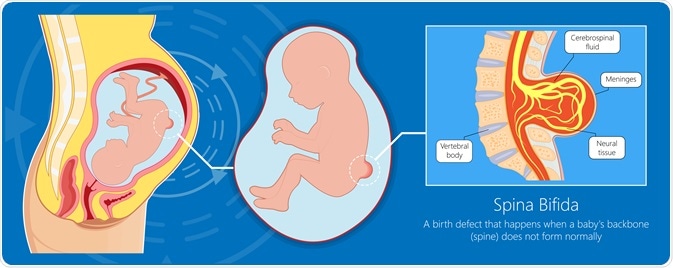 Spina bifida infographic. Image Credit: rumruay / Shutterstock.com
Surgery
Infants born with spina bifida surgery will require surgery shortly after birth in the vast majority of cases. This is because the opening in the spine can lead to the nerves and membranes pushing out and forming a sack, which can cause nerve damage and increases the risk of serious infections. Surgery to repair the spine should take place as soon as possible, usually within 48 hours of the birth.
The reparative surgery involves the repositioning of the spinal cord, nerves and exposed tissues, such that they return to their anatomically correct place. Following this, the spinal opening is sealed with a graft of muscle and skin.
Some infants may also need surgery to treat complications, such as hydrocephalus. This surgery involves the implantation of a shunt to drain the excess fluid from the brain to another area of the body, such as the abdomen. The shunt usually stays in place permanently, although subsequent surgery may be required if it becomes blocked, infected or too small to be of use for a growing child.
Orthopedic surgery may be required to correct abnormal bone development, such as a hip dislocation or clubfoot.
Physical and Occupational Therapy
It is important for spina bifida patients to be able to become as independent as possible, which can be assisted with the help of physical and occupational therapists.
Physiotherapy is useful to promote body movement, particularly of the legs to prevent the weakening of the muscles. This usually consists of daily leg exercises to strengthen the muscles, as well as the use of a splint to support the legs. Patients with mobility issues that are not able to move their legs may benefit from assistive devices, such as a leg brace, walking aid or wheelchair.
Occupational therapy is helpful in aiding patients to partake in everyday activities as usual. Problem areas are identified and practical solutions are worked out to enable individuals to successfully complete activities they need to do. This includes simple activities and the implementation of practical interventions to make the activity easier, such as installing a handrail to help a patient climb the stairs in the house.
Together, physical and occupational therapy enables patients to become more independent and help to boost the self-esteem of the individuals.
Spina bifida (myelomeningocele, meningocele, occulta) - an Osmosis Preview
Incontinence Treatment
There are several treatments that can help to aid patients that suffer from urinary or bowel incontinence.
For urinary incontinence, the following treatments may be beneficial:
- Clean intermittent catheterization (CIC): This technique enables the regular emptying of the bladder, which helps to reduce the risk of infections of the urinary tract. The catheter is inserted up the urethra to empty the bladder and can be performed at various intervals, from one to six times each day.
- Antimuscarinics: This class of medications helps to relax the muscles in the bladder, reducing the frequency of urination and the likelihood of infection.
- Surgery: Several surgical techniques can be implemented, including botulinum toxin injections, artificial urinary sphincter insertion, Mitrofanoff procedure and augmentation cystoplasty procedure.
For bowel incontinence, the following treatments may be beneficial:
- Lifestyle changes: Dietary changes and toilet training techniques can be implemented to help reduce symptoms
- Anal irrigation: A catheter can be inserted to pump water into the bowel and wash out the area.
- Antegrade continence enema (ACE): A surgical procedure that helps to increase ease and convenience of enemas.
- Colostomy and ileostomy: Usually used in adult patients, these are surgical procedures that involve colon or intestinal diversion to the abdomen, where the stools can be excreted.
Learning Support
Although most patients will have a normal intelligence level, they may need additional support to help them cope with learning difficulties and relevant physical problems.
 Yellow ribbon for spina bifida awareness. Image Credit: ADragan / Shutterstock.com
References
Further Reading
Last Updated: Nov 26, 2022