Semen is a bodily fluid that is secreted by the gonads of male animals. It contains spermatozoa and fructose and other enzymes that help the sperm to survive and facilitate successful fertilization. During the process of ejaculation, the semen is ejaculated from the seminal vesicle in the pelvis, which is where it is produced.
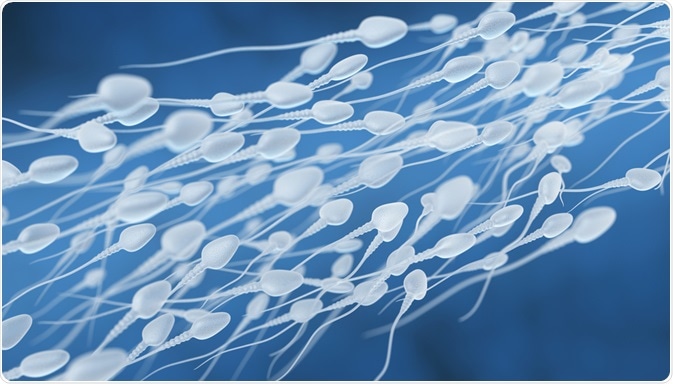
Image Credit: Tatiana Shepeleva / Shutterstock.com
Amount of semen per ejaculate
The volume of semen released per ejaculate varies. It is estimated that an average of around 3.4 milliliters (mL) is ejaculated at one time. The amount ejaculated can be as high as 4.99 mL or as low as 2.3 mL.
If there is a prolonged gap between ejaculations, the number of sperm in the semen increases, but there is no overall increase in the semen.
Composition of semen
Semen passes through the ejaculatory ducts and mixes with fluids from the seminal vesicles, the prostate, and the bulbourethral glands. The seminal vesicles produce a viscous, fructose-rich fluid. This forms around 65-70% of the semen base.
The white color of the semen is due to secretion from the prostate glands containing enzymes, citric acid, lipids, and acid phosphatase which, taken together, forms around 25-30% of the semen base. At each ejaculation, around 200-500 million spermatozoa are released by the testes. This forms about 2-5% of the semen composition.
The bulbourethral glands produce a clear secretion that helps in the mobility of the sperm cells in the vagina and cervix. In addition, this clear secretion reduces the thickness of the channel that the sperm cells swim through and adds a cohesive, jelly-like consistency to the semen. The glands’ secretion contributes less than 1% to the overall semen composition.
Semen also contains more than 50 different compounds including hormones, endorphins, neurotransmitters, and immunosuppressants. Other substances present in the semen include:
- Fructose
- Ascorbic acid
- Zinc
- Cholesterol
- Protein
- Calcium
- Chlorine
- Blood group antigens
- Citric acid
- DNA
- Magnesium
- Vitamin B12
- Phosphorus
- Sodium
- Potassium
- Uric acid
- Lactic acid
- Nitrogen
- Vitamin C
Semen also consists of a variety of proteins that have antimicrobial activity against bacteria, viruses, and fungi.
Possible beneficial effects of consumption of semen
Also present in the semen are mood-enhancing compounds such as cortisol, estrone, oxytocin, thyrotropin-releasing hormone, prolactin, melatonin, and serotonin. For this reason, scientists have begun studying the health benefits of semen intake, both orally and vaginally. Some of the studies into the effects of swallowing semen are described here.
Pregnancy
In a Dutch study of women who engaged in oral sex and swallowed the semen, the researchers found that swallowing semen was associated with a lower risk of preeclampsia. One hypothesis for this is that substances in the semen adapt the mother’s immune system so that it accepts foreign proteins present in sperm, as well as in the placenta and fetus. This maintains the blood pressure at a low level and thereby reduces the preeclampsia risk.
Research has also shown that some women are infertile or miscarry due to the presence of antibodies that destroy the proteins or antigens present in their partner’s semen. Having oral sex and swallowing the semen of the partner may help make the pregnancy safer and more successful as the woman is swallowing her partner's antigens.
Work carried out by reproductive expert and psychologist Gordon Gallup from the State University of New York (SUNY) at Albany suggests that swallowing semen could provide a cure for morning sickness. Gordon hypothesizes that pregnant women vomit as a result of their bodies rejecting genetic material in the sperm as a foreign substance, but that by swallowing and ingesting the sperm of the baby’s father, they can build up immunity.
Ovulation
In a study conducted by researchers from the University of Saskatchewan, a protein in semen was found to act on the female brain to induce ovulation. That protein is the same molecule that controls the growth, maintenance, and survival of neurons. The findings suggest that semen may work as a signaling hormone that acts via the hypothalamus and pituitary gland of the female brain, which triggers the release of other hormones involved in prompting ovulation.
Hair health
Some studies have shown that semen extracted from bulls rejuvenates damaged hair. Semen has been found to contain many proteins that may complement the protein present in hair molecules.
Possible disadvantages of consumption of semen
Semen can contain several viruses that may be transmitted via bodily fluids from an infected man. Some common examples of such sexually transmitted infections (STIs) include the human immunodeficiency virus (HIV), hepatitis B and C, herpes, and chlamydia.
The risk of transmitting an STI through oral sex is higher if there is an open sore in the mouth or if a person has gingivitis and bleeding gums. According to the United States Centers for Disease Control and Prevention, hepatitis B can also be transmitted through contact with infected semen if an open sore is present in the mouth.
Human papilloma virus
The human papillomavirus has emerged as a serious concern in relation to oral sex. This virus can cause cervical cancer, anal cancer, and the development of other growths such as genital warts. In 2013, some research suggested the virus can even cause lung cancer.
In 2010, a multinational review published in the British Medical Journal demonstrated that the incidence of oropharyngeal squamous cell carcinoma is on the rise in Western countries and that this increase seems to be linked to HPV, particularly the HPV-16 strain. The article implied that HPV is spread through sex, but in particular, oral sex.
Chlamydia and gonorrhea
The transmission of chlamydia and gonorrhea through oral sex has also become a concern. In May 2011, a study of female commercial sex workers showed that one in 25 of the workers had chlamydia in their throats. In addition, one in 50 of the sex workers had gonorrhea in their throats.
Cultural practices and beliefs
Some cultures believe that semen has special properties of masculinity. The idea of semen being associated with masculinity was prevalent in ancient Greece when Aristotle considered semen to be very important.
To this end, Aristotle said that a connection existed between blood and semen, in that semen was produced from blood using body heat. Aristotle also believed that too early initiation of sexual activity may mean a loss of semen and, subsequently, a loss of valuable and much-needed nourishment.
In Papua New Guinea, some communities believe that semen provides sexual maturation to the younger men of the tribe. The tribes believe that the semen of older men can bestow manliness and wisdom to the younger men and for this reason, the younger men fellate their elders in order to receive their authority and powers.
In ancient eastern cultures, gemstones are believed to be drops of divine semen. Chinese believe jade is the dried semen of the celestial dragon.
References
Further Reading
Last Updated: Oct 29, 2022
 Organophosphate pesticide exposure linked to reduced sperm quality in healthy men