'Gene therapy' involves inserting one or more corrected genes into a patient's genetic material to treat a genetic disease. The genes are designed in the lab to compensate for errors in the patient's DNA.
Therefore, the expression of the new gene or genes can alter the DNA or RNA transcript used to synthesize proteins, thereby correcting the disease. In spite of its potential, gene therapy is still in its infancy and not widely used yet.
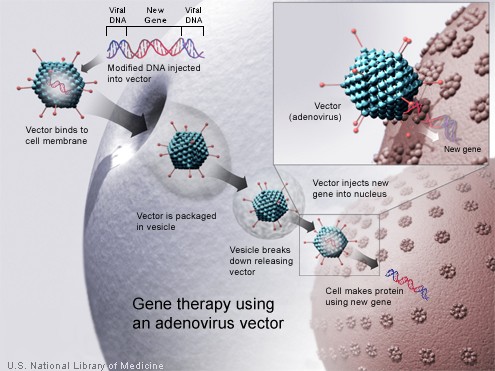
Gene therapy using an adenovirus vector: A new gene is injected into an adenovirus vector, which is used to introduce the modified DNA into a human cell. If the treatment is successful, the new gene will make a functional protein.
Procedure of gene therapy
One of the first hurdles of gene therapy is successful introduction of the corrected gene into the human cells. Once introduced, the gene needs to be incorporated into the genetic material of those cells.
Some of the main diseases currently being researched in gene therapy studies include:
- Cystic fibrosis
- Sickle cell anemia
- Hemophilia
- Muscular dystrophy
- Cancer
One of the main vectors used to carry modified genes into cells is the virus. Viruses usually attach to a host cell and transfer their viral genetic material into it. They then take over the cell and use the cell components to make copies of the virus.
Scientists can modify these viruses so that they contain only therapeutic and not viral genetic material but still retain their infective ability so that the beneficial DNA can be transferred into host cells.
Commonly used vectors include adenoviruses, adeno-associated viruses, retroviruses and the herpes simplex virus.
There are two main types of gene therapy which include:
Somatic gene therapy
With this form of therapy, only somatic cells (body cells) are targeted and not the germline cells, otherwise known of as the gametes or sex cells. If the modification of DNA is confined to body cells only, then the altered genome only effects the individual treated and not any offspring produced when the gametes join to form a zygote.
Germline therapy
This involves incorporation of a tailored gene into the gametes, permanently altering the genes inherited by future generations. This type of therapy is prohibited in many countries due to ethical and technical concerns.
Further Reading
Last Updated: Jan 18, 2023
 Fondazione Telethon achieves milestone with Waskyra approval for Wiskott-Aldrich Syndrome