Thirty years of research have informed Boyan’s understanding of how bone and cartilage cells behave. Determined to discover the reasons why some people – women, in particular -- have a greater propensity for cartilage degradation over time, Boyan focused her attention on differences at the cellular level. There, she and her colleagues made the remarkable finding of biochemical differences between male and female cartilage cells in both animals and humans.
“There is a fundamental difference in these cells in males and females,” says Boyan, the Price Gilbert Jr. Chair in Tissue Engineering and deputy director of research for the Georgia Tech/Emory Center for the Engineering of Living Tissues. “Now we want to understand the mechanism involved in this difference.”
Boyan’s research team is exploring whether females possess special steroid hormone receptors or whether their receptors just operate differently. This mechanism is of critical importance to bodily functions such as cartilage and bone formation, and probably affects a person’s risk for diseases such as osteoporosis, osteoarthritis and some cancers, Boyan explains. Researchers elsewhere recently found biochemical differences in colon cancer cells in males and females.
“So this is a very important question for how you do tissue engineering, but also in general how you would treat males and females differently when there is a clear sex-specific effect,” says Boyan, also a faculty member in Georgia Tech’s Petit Institute for Bioengineering and Bioscience.
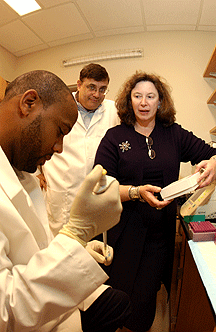 |
| Professor Barbara Boyan conducts basic research on steroid hormone receptors with long-time colleague Zvi Schwartz, center, a visiting professor from Hebrew University Hadassah. Research Technician Jonathan Turner works with the team. |
| Georgia Tech Photo: Gary Meek |
|
|
This finding on the sex specificity of cartilage cells led Boyan and her colleagues to question the ways scientists study cells. For example, most laboratories culture cells on tissue-culture plastic, which is not a natural surface. Yet bone and cartilage cells live in a complicated environment inside the body.
“So we started examining how cells respond to more biologically relevant surfaces and how those responses are regulated by steroid hormones,” Boyan explains. “We found that micro- and nano-topography of surfaces can regulate cell growth.”
Subsequently, Boyan and her colleagues, Professor David Ku and Associate Professor Robert Guldberg of Georgia Tech and former Georgia Tech VentureLab fellow Steve Kennedy, designed a more natural microstructure for the surfaces of hydrogel biomaterials used to replace defective bone and cartilage in the body – in particular, spinal discs.
By early 2003, the early-stage technology had proven its potential for commercialization, and Boyan received a VentureLab faculty commercialization grant, funded in part by the Georgia Research Alliance, to form a company called Orthonics. Kennedy serves as the CEO for the company, which is seeking its first round of investor financing. Orthonics is housed in the Advanced Technology Development Center’s Biosciences Center on the Georgia Tech campus.
Orthonics’ first product will be a “bionic spinal disc” for replacing diseased or damaged intervertebral discs in millions of people with severe chronic back pain. Currently, doctors performing disc surgery typically remove the inflamed cartilage and fuse two vertebrae together. This procedure reduces the patient’s pain, but also their mobility.
“If we can come up with a material that behaves like a normal disc and helps patients retain their mobility – and I think we can – it will have an important impact on people’s health and quality of life,” Boyan says.
Orthonics researchers are studying whether the hydrogel’s microstructure encourages cells to sufficiently multiply and become bone cells – promoting the bionic disc’s attachment to vertebrae and not forming scar tissue, Boyan says. Researchers are following a similar line of study on cartilage cell formation on the hydrogel surface.
Laboratory experiments have yielded promising results for the bionic spinal disc, says Orthonics CEO Steve Kennedy. He expects that pre-clinical trials in animals will begin in early 2004, followed by clinical trials in humans by 2006. Like other medical devices, it will require FDA approval for use in the United States.
The bionic disc is made from a tough and rubbery hydrogel material similar to one used in contact lenses, Kennedy explains. Because of the material’s similarity to natural tissue, bone and cartilage will grow into it. The device could be inserted in the spine in an arthroscopic procedure. Recovery time would range from one to six weeks, compared to as much as 15 months of recovery from spinal fusion surgery.
With Orthonics operating under the full-time care of Kennedy, Boyan can continue her basic research on steroid hormone receptors with long-time colleague Zvi Schwartz, a visiting professor in biomedical engineering from Hebrew University Hadassah in Jerusalem, Israel. Boyan also collaborates with colleague Guldberg to address the repair of injuries to growth plates, a layer of cartilage in children’s bones that provides growth until skeletal maturity.
Bone fractures often cause growth plates to prematurely fuse, resulting in slowed bone growth, limb length discrepancy or angled limb deformity. Although doctors try to stop the fusion of cartilage into the bone when possible, there is no clinical treatment for restoring growth function in damaged growth plates.
But biologist Boyan and engineer Guldberg are designing a tissue-engineered construct – made from a biological scaffold and cells -- to implant into defective growth plates. They hope the construct will stop the fusion of cartilage into bone and restore growth in long bones.
With pediatric orthopedic surgeon Tracy Ballock of the Cleveland Clinic, Boyan and Guldberg are using microcomputed tomography (Micro CT) to monitor growth plate repair in rats. The researchers hope to obtain additional funding from the National Institutes of Health to continue this research.
This study represents the kind of collaboration inspired by Boyan’s leadership role at the tissue engineering center GTEC, says Professor Robert Nerem, the center’s director. The Georgia Research Alliance (GRA) and Georgia Tech recruited Boyan from the University of Texas Health Science Center at San Antonio in 2001 to help lead GTEC.
“She has brought biology to the forefront in terms of the activities of the center,” Nerem says. “…. Barbara’s presence has challenged us to bring the best of biology into the tissue engineering research we’re doing – in the orthopedic area in particular. She’s been a breath of fresh air for our leadership team because she brought a different perspective.”
Nerem also cites Boyan’s research contributions for making a significant impact in tissue engineering. He calls her a first-rate researcher, noting that she received the prestigious Clemson Award from the Society for Biomaterials in 2002 for the body of research she’s done in her career.
Boyan expresses gratitude for the research, leadership and technology transfer accomplishments she’s made from the opportunities provided by Georgia Tech and the GRA. But her feet remain firmly planted in the reality of the big-picture goals she and her colleagues share.
“At the current state of tissue engineering, we know almost nothing,” Boyan says. “We don’t know how to make stem cells differentiate into the cell of interest and continue to be that kind of cell over time. A better understanding of the cells responsible for regulation in the body will allow us to produce better tissue-engineered products outside the body or use strategies to get the body to heal itself.”
 Study identifies new therapeutic candidate for KRAS-driven pancreatic cancer