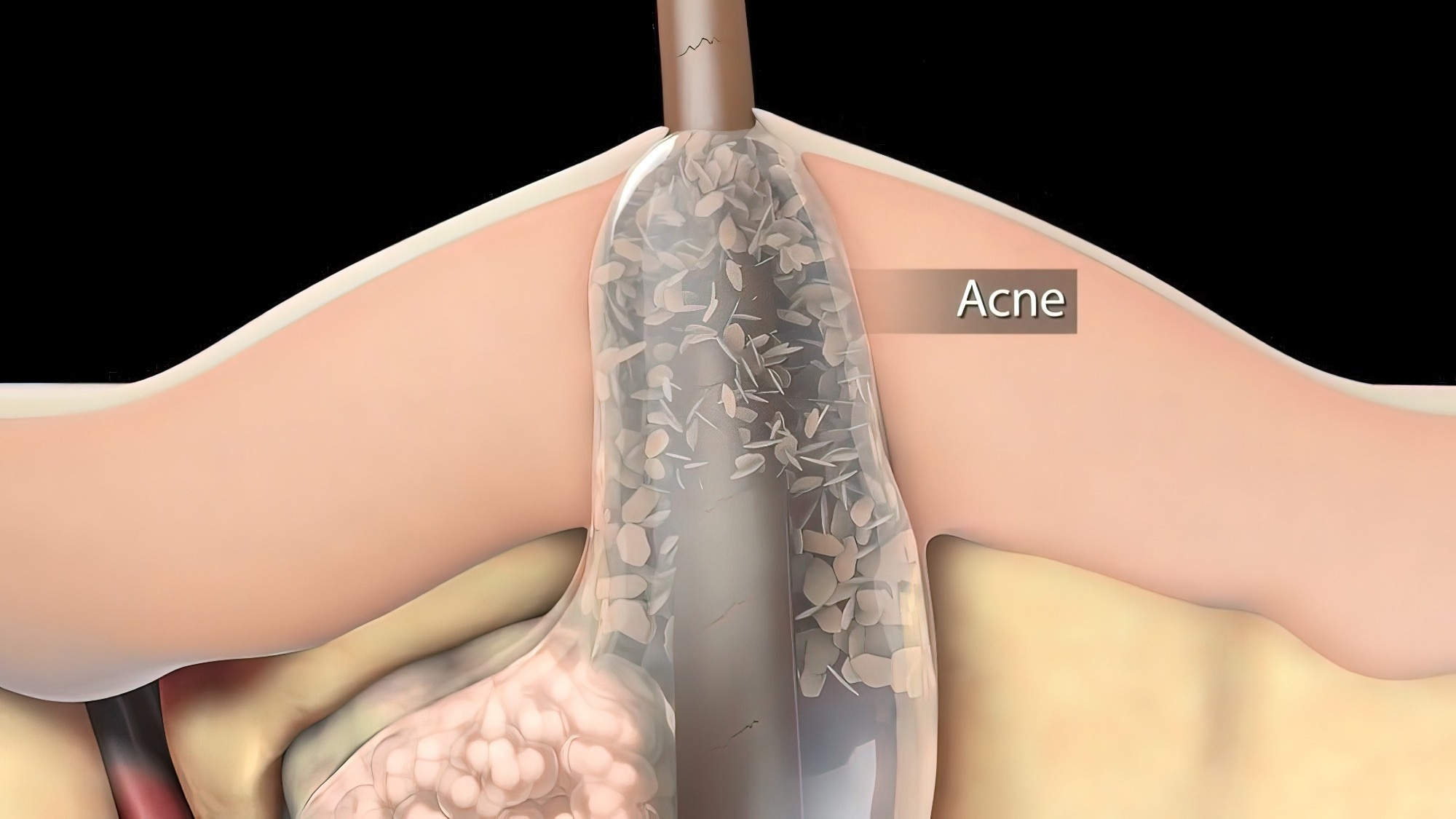
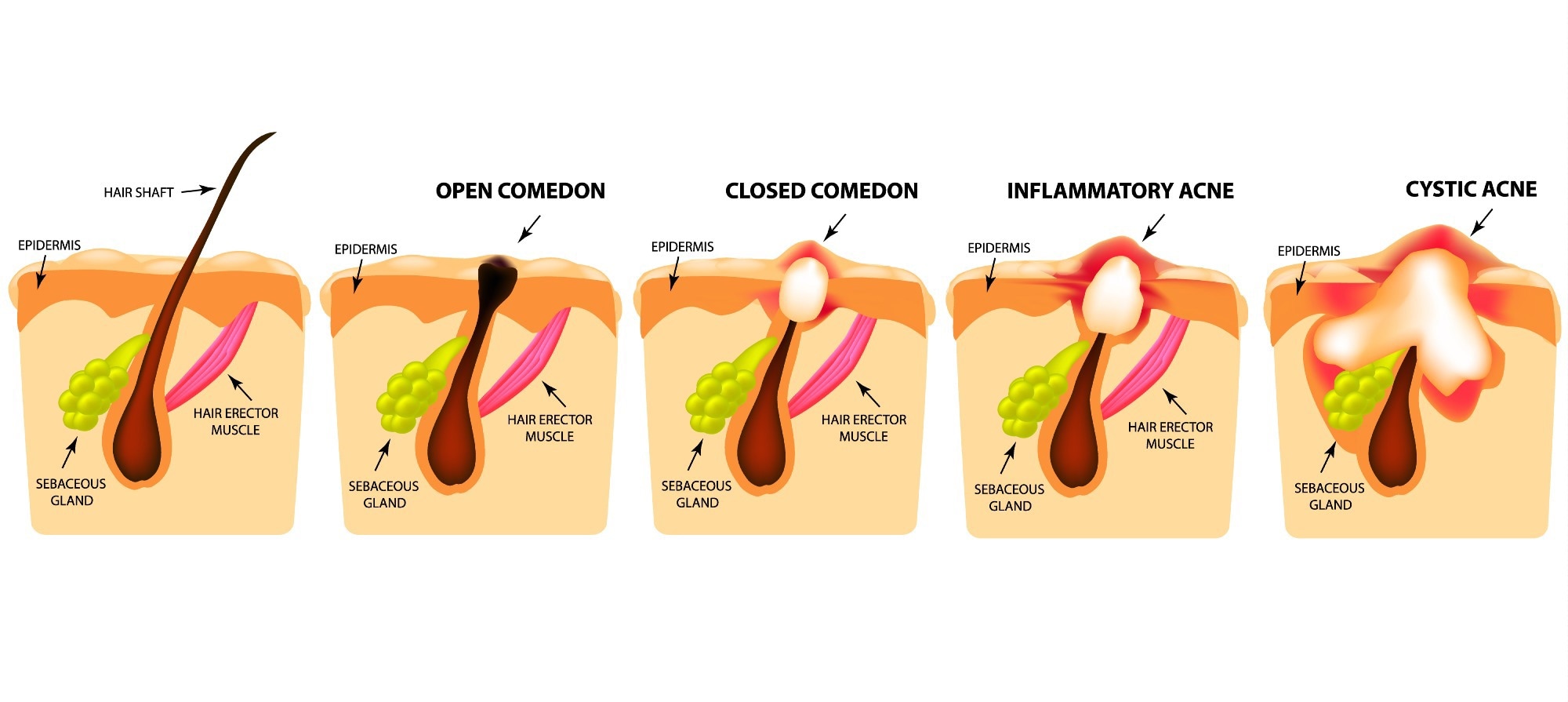
Doctors describe acne as a disease of the pilosebaceous units (PSUs). Found over most of the body, PSUs consist of a sebaceous gland connected to a canal, called a follicle, that contains a fine hair (see "Normal Pilosebaceous Unit" diagram). These units are most numerous on the face, upper back, and chest. The sebaceous glands make an oily substance called sebum that normally empties onto the skin surface through the opening of the follicle, commonly called a pore. Cells called keratinocytes line the follicle.
|
| Normal Pilosebaceous Unit |
The hair, sebum, and keratinocytes that fill the narrow follicle may produce a plug, which is an early sign of acne. The plug prevents sebum from reaching the surface of the skin through a pore. The mixture of oil and cells allows bacteria Propionibacterium acnes (P. acnes) that normally live on the skin to grow in the plugged follicles. These bacteria produce chemicals and enzymes and attract white blood cells that cause inflammation. (Inflammation is a characteristic reaction of tissues to disease or injury and is marked by four signs: swelling, redness, heat, and pain.) When the wall of the plugged follicle breaks down, it spills everything into the nearby skin – sebum, shed skin cells, and bacteria – leading to lesions or pimples.
People with acne frequently have a variety of lesions, some of which are shown in the diagrams below. The basic acne lesion, called the comedo (KOM-e-do), is simply an enlarged and plugged hair follicle. If the plugged follicle, or comedo, stays beneath the skin, it is called a closed comedo and produces a white bump called a whitehead. A comedo that reaches the surface of the skin and opens up is called an open comedo or blackhead because it looks black on the skin's surface. This black discoloration is due to changes in sebum as it is exposed to air. It is not due to dirt. Both whiteheads and blackheads may stay in the skin for a long time.
|
| Microcomedo |
|
| Open Comedone (Black Head) |
|
| Closed Comedone (White Head) |
Primary causes
The root causes of why some people get acne and some do not are not fully known. It is known to be partly hereditary. Several factors are known to be linked to acne:
- Family/Genetic history. The tendency to develop acne runs in families. For example, school-age boys with acne often have other members in their family with acne as well. A family history of acne is associated with an earlier occurrence of acne and an increased number of retentional acne lesions.
- Hormonal activity, such as menstrual cycles and puberty. During puberty, an increase in male sex hormones called androgens cause the follicular glands to get larger and make more sebum.
- Inflammation, skin irritation or scratching of any sort will activate inflammation. Anti-inflammatories are known to improve acne.
- Stress, through increased output of hormones from the adrenal (stress) glands. While the connection between acne and stress has been debated, scientific research indicates that "increased acne severity" is "significantly associated with increased stress levels." The National Institutes of Health (USA) list stress as a factor that "can cause an acne flare." A study of adolescents in Singapore "observed a statistically significant positive correlation […] between stress levels and severity of acne."
- Hyperactive sebaceous glands, secondary to the three hormone sources above.
- Accumulation of dead skin cells that block or cover pores.
- Bacteria in the pores. Propionibacterium acnes (P. acnes) is the anaerobic bacterium that causes acne. In-vitro resistance of P. acnes to commonly used antibiotics has been increasing.
- Use of anabolic steroids.
- Any medication containing lithium, barbiturates or androgens.
- Exposure to certain chemical compounds. Chloracne is particularly linked to toxic exposure to dioxins, namely Chlorinated dioxins.
- Exposure to halogens. Halogen acne is linked to exposure to halogens (e.g. iodides, chlorides, bromides, fluorides).
- Chronic use of amphetamines or other similar drugs.
Several hormones have been linked to acne: the androgens testosterone, dihydrotestosterone (DHT) and dehydroepiandrosterone sulfate (DHEAS), as well as insulin-like growth factor 1 (IGF-I). In addition, acne-prone skin has been shown to be insulin resistant.
Development of acne vulgaris in later years is uncommon, although this is the age group for Rosacea which may have similar appearances. True acne vulgaris in adult women may be a feature of an underlying condition such as pregnancy and disorders such as polycystic ovary syndrome or the rare Cushing's syndrome. Menopause-associated acne occurs as production of the natural anti-acne ovarian hormone estradiol fails at menopause. The lack of estradiol also causes thinning hair, hot flashes, thin skin, wrinkles, vaginal dryness, and predisposes to osteopenia and osteoporosis as well as triggering acne (known as acne climacterica in this situation).
Diet
Chocolate
The popular belief that chocolate intake, in and of itself, is a cause of acne is not supported by scientific studies. As discussed below, various studies point not to chocolate, but to the high glycemic nature of certain foods containing simple carbohydrates as a cause of acne. Chocolate itself has a low glycemic index.
Milk
Recently, three epidemiological studies from the same group of scientists found an association between acne and consumption of partially skimmed milk, instant breakfast drink, sorbet, cottage cheese, and cream cheese. The researchers hypothesize that the association may be caused by hormones (such as several sex hormones and bovine insulin-like growth factor 1 (IGF-1)) or even iodine present in cow milk.
Carbohydrates
The long-held belief that there is no link between diets high in refined sugars and processed foods, and acne, has recently been challenged. The previous belief was based on earlier studies (some using chocolate and Coca-Cola) that were methodologically flawed. The recent low glycemic-load hypothesis postulates that rapidly digested carbohydrate foods (such as soft drinks, sweets, white bread) produce an overload in blood glucose (hyperglycemia) that stimulates the secretion of insulin, which in turn triggers the release of IGF-1. IGF-1 has direct effects on the pilosebaceous unit (and insulin at high concentrations can also bind to the IGF-1 receptor) and has been shown to stimulate hyperkeratosis and epidermal hyperplasia. These events facilitate acne formation. Sugar consumption might also influence the activity of androgens via a decrease in sex hormone-binding globulin concentration.
In support of this hypothesis, a randomized controlled trial of a low glycemic-load diet improved acne and reduced weight, androgen activity and levels of insulin-like growth factor binding protein-1. High IGF-1 levels and mild insulin resistance (which causes higher levels of insulin) had previously been observed in patients with acne. High levels of insulin and acne are also both features of polycystic ovarian syndrome.
According to this hypothesis, the absence of acne in some non-Westernized societies could be explained by the low glycemic index of these cultures' diets. It is possible that genetic reasons account for there being no acne in these populations, although similar populations (such as South American Indians or Pacific Islanders) do develop acne. Note also that the populations studied consumed no milk or other dairy products.
Further research is necessary to establish whether a reduced consumption of high-glycemic foods, or treatment that results in increased insulin sensitivity (like metformin) can significantly alleviate acne, though consumption of high-glycemic foods should in any case be kept to a minimum, for general health reasons. Avoidance of "junk food" with its high fat and sugar content is also recommended.
Vitamins A and E
Studies have shown that newly diagnosed acne patients tend to have lower levels of vitamin A circulating in their bloodstream than those who are acne free. In addition people with severe acne also tend to have lower blood levels of vitamin E.
Hygiene
Acne is not caused by dirt. This misconception probably comes from the fact that blackheads look like dirt stuck in the openings of pores. The black color is not dirt but simply oxidised keratin. In fact, the blockages of keratin that cause acne occur deep within the narrow follicle channel, where it is impossible to wash them away. These plugs are formed by the failure of the cells lining the duct to separate and flow to the surface in the sebum created there by the body. Built-up oil of the skin can block the passages of these pores, so standard washing of the face could wash off old oil and help unblock the pores.
Further Reading
Sourced and Abstracted from information found at NIAMS, CDC, NIH, FDA, Wikipedia (Creative Commons Attribution-ShareAlike License)