A few pimples or acne occurs in the lifetime of most women. Acne, however, may affect men and women in a markedly different manner.
Adolescent men are more likely to suffer from severe forms of acne than women. In women acne is related to several hormonal factors and sometimes the menstrual cycle - with the acne being more severe before their periods.
With age most women experience marked improvement in their symptoms. But some women have acne for many years. Some women even get acne for the first time in their 30’s.
Acne can affect women markedly. It may be severely upsetting in some women. Acne may give rise to feelings of depression, low self-esteem and poor body image.
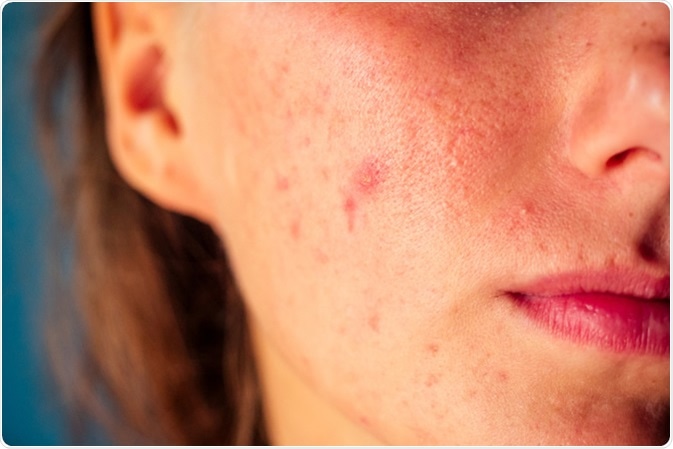
Post-acne, scars and red pimples on the face of a young woman. Image Credit: Yurakrasil / Shutterstock
Acne and a woman’s age
Studies have shown that acne peaks in women in their teenage years but may remain prevalent among older women. There may be many women in their 20’s and some in their 30’s who are affected by acne.
Mild acne can affect girls between 10 and 15 years of age. During teenage years there is primarily inflammatory acne.
Risk factors for acne in women
Women who have acne have been found to secrete more sebum than those who do not have acne. Excess sebum is directly co-related with inflammatory but not comedonal acne.
Women with acne are also likely to have hirsuitism. Hirsuitism refers to excessive body hair particularly over the upper lip. Women who have hirsuitism also have high levels of sebum.
Several risk factors have been seen to be associated with women who have acne. Some of these include current smoking status and a higher body weight (Body mass index).
Alcohol consumption and caffeine are not found to be associated with acne. Other factors that are not related to acne include lifetime sun exposure, education, and income.
Hormonal changes
Acne among women over 25 is primarily a result of hormonal changes. These women tend to have higher levels of male sex hormones like testosterone in their blood. This is called hyperandrogenism.
Hyperandrogenism means there are features like:-
- loss of hair on the head
- increased sebum production
- hirsuitism over the upper lip
- menstrual disorders
- metabolic syndrome
- obesity
- infertility
- psychological disturbances
- alteration of ovulation schedules (ovulation refers to release of an egg each menstrual cycle)
Hyperandreogenism is seen in women with polycystic ovary syndrome (PCOS) and these women are 70% more likely to get acne.
Hormonal treatment in women with acne
In many women over 25 there is a failure to respond to traditional anti-acne therapy. Recurrence rates after isotretinoin treatment also range from 15 to 30 percent.
Women who have hyperandrogenism usually do not respond to conventional topical therapy. These women may be treated using hormonal therapy.
Drugs used in the hormonal treatment of acne are of four types:-
- Those that block androgen (male sex hormone) receptors and prevent the action of the excess androgens. These include spironolactone, flutamide and cyproterone acetate. There are agents that block the effect of the androgens on the sebaceous glands preventing excess sebum secretion. These three agents are not US Food and Drug Administration (FDA)-approved for the treatment of acne and cyproterone acetate is not available in the United States.
- Oral contraceptive pills may be used. These suppress the production of androgens from the ovaries. They are particularly useful for women affected by acne who also want to use a contraceptive. These pills used in acne contain both an estrogen (usually ethinyl estradiol) and progestin. Progestin-only containing pills may exacerbate the condition. Combined oral contraceptive pills have been approved by the FDA for use in acne.
- Glucocorticoids may be used. These suppress the androgen production from the adrenal glands
- Enzyme inhibitors like 5α-reductase inhibitors. These enzymes prevent the conversion of androgens to their active forms. Finasteride, the only drug marketed as a 5α-reductase inhibitor has not been used widely in acne mainly because of its risk to an unborn baby if the woman is pregnant at the time of use.
YOU LOOK DISGUSTING
Further Reading
Last Updated: Jul 8, 2023
 FDA shares safety guidance for people considering microneedling