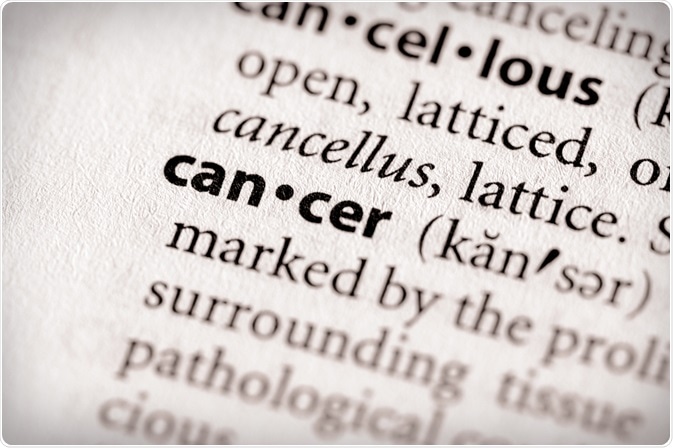
The terminology used by oncologists and those working in the field of cancer research can be highly complex and confusing for many. This article provides definitions for some commonly used words and phrases.
 Mark Poprocki | Shutterstock
Terms related to cancer types
- Tumor – any abnormal swelling, lump or mass.
- Neoplasm – this is the medical term for cancer and means "new growth".
- Benign neoplasm, or benign tumors - a cancer that is not likely to spread, and is contained within one region of the body.
- Invasive or metastatic tumor - a tumor that has spread from one area of the body to another
- Non-invasive tumor - a tumor that has not yet spread to another area of the body, but if left untreated, has the potential to become aggressive and invade other organs.
- Atypia, dysplasia and carcinoma in situ – non-invasive tumors where the cells look abnormal under the microscope.
- Carcinoma – any cancer that arises from skin cells or epithelial cells that line the internal organs.
- Sarcoma – a type of cancer that begins in bone, cartilage, fat, muscle, blood vessels and other supportive tissues.
- Leukemia – a blood cancer that arises in blood-forming tissues such as the bone marrow and leads to the overproduction of large numbers of abnormal blood cells.
- Lymphoma and myeloma – cancers that originate from the cells of the immune system.
Terms related to the diagnosis and pathology of cancer
Screening – any test that is carried out routinely among healthy individuals to identify tumors before they become symptomatic. A good example of a screening test is a mammogram to detect breast cancer. These tests are usually minimally painful or invasive to increase their acceptability.
Biopsy – where a small sample of an unknown growth, such as a mole, is removed and analyzed in the laboratory under a microscope. There are several types of biopsy procedures, including fine needle aspiration, core biopsy or excision biopsy.
Tumor grade – defined as the degree of resemblance of the tumor cells to the surrounding tissue. A low grade tumor resembles the surrounding normal tissues closely while a high grade tumor is very different from surrounding tissues. An intermediate grade lies somewhere in between.
Cancer staging - a number, usually between 0 and 4 that describes the aggressiveness of the tumor. A grade 4 cancer is an advanced cancer that has spread to distant organs and is resistant to treatment.
Tumor transformation - the advancement of a low-grade tumor into a high-grade tumor.
Aggression - the likelihood of the cancer spreading to other organs. A minimally aggressive tumor spreads slowly whereas an aggressive tumor tends to spread faster.
Oncologist – a medical specialist who deals with cancer and its treatment.
Oncopatholgist – a scientist who helps in diagnosis and detection of cancers.
Terms related to the treatment of cancer
Remission – when a cancer patient shows no sign of cancer after therapy, he or she is said to be in remission. They are kept under a close watch and system of monitoring and follow up to detect a relapse.
Cure – where 95% of treated patients are still alive within a specified time period after their diagnosis. For Hodgkin’s lymphoma it is 10 years, whereas for Burkitt's lymphoma this period is 1 year.
Recurrence – when the cancer returns at the site of the original tumor after surgery or treatment.
Median survival time – this is a period of time measured in months or years over which at least 50% of the cancer patients are expected to be alive.
Overall survival – this is statistical term that determines the maximum survivability with a cancer.
Prognosis – the probable outcome of a cancer. Prognosis is usually expressed as a probability of survival five years after diagnosis. It can also be expressed as the number of years when 50% of the patients are still alive. A graphical analysis by the Kaplan-Meier curve is used to determine the prognosis.
Other terms related to the treatment of cancer:
- Protocol – the chemotherapy regimen that is prescribed.
- Chemotherapy – the treatment of cancer using anti-cancer drugs.
- Treatment cycle - chemotherapy drugs are often given in the same order on the same schedule repeatedly. These are called cycles of chemotherapy.
- Radiation therapy – therapy with high energy beams or rays and radiation to kill the cancer cells. Radiation works by damaging the DNA of the cancer cells beyond repair, causing cell death.
- Adjuvant therapy – any treatment given with chemotherapy or radiation therapy. Adjuvant therapy is typically given after surgery to kill any remaining cancer cells.
- Neo-adjuvant therapy – similar to adjuvant therapy, but used before surgery to reduce the burden of cancer cells.
- Palliative therapy – symptomatic relief that is provided in patients with advanced cancers.
Sources
- http://www.oncolink.org/types/article.cfm?c=22&s=69&ss=545&id=6001
- http://www.cancer.gov/cancertopics/cancerlibrary/what-is-cancer
- http://www.cancer.org/cancer/cancerbasics/what-is-cancer
- http://kidshealth.org/kid/cancer_center/cancer_basics/cancer.html
- https://cancer.org.in/
- https://learn.genetics.utah.edu/
Further Reading
Last Updated: Jul 5, 2023
 Unusual i-DNA structure shown to regulate genes and cancer