Plasma donation is a process that involves the separation of plasma from the donor's whole blood, while the unselected constituents of the blood are returned to the donor. Blood is composed of four major components including red blood cells (RBCs), white blood cells (WBCs), platelets, and plasma. Plasma is a liquid portion of the blood that transports clotting factors, proteins, and other nutrients throughout the bloodstream.
Plasma donation is sometimes also called plasmapheresis; however, a distinction from therapeutic plasmapheresis has to be made. For treatment applications, the goal of plasmapheresis is to deplete the circulating substances directly responsible for the disease process. On the other hand, the aim of collecting plasma for transfusion is the efficient removal of the specific blood elements without causing harm to the donor due to the over-depletion
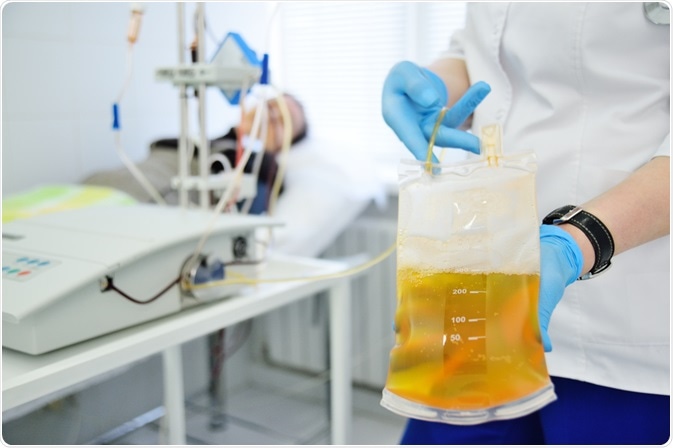
Image Credit: Evgeniy Kalinovskiy / Shutterstock.com
Methods of collecting plasma
In the early days, manual plasmapheresis was the principal method of collection. The blood was drawn into a primary pack containing anticoagulants and a series of additional packs. It was then centrifuged, while simultaneously maintaining the intravenous line with a saline drip. The plasma was extracted and retained, and the RBCs were returned to the donor. The whole procedure was repeated, thus leading to its name “double plasmapheresis," which typically yielded a total of 500 ml of plasma in one hour time.
Although the manual method of plasma collection is still available, automated equipment is now routinely used due to its convenience and improved product safety. The advantages of automated plasmapheresis is that the procedure is faster and more tolerable, donors are never disconnected from their own blood, thereby eliminating the risk of contamination, and the total extracorporeal volume is less than in double plasmapheresis.
Several machines have been constructed exclusively for this purpose. Moreover, these systems are based either on the principle of centrifugation as a way to separate the blood components or filtration through a spinning cylindrical membrane. In modern instruments, the anticoagulant dose is also measured in an automated waycontrolled by a microprocessor.
Products made from plasma
Different products can be made from plasma donations. Immunoglobulins (Igs) are preparations containing antibodies used to protect patients from several infectious diseases such as varicella zoster, hepatitis B, and tetanus. Intravenous (IV) Igs (IVIG) are also used to boost the immune system in people with various immune deficiencies and in the treatment of a growing number of hematologic, immunologic, and neurologic illnesses.
Albumin from plasma is used to restore blood volume in shock or burn patients, as well as assist in the treatment of kidney and liver diseases. Concentrate of factor VIII, which is the anti-hemophilic factor, is used to prevent bleeding in patients with hemophilia A and von Willebrand disease (VWD). Both hemophilia A and VWD are well-known hereditary coagulation abnormalities that are caused by a deficiency in factor VIII and von Willebrand factor, respectively.
The Power of Plasma Donation Animation
Care of donors
The criteria for the acceptance of plasma donors are stricter as compared to those required for routine blood donation. Annual examination of donors is often mandatory and comprehensive laboratory tests are carried out periodically. Detailed informed consent should be signed before the start of the procedure and every donor should be aware of all possible hazards.
If plasma donors do not have their RBCs returned during the procedure, or give whole blood, at least 8 weeks should elapse before the next donation. Regulations in the United States and Europe differ significantly; the maximum amount of plasma that can be donated in the United States is 50-60 liters a year, whereas in Europe it is only 15 liters per year.
Outbreaks of blood-borne diseases in donation centers have been described. These outbreaks arose because of practices associated with human blood injection, reuse of material, and sharing of syringes or IV lines during apheresis. Thus, commercial plasma donation in less-developed countries puts donors and recipients at risk of contamination of the plasma pool by blood-borne pathogens.
References
Further Reading
Last Updated: Apr 12, 2021