Eczema, also known as atopic dermatitis, is a chronic inflammatory skin condition that affects millions of people worldwide. While there is no cure for eczema, there have been significant advances in treatments to alleviate the symptoms of the disease. Children with eczema may often grow out of it as they age. Several new therapies are being tried in this condition that may severely affect the quality of life in an individual.
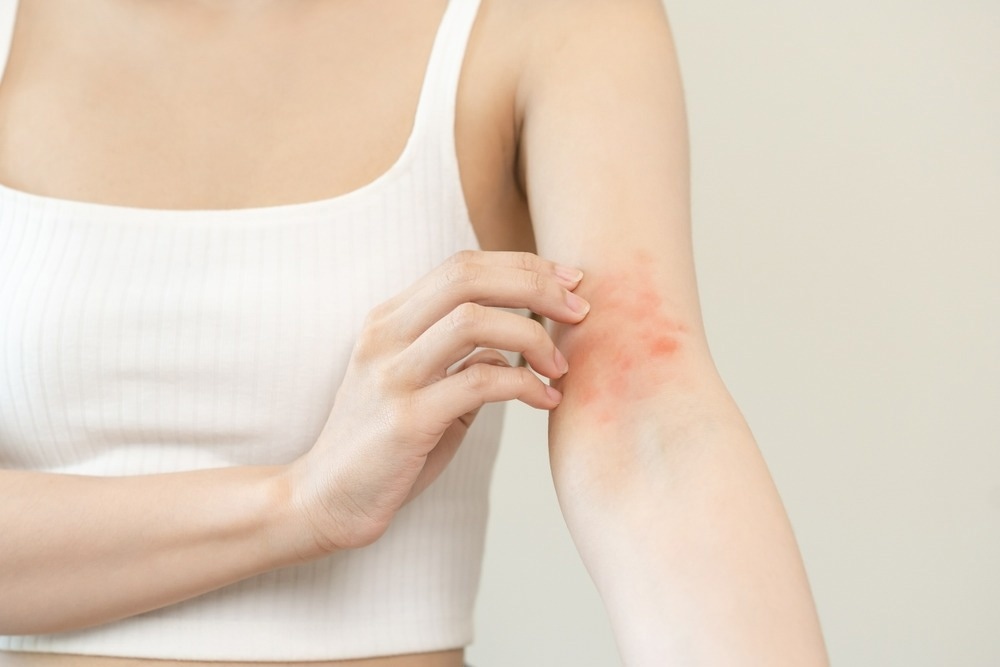
Image Credit: Kmpzzz/Shutterstock.com
Immunomodulation
Several immunomodulators or immunosuppressants, such as topical calcineurin inhibitors (e.g., pimecrolimus and tacrolimus), are now being used to treat severe eczema. Additionally, numerous agents that locally modulate the immune system to alleviate eczema and its associated symptoms are undergoing evaluation in various clinical trials.
Biologics are a new class of drugs that target specific immune cells involved in eczema. These drugs are typically used for moderate to severe eczema when it is not responding to conventional treatments. In 2017, the FDA approved the inhibitor dupilumab for treating eczema, which is known to suppress IL‐4 and IL‐13 signaling pathways. Recent research has proposed dupilumab as the most effective biologic treatment for atopic dermatitis, showing substantial evidence of effectiveness. While other biologics also demonstrate promising therapeutic potential (e.g., nemolizumab, lebrikizumab, and tralokinumab), more research is needed to confirm their efficacy.
Gene therapy
Given the frequent association of eczema with family history and personal allergies, genetic factors are likely involved in eczema. Emerging gene therapy approaches are opening promising avenues for eczema treatment and prevention. In the last years, several genes have emerged as potential targets for gene therapy, each contributing to the underlying immune dysregulation and skin barrier dysfunction characteristic of eczema.
- The human body produces its own protease inhibitors, such as LEKTI, encoded by the gene SPINK5, which safeguard against damage from the enzymatic activity of allergens. Mutations in this gene are known to cause Netherton’s syndrome, a congenital erythroderma. Individuals with Netherton's syndrome almost invariably develop atopic diseases, including hay fever, food allergy, urticarial, and asthma. These insights could pave the way for a deeper understanding of eczema and its treatment strategies.
- Filaggrin (FLG), another gene implicated in inherited eczema and related disorders, encodes the protein filaggrin. Deficiency of this protein leads to dry skin and impaired skin barrier function. Gene therapy holds promise for correcting FLG mutations, restoring filaggrin production, and enhancing skin barrier integrity.
- Thymic stromal lymphopoietin (TSLP) is an epithelial-derived cytokine involved in eczema pathogenesis and other allergic diseases. It is produced by skin cells (i.e., keratinocytes) and triggers the activation of immune cells, contributing to inflammation. Gene therapy could target TSLP production or signaling to dampen the immune response and alleviate eczema.
The roles of Brain-Derived Neurotrophic Factor (BDNF) and Substance P
Recent research has uncovered a link between brain-derived Neurotrophic Factor (BDNF) and Substance P chemical mediators in the body and itching sensations characteristics of eczema. Further investigations in this area hold promise for unraveling a deeper understanding of the pathology and paving the way for the development of novel therapeutic agents to combat this condition.
Brain-derived neurotrophic factor is a protein encoded by the BDNF gene, a member of the "neurotrophin" family of growth factors related to the canonical Nerve Growth Factor (NGF). These neurotrophic factors can be located in the brain and its periphery.
Substance P (SP), an undecapeptide neuropeptide, functions as a neurotransmitter and neuromodulator. It belongs to the tachykinin neuropeptide family alongside its closely related counterpart, neurokinin A (NKA). Both SP and NKA are derived from a polyprotein precursor following differential splicing of the preprotachykinin A gene.
Epidemiological studies
Allergic conditions are exhibiting an overall upward trend. A study conducted in England revealed a substantial increase of 42% in diagnoses between 2001 and 2005, with an estimated to affect 5.7 million affected adults and children by 2005. Researchers are exploring whether the cause lies in genetics or environmental factors.
Microbiome research
The skin microbiome is a diverse community of microorganisms residing on the skin that plays a crucial role in maintaining skin health and immune balance. Recent research has shown that people with eczema have an imbalance in their skin microbiome. This has led to the development of new treatments that aim to restore a healthy balance of bacteria on the skin, also offering new insights into the complex interplay between the skin microbiome and the development and severity of eczema. In individuals with eczema, this delicate balance is disrupted, leading to an altered microbiome composition and an increased susceptibility to skin inflammation.
Recent studies have revealed that people with eczema exhibit a decrease in beneficial bacteria, such as Staphylococcus epidermidis, which protect the skin from diverse infections, and an overgrowth of harmful bacteria, such as Staphylococcus aureus, which is well-known to cause skin diseases. This imbalance, known as dysbiosis, contributes to skin barrier dysfunction, heightened immune responses, and increased inflammation, exacerbating eczema symptoms.
The growing understanding of the microbiome's role in eczema has paved the way for novel therapeutic approaches for restoring a healthy skin microbiome. These new approaches include:
- Probiotics: Probiotics are live microorganisms that, when consumed or applied topically, can replenish beneficial bacteria and promote a balanced microbiome. Studies have shown that probiotics can reduce eczema severity and improve skin barrier function.
- Prebiotics: Prebiotics are non-digestible fibers that act as food for beneficial bacteria, promoting their growth and activity. Prebiotics can indirectly improve the skin microbiome and potentially alleviate eczema symptoms.
References
- http://www.patient.co.uk/doctor/Atopic-Dermatitis-and-Eczema.htm
- http://www.nhs.uk/Conditions/eczema-(atopic)/Pages/Introduction.aspx
- http://www.ncbi.nlm.nih.gov/books/NBK49365/
- https://www.nice.org.uk/
- https://www.studenthealth.cuimc.columbia.edu/
- http://www.adhb.govt.nz/starshipclinicalguidelines/_Documents/Eczema.pdf
- http://www.brown.edu/Student_Services/Health_Services/docs/Eczema.pdf
- Al‐Janabi, A., et al. "Phenotypic switch to eczema in patients receiving biologics for plaque psoriasis: a systematic review." Journal of the European Academy of Dermatology and Venereology 34.7 (2020): 1440-1448.
- Cianferoni, Antonella, and Jonathan Spergel. "The importance of TSLP in allergic disease and its role as a potential therapeutic target." Expert review of clinical immunology 10.11 (2014): 1463-1474.
- Marini, A., and J. Krutmann. "Pre-and probiotics for human skin." Handbook of diet, nutrition and the skin (2012): 318-331.
- Ordóñez‐Rubiano, Maria Fernanda, Isabela Campo, and Mirian Casas. "Dupilumab in atopic dermatitis, a protocol for SARS‐COV‐2‐infected patients." Dermatologic Therapy 33.6 (2020).
- Snast, Igor, et al. "Are biologics efficacious in atopic dermatitis? A systematic review and meta-analysis." American journal of clinical dermatology 19 (2018): 145-165.
- Zhao, Y., et al. "The efficacy and safety of dupilumab in Chinese patients with moderate‐to‐severe atopic dermatitis: a randomized, double‐blind, placebo‐controlled study." British Journal of Dermatology 186.4 (2022): 633-641.
Further Reading
 The International Eczema Council investigate how climate change may impact eczema