Fabry disease is a rare genetic condition that belongs to a group of disorders referred to as lysosomal storage disease. This condition is also called Anderson-Fabry disease, Fabry’s disease, angiokeratoma corporis diffusum, and alpha-galactosidase A deficiency. The disease is named after Johannes Fabry who discovered it.
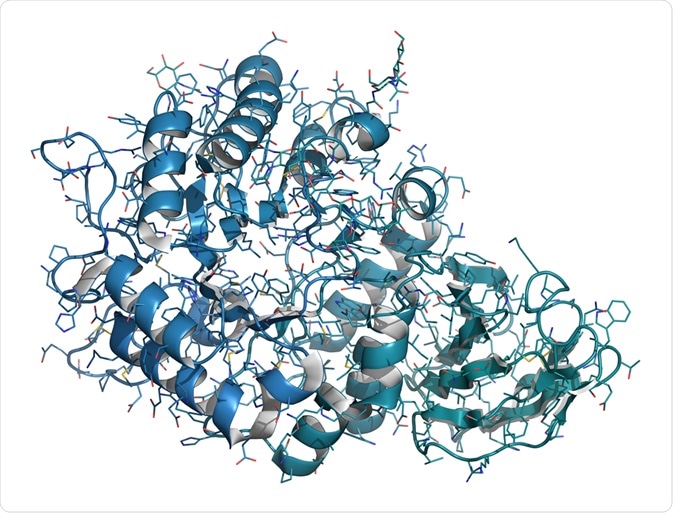 Alpha-galactosidase. Image Credit: StudioMolekuul/Shutterstock.com
Disease inheritance
Fabry disease is inherited in an X-linked manner, meaning the mutation that causes this condition is carried on the X chromosome. Since men have only one X chromosome, the disease is more common in males than in females, who require two copies of the mutation in order to develop the condition. Since boys only inherit the Y chromosome from their father, a father cannot pass this condition onto their sons.
Fabry disease affects around 1 in 40,000 to 60,000 boys. Late-onset and milder forms of this disease are more common than the severe form.
Pathology and symptoms
Fabry disease is caused by a deficiency in the enzyme alpha-galactosidase A, which used to be known of as ceramide trihexosidase. Alpha-galactosidase A is found in lysosomes, where it is responsible for the breakdown of a glycolipid called globotriaosylceramide (also called ceramide trihexoside or Gb3 or GL-3). This enzyme is encoded by the gene GLA and mutation in this gene alters the structure and function of this enzyme, which then fails to break down the globotriaosylceramide properly. As a result, this substance starts to accumulate in the blood vessels, which eventually causes the dysfunction of various tissues and organs.
As the globotriaosylceramide accumulates, the blood vessels become increasingly narrow, preventing the flow of blood and nutrients to tissues that are usually supplied by the vessels. The kidneys and nervous system are particularly affected.
If alpha-galactosidase A is absent altogether or less than 1% of the usual amount is present, the severe, classic form of Fabry’s disease develops. Mutations that cause dysfunction of alpha-galactosidase A, but do not completely eliminate the enzyme, lead to a milder form of the illness that usually only involves the heart or kidneys.
Symptoms
Symptoms of Fabry disease usually develop during childhood or adolescence. As globotriaosylceramide accumulates in the cells, various symptoms arise as different areas of the body become affected. Typical features of this condition include pain in the hands and feet and the development of dark red spots on the skin called angiokeratomas, a decrease in sweat function (hypohidrosis), opaque cornea, hearing loss, gastrointestinal complaints and tinnitus. A common heart symptom that develops is a benign condition called mitral valve prolapse, but more serious complications that can develop include heart attack and stroke. Other symptoms include decreased sweating, gastrointestinal problems, joint pain, back pain, ringing in the ears (tinnitus) and fever. Symptoms may be triggered by exercise, fatigue, stress, and changes in the weather.
The disease is slowly progressing, with symptoms that affect the heart, kidney or nervous system usually only developing between ages 30 and 45.
Fabry disease - causes, symptoms, diagnosis, treatment, pathology
Treatment of Fabry disease
Although the pain that occurs in Fabry disease can be difficult to treat, it generally responds to anticonvulsants such as carbamazepine and phenytoin. A nutritional supplement called Lipisorb and an enzyme supplement called Pancrelipase (contains lipase, protease and amylase) can be helpful for managing gastrointestinal problems. Enzyme replacement therapy has now been approved by the U.S Food and Drug Administration as a treatment for this condition. This therapy reduces pain, decreases the storage of globotriaosylceramide and improves the function of organs. In some cases, kidney dialysis or a kidney transplant may be required.
Prognosis of Fabry disease
Patients affected by Fabry disease often die at a relatively young age due to complications that affect vital organs such as the heart and kidneys.
References
Further Reading
Last Updated: Apr 8, 2023