Tuberculosis is a highly contagious disease caused by the bacteria Mycobacterium tuberculosis (M. tuberculosis), which is believed to be present in nature for at least 15,000 years.
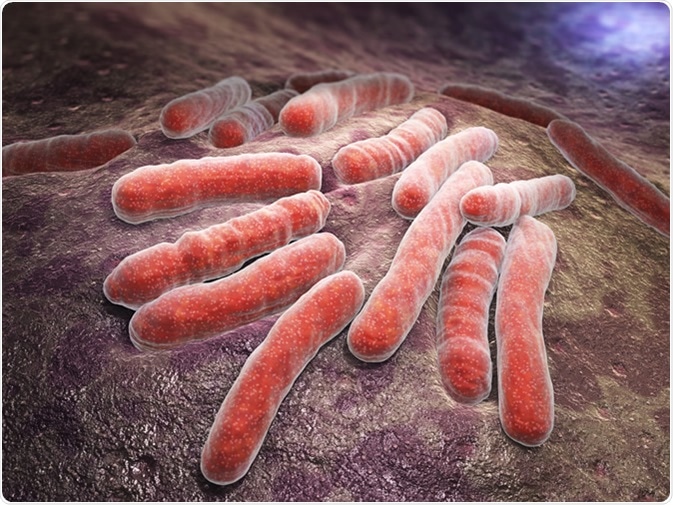
Mycobacterium tuberculosis is a pathogenic bacterial species in the family Mycobacteriaceae and the causative agent of most cases of tuberculosis - Illustration Credit: Tatiana Shepeleva / Shutterstock
Tuberculosis has been known to mankind since ancient times. It is believed that the genus Mycobacterium was present in the environment about 150 million years ago, and an early variant of M. tuberculosis originated in East Africa about 3 million years ago. A growing pool of evidence suggests that the current strains of M. tuberculosis is originated from a common ancestor around 20,000 – 15,000 years ago.
Studies on Egyptian mummies (2400 – 3400 B.C) revealed the presence of skeletal deformities related to tuberculosis, such as characteristic Pott's deformities. However, no evidence of tuberculosis was found in Egyptian papyri. The description of tuberculosis was initially found in India and China as early as 3300 and 2300 years ago, respectively. Moreover, tuberculosis was mentioned in the Biblical books using the Hebrew word ‘schachepheth’ to describe tuberculosis.
In the Andean states, the first pre-Columbian evidence of tuberculosis was observed in Peruvian mummies, indicating the presence of the disease before the European colonization of South America.
Tuberculosis was well documented in the Ancient Greece as ‘Phthisis’ or ‘Consumption’. In Book I, Of the Epidemics, Hippocrates described the symptoms of Phthisis, which are very similar to the common characteristics of tubercular lung lesions.
A Greek physician, Clarissimus Galen, who became the physician of the Roman Emperor Marcus Aurelius in 174 AD, described the symptoms of tuberculosis as fever, sweating, coughing, and blood-stained sputum. He also suggested that fresh air, milk, and soy beverages should be effective treatments for tuberculosis.
In Roman times, tuberculosis was mentioned by Celso, Aretaeus of Cappadocia, and Caelius Aurelianus. However, it remained unrecognized at that time. After the decline of the Roman Empire in the 5th century, a vast pool of archeologic evidence of tuberculosis was found throughout Europe, indicating that the disease was widespread in Europe during this time.
In the Middle Ages, a new clinical form of tuberculosis was described as scrofula, a disease of cervical lymph nodes. In England and France, the disease was known as ‘king’s evil’, and there was a popular belief that it could be treated with the ‘royal touch’. The practice of the ‘royal touch’ established by English and French kings continued for several years. Queen Anne was the last British monarch to employ this method for healing.
A French surgeon, Guy de Chauliac, proposed the first medical intervention for treating tuberculosis. He advised the removal of the scrofulous gland as a treatment option.
An Italian physician, Girolamo Fracastoro, first described the contagious nature of tuberculosis clearly in the 16th century.
In 1679, Francis Sylvius provided the exact pathological and anatomical description of tuberculosis in his book ‘Opera Medica’. In 1720, a British physician, Benjamin Marten, first described the infectious origin of tuberculosis in his publication entitled ‘A new theory of Consumption. In the 17th and 18th centuries, the terms ‘Consumption’ and ‘phthisis’ were used to describe tuberculosis.
In 1819, a French physician, Theophile Laennec, identified the pathological signs of tuberculosis, including consolidation, pleurisy, and pulmonary cavitation. He also identified that M. tuberculosis can infect the gastrointestinal tract, bones, joints, nervous systems, lymph nodes, genital and urinary tracts, and skin (extra-pulmonary tuberculosis), in addition to the respiratory tract (pulmonary tuberculosis).
Johann Schonlein first coined the term ‘tuberculosis’ in 1834. At the beginning of the 19th century, there was a scientific debate about the exact etiology of tuberculosis. Many theories existed at that time, describing the disease as infectious, hereditary, or a type of cancer.
In 1843, Philipp Friedrich Hermann Klencke, a German physician, experimentally produced the human and bovine forms of tuberculosis for the first time by inoculating extracts from a miliary tubercle into the liver and lungs.
In 1854, sanatorium cure for tuberculosis was introduced by Hermann Brehmer, a tuberculosis patient, in his doctoral thesis. He mentioned that a long-term stay in the Himalayan mountains helped cure his tuberculosis.
A French military surgeon, Jean-Antoine Villemin, experimentally proved the infectious nature of tuberculosis in 1865. He inoculated a rabbit with fluid taken from a tuberculous cavity of a person who died of tuberculosis.
A German physician and microbiologist, Robert Koch, successfully identified, isolated, and cultured the tubercle bacillus in animal serum. Afterward, he produced animal models of tuberculosis by inoculating the bacillus. In 1882, his groundbreaking work was published in the Society of Physiology in Berlin.
Discovery of diagnostic methods
In 1907 – 1908, Clemens von Pirquet and Charles Mantoux developed the tuberculosis skin test, in which tuberculin (extracts of the tuberculosis bacillus) is injected under the skin, and the body’s reaction is measured. In recent years, advancements in tuberculosis diagnosis have included interferon-gamma release assays, which are whole-blood tests to detect M. tuberculosis infection.
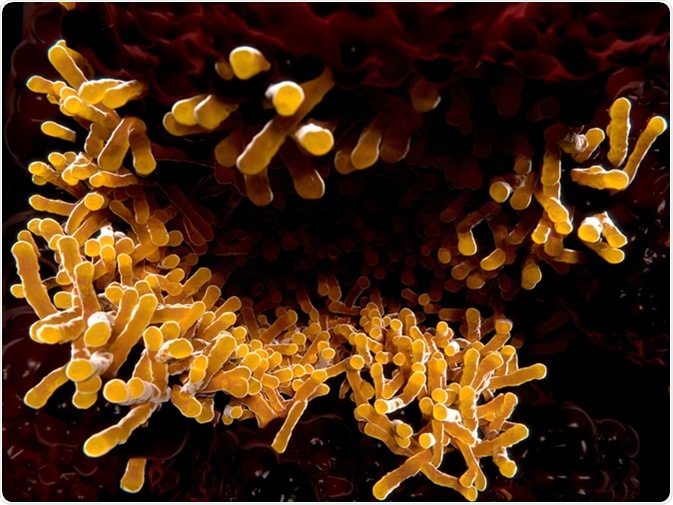
Tuberculosis bacillus in the lungs. Tuberculosis is caused by the bacterium Mycobacterium tuberculosis. Image Credit: Juan Gaertner / Shutterstock
Discovery of vaccine
A pioneering work toward the prevention of tuberculosis was made by Albert Calmette and Jean-Marie Camille Guerin, who developed the Bacille Calmette-Guérin (BCG) vaccine in 1921.
Discovery of therapeutic agents
Besides preventive vaccines, a major breakthrough in tuberculosis treatment occurred with the discovery of antibiotics. In 1943, a tuberculosis antibiotic streptomycin was developed by Selman Waksman, Elizabeth Bugie, and Albert Schatz. Afterward, Selman Waksman received the Nobel prize in 1952.
In the recent era, four antibiotics namely isoniazid (1951), pyrazinamide (1952), ethambutol (1961), and rifampin (1966) are used to effectively treat tuberculosis. With the improvement in diagnostic procedures, therapeutic interventions, and preventive strategies, the World Health Organization (WHO) has committed to eradicate M. Tuberculosis by the year 2050.
Further Reading
Last Updated: Mar 20, 2025
 Progress and gaps shape India's tuberculosis control strategy