The treatment of cancer is a great challenge to medical professionals as the search for a medical treatment that can distinguish between healthy rapidly dividing cells and abnormal cancerous cells is difficult.
Specific drug delivery systems, such as those with liposome carriers, can be employed to improve the therapeutic index of anticancer agents with serious side effects. This can help to decrease the risk of factors as the pharmaceutical formulation is targeted towards specific tissues where it will have the greatest benefit.
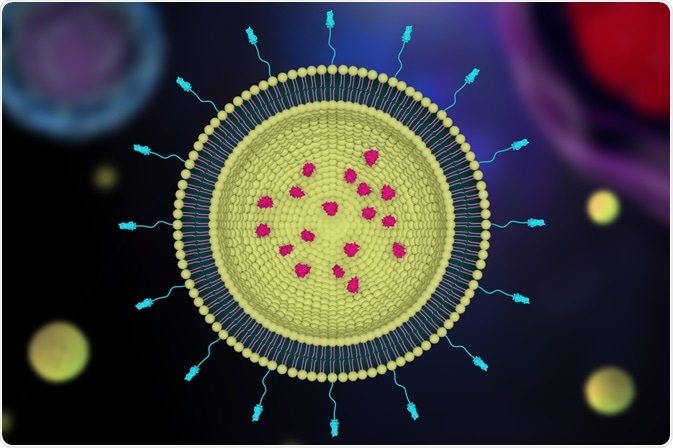
Image Credit: Meletios Verras / Shutterstock
Cancer Cells
As cancer cells originate from healthy cells in the body that have some mutations to alter their properties and lead to uncontrolled growth in the body, it can be difficult to distinguish them from other cells in treatment.
This fact explains the harsh treatments commonly used in cancer therapy and the non-selective nature of their effects. A common characteristic con cancer cells of frequent cell division has been noted and treatment therefore aim to target cells in the process of division. This also affects other healthy cells that frequently divide, such as the cells in the bone marrow, and leads to significant adverse effects.
The application of drugs encapsulated in liposomes has the potential to reduce side effects by increasing specificity for cancer cells.
Passive Targeting
Using liposomes as a carrier for drugs used in the treatment of cancer is beneficial because the liposomes promote passive targeting for the cancer cells.
Unlike the blood vessel cells in healthy humans, tumor cells have an enhanced permeability and retention effect, allowing the passage of larger molecules. For this reason, drugs encapsulated with liposomes up to the size of 400nm can enter tumor sites easily but are restricted from the healthy tissues by the endothelial wall.
As a result, the drug molecules are targeted to the tumor cells rather than other healthy tissues in the body, known as passive targeting.
Anthracycline Drugs
Anthracyclines are a potent class of anticancer drugs that have significant restrictions on their use due to problematic systemic toxicities, particularly for the myocardium and bone marrow cells. Doxorubicin and daunorubicin are examples of drugs in this class.
To solve this issue, anthracyclines have been encapsulated in liposomes enabling changes to the properties of the drug vessel and allowing the active component to target specific sites.
Currently, groups of pharmaceutical molecules are surrounded by a single bilayer (unilamellar) of liposomes via a method of ion trapping. As a result of this formulation utilizing liposomes, the drug may exist in the systemic circulation for longer than the free drug. However, changes in the biodistribution and the passive targeting of the formulation results in fewer side effects.
References
Further Reading
Last Updated: Mar 11, 2021