A nanoparticle is a small object that behaves as a whole unit in terms of its transport and properties.
Size of Nanoparticles
In terms of diameter, fine particles cover a range between 100 and 2500 nanometers, while ultrafine particles are sized between 1 and 100 nanometers. Nanoparticles may or may not exhibit size-related properties that are seen in fine particles. Despite being the size of the ultrafine particles individual molecules are usually not referred to as nanoparticles.
Nanoclusters have at least one dimension between 1 and 10 nanometers and a narrow size distribution. Nano powders on the other hand are agglomerates of ultrafine particles, nanoparticles, or nanoclusters. Nano particle sized crystals are called nanocrystals.
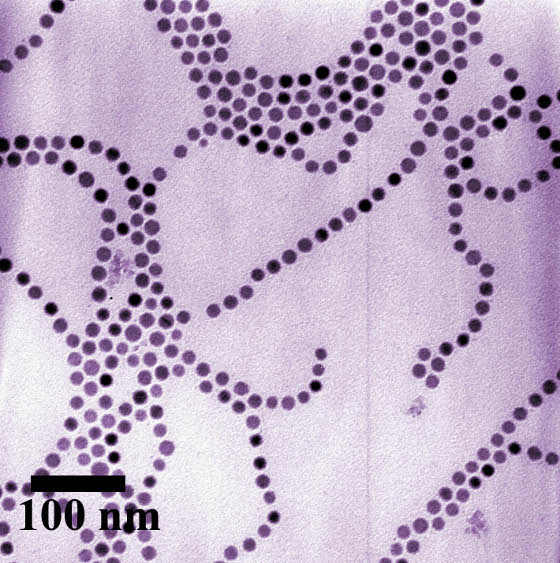
Colorized transmission electron micrograph showing chains of cobalt nanoparticles. Image credit: G. Cheng, A.R. Hight Walker/NIST
Nanoparticles
Nanoparticle Research and Uses
Nanoparticle research is currently the most studied branch of science with the number of uses of nanoparticles in various fields. The particles have wide variety of potential applications in biomedical, optical and electronic fields.
History of Nanoparticle Research
The history of nanoparticle research is long and the use of these particles dates back to the 9th century in Mesopotamia when artisans used these to generate a glittering effect on the surface of pots.
This lustre or glitter over pottery from the Middle Ages and Renaissance is due to a metallic film that was applied to the transparent surface of a glazing. The lustre can still be visible if the film has resisted atmospheric oxidation and other weathering.
The lustre is within the film itself which contained silver and copper nanoparticles dispersed homogeneously in the glassy matrix of the ceramic glaze. Artisans created the nanoparticles by adding copper and silver salts and oxides together with vinegar, ochre and clay, on the surface of previously-glazed pottery. Then the pots were placed into a kiln and heated to about 600 °C in a reducing atmosphere. With the heat the glaze would soften, causing the copper and silver ions to migrate into the outer layers of the glaze.
Michael Faraday provided the first description, in scientific terms, of the optical properties of nanometer-scale metals in his 1857 paper.
Uses and Advantages of Nanoparticles in Medicine
Some of the uses of nanoparticles in biology and medicine include:
- Creating fluorescent biological labels for important biological markers and molecules in research and diagnosis of diseases
- Drug delivery systems
- Gene delivery systems in gene therapy
- For biological detection of disease causing organisms and diagnosis
- Detection of proteins
- Isolation and purification of biological molecules and cells in research
- Probing of DNA structure
- Genetic and tissue engineering
- Destruction of tumours with drugs or heat
- In MRI studies
- In pharmacokinetic studies.
Nanoparticles are being increasingly used in drug delivery systems. The advantages of using nanoparticles as a drug delivery system include:
- The size and surface characteristics of nanoparticles can be easily manipulated. This could be used for both passive and active drug targeting
- Nanoparticles can be made to control and sustain release of the drug during the transportation as well as the location of the release. Since distribution and subsequent clearance of the drug from the body can be altered, an increase in drug therapeutic efficacy and reduction in side effects can be achieved.
- Choosing an appropriate matrix also helps in increasing the efficacy and reducing side effects
- Targeted drugs may be developed
- Various routes of administration including oral, nasal, injection, intra-ocular (within the eyes) etc. can be used.
Last Updated: Jul 20, 2023
 Mosaic nanoparticle vaccine boosts broad mucosal coronavirus immunity