Rotavirus, a highly infectious double-stranded RNA virus of the family Reoviridae, is the main etiological agent of severe dehydrating diarrhea in infants worldwide. In adults, symptomatic rotavirus infections can cause outbreaks in the elderly and in immunocompromised individuals. Infections in humans are caused by serogroups A, B and C, with serogroup A being the most common.
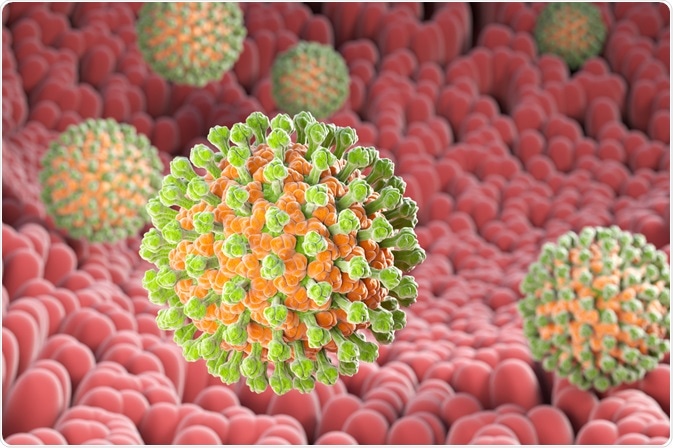
Image Credit: Tatiana Shepeleva / Shutterstock
Transmission routes
Transmission of rotaviruses is primarily by the fecal-oral route, which can happen directly from person to person, or indirectly via contaminated fomites. Viruses are shed in large numbers in stool (more than 10 trillion per gram) by patients with diarrhea, and can easily contaminate the environmental objects. A respiratory mode of transmission has also been suggested.
Rotaviral diarrhea can be particularly problematic in daycare centers and pediatric hospitals. Infants get infected by putting their fingers in the mouth after touching contaminated objects, although healthcare providers can also spread the virus when they fail to wash their hands after changing diapers. Therefore increased hand washing by hospital staff can result in decreased nosocomial infections with this virus.
Infected food handlers may contaminate foods that require handling and no further cooking, such as fruits and salads. Fecal-oral transmission is also commonly encountered in family homes, day-care centers and homes for the elderly. In those settings, control policies need to be evaluated repeatedly and new measures need to be implemented should an outbreak of rotavirus occur.
Shedding can begin a few days prior to the onset of symptoms and continue until 21 days after the onset of illness. Compared to children with rotavirus diarrhea, those with asymptomatic infection tend to shed lower quantities of virus, with a possibility of intermittent shedding.
There is ample evidence that rotavirus is a waterborne pathogen. This virus can retain its infectivity for days in aqueous environments, and waterborne spread has been implicated in a myriad of rotavirus outbreaks, although there is not enough evidence that water alone is responsible for all rotaviral transmission.
Seasonal distribution of rotavirus infections
Rotaviral infections exhibit distinct seasonality, thus the disease has been known as “winter diarrhea” in some parts of the world. Nevertheless, the most recent data on the global seasonality of rotavirus infections point to the conclusion that the winter seasonality of rotavirus infections can be considered a generalization.
Rotavirus is encountered year-round in the tropics with peaks and valleys, while in temperate areas incidence in certain months often reaches zero. The explanation for this phenomenon is that less climatic variability is seen in tropical zones, thus variations in climatological variables are not extensive enough to cause the observed effect.
In Africa, rotavirus can be detected year-round in practically every country with distinct peaks during the dry months. Such peaks are more commonly observed during dry periods than wet periods, albeit this pattern is not consistent for every country. In South Asia, the highest rate of rotavirus is seen in the colder, drier months.
The research has shown that in the tropical region a 1°C increase in mean temperature results in a 10% decrease in rotavirus incidence; furthermore, a 1 cm increase in mean monthly rainfall is associated with a 1% decrease in rotavirus incidence. The seasonal pattern may also be influenced by socio-demographic factors.
Due to the high burden of rotavirus disease in developing countries (with many of them lying in the tropical belt), additional analysis of the seasonality of rotavirus can shed light on the epidemiology of this important disease. Innovative strategies for global disease forecasting, vaccination programs and other preventive measures should be developed at the regional level.
Further Reading
Last Updated: Dec 22, 2022
 The CDC just sidelined these childhood vaccines. Here’s what they prevent.