Strabismus, squint, or crossed eyes, is a condition in which both eyes do not look in the same direction at the same time. It occurs because the eyes do not move in synchrony with each other, resulting in different positions of the two eyes when looking at an object.
One or more of the six muscle pairs that control eye movement are out of harmony. One eye fixates on the object the person wants to look at, the other eye turns in another direction. Often both eyes alternate in fixing on the object. In other cases, it is always the same eye that fixates, and the other eye has poorer vision.
People with strabismus complain that their eyes look in different directions, or of loss of vision and depth perception. Driving may be difficult, and children, in particular, may have reading problems, as well as a hard time with sports due to the lack of visual coordination. A squint may first be detected because of apparent learning problems, which arise because the child cannot read well.
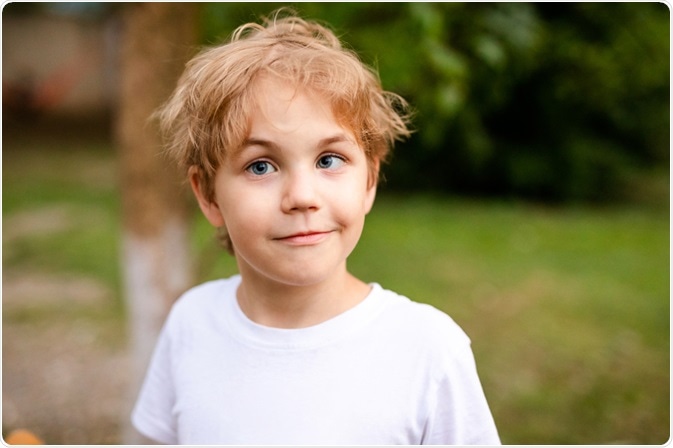 Strabismus is more likely to be successfully corrected if treated at a young age. Image Credit: Lena May / Shutterstock.com
Strabismus and amblyopia
In strabismus, each eye sends a different image to the brain, which is confusing. When this starts in childhood, before the eye-brain connections are firmly in place, this eventually results in the brain ignoring one of the images. In other words, only the images from one eye are processed. Finally, the eye whose image is consistently ignored becomes ‘lazy’.
What this really means is that the brain always suppresses the image from one eye, resulting in the lack of processing and feedback to the nerve cells of that eye. This finally causes an otherwise functionally and physically normal eye to stop ‘seeing’. This condition is called amblyopia. It is seen in about a third of children with a squint and may be prevented if the squint is corrected by about 11 years.
Amblyopia can also be the cause of strabismus. Adults do not develop amblyopia because the eye-brain circuits have already been formed, before the appearance of the different images. Instead, adults with strabismus often complain of double vision.
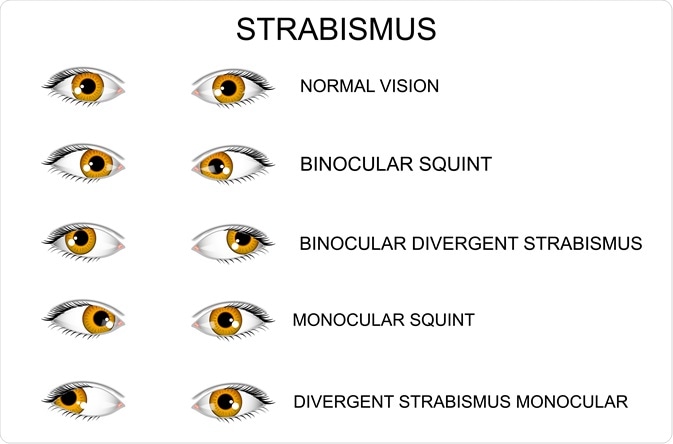 Types of strabismus. Image Credit: Artemida-psy / Shutterstock.com
Causes of strabismus
More than half of all children with a squint have congenital strabismus, mostly due to a lack of nerve control over the movement of otherwise healthy eye muscles. More rarely, it is due to cerebral palsy, cataracts (as in congenital rubella), various congenital syndromes, tumors, or traumatic brain injury.
Adults develop strabismus less commonly, and it may be the result of botulism, which paralyzes some muscles, diabetes, Graves’ disease or Guillain-Barre syndrome, injury to the eye, or the brain, among other causes.
Diagnosis and treatment
Diagnosis is by means of standard eye tests, including covering and uncovering the eye to watch the shift in the pupillary direction, light reflex tests and retinal testing, as well as visual acuity. Brain and nerve testing is also required. Treatment begins with glasses of the right power, if visual acuity is impaired, followed by patching the sound eye to encourage the lazy eye if amblyopia is present.
Finally, eye surgery is often required to strengthen or weaken various eye muscles, so that both eyes move together in the same direction. Surgery is best done when the child is young. Visual acuity will still need correction by glasses, and surgery will not be successful if the lazy eye was not previously treated. Uncorrected squints in children may result in vision loss. Strabismus may even recur, following treatment, and so careful monitoring is mandatory.
Adults with fluctuating strabismus may require eye muscle exercises, glasses, or both. Severe squints may require eye surgery straightaway. If the squint is due to poor vision, this must be first corrected.
What is Strabismus Surgery?
References
Further Reading
Last Updated: Aug 18, 2022