Dementia occurs due to loss of brain function that occurs with certain diseases. It can affect several brain functions such as memory, thinking, language, planning, behavior and judgement. Dementias are usually progressive and worsen with time. They usually are degenerative and non reversible.
©Alexilusmedical / Shutterstock.com
Types of dementia
Alzheimer's disease is the most common type of dementia. Lewy body disease is a leading cause of dementia among the elderly. Dementia also can be due to many episodes of stroke and is called vascular dementia.
Causes of dementia
There are several causes of dementia and dementia like symptoms. These could be due to underlying diseases and disorders or due to influence of drugs and alcohol.
Medical conditions associated with dementia
Medical conditions associated with irreversible dementia include:
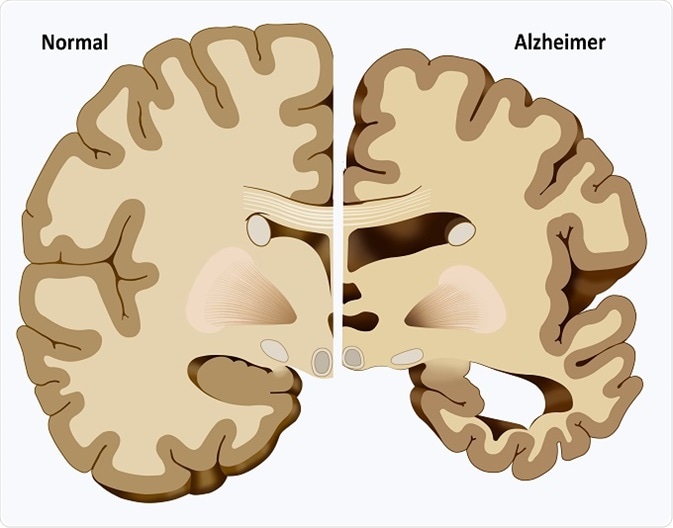
- Alzheimer’s disease seen in 65% cases of dementia.
- Huntington’s disease or Huntington’s chorea – this is a genetic condition and may affect susceptible adults before 65. This condition is almost always fatal and progressive.
- Multiple sclerosis – this is another degenerative nerve condition. It is associated with dementia.
- Parkinson’s disease – this is a nerve degenerative disorder that progressively affects the brain and movements. Parkinson’s disease may also be associated with dementia.
- Infections – certain infections may affect the brain leading to dementia. These include infections like HIV/AIDS and Lyme disease.
- Other infections and inflammations that may lead to dementia and dementia-like symptoms include syphilis, Progressive multifocal leukoencephalopathy, Subacute sclerosing panencephalitis, Behçet's disease, Sarcoidosis, Disseminated encephalomyelitis etc.
- Pick’s disease.
- Progressive supranuclear palsy.
- Creutzfeldt-Jakob disease (CJD), a rare and fatal condition that causes damage to the brain and nervous system.
- Spinocerebellar degenerations.
- Progressive myoclonic epilepsy.
- Inherited metabolic and storage disorders for example pophyria, Wilson’s disease, mitochondrial cytopathies etc.
- As part of normal aging process.
Causes of dementia that may be reversible
Some causes of dementia may be stopped or reversed if detected early:
- Brain injury – repeated head injuries raise the risk of dementia. This is seen in long term boxers and wrestlers. This is termed dementia pugilistica
- Brain tumours and cancers including Meningiomas, gliomas, brain metastases and lymphomas.
- Brain infections such as meningitis and encephalitis.
- Excessive fluid in the brain (normal pressure hydrocephalus).
- Long term alcohol abuse.
- An overactive or underactive thyroid gland.
- Dehydration.
- Fluctuations of blood levels of blood sugar, sodium, and calcium levels.
- Low levels of Vitamin B12.
- Poisoning from lead or pesticides etc.
- Some medications like cimetidine, some of the cholesterol lowering medications.
- Lung and heart conditions that interrupt the supply of blood and oxygen to the brain.
- Other causes include hypocalcaemia and hypercalcaemia, uraemia, dialysis related dementia, alcoholic dementia, pellagra, Malabsorption syndrome, post-irradiation/aquaduct stenosis, Chronic obstructive pulmonary disease and carbon monoxide poisoning.
Risk factors for vascular dementia
Vascular dementia occurs if there is an interruption in the blood supply to the brain. As there is lack of oxygen rich blood in certain parts of the brain, the brain cells begin to die and this results in brain damage. This interruption to blood supply over a long time can cause vessels inside the brain narrow and harden. This can also result from atherosclerosis.
Risk factors for vascular dementia include:
- Diabetes
- Obesity
- heart disease
- lack of exercise
- unhealthy diet with high amounts of saturated fats
- smoking
- long term alcohol abuse etc.
Stroke also may raise the risk of dementia. Not everyone who has had a stroke however will go on to have vascular dementia.
Other causes of vascular dementias include:
- multiple cortical infarcts (multi-infarct dementia)
- cranial arteritis
- polyarteritis nodosa
- systemic lupus erythematosus
- AV malformations and giant aneurysms
- hyperviscosity syndromes like polycythemias
- Thrombotic thrombocytopenic purpura
- arteriopathies (Cerebral autosomal dominant arteriopathy with subcortical infarcts and leukoencephalopathy called CADASIL) and angiopathies
Risk factors and causes of dementia with Lewy bodies
Lewy bodies are small clumps of protein that develop inside the brain. The exact cause of these is unknown. It is hypothesized that two neurotransmitters called dopamine and acetylcholine may be involved in causation. Neurotransmitters are messenger chemicals that carry messages within the nerves and brain. Dopamine and acetylcholine play an important role in memory, learning, mood and attention and their decline may thus lead to dementia.
Causes and risk factors for fronto-temporal dementia
Fronto-temporal dementia is caused by two parts of the brain. One is the temporal lobe (located at the side of the head) and another is the frontal lobe (located in the front of the brain). These lobes become damaged and then shrink.
In around 40-50% of cases who develop fronto-temporal dementia there is presence of a genetic mutation (an altered gene) that may be inherited. These genetic mutations are thought to have a negative effect on a protein called the tau protein. All brain cells contain tau proteins that help to keep them stable but abnormal tau proteins may lead to dementia.
Further Reading
Last Updated: Jul 4, 2023
 A shingles vaccine may delay dementia onset