The adrenal glands are also called suprarenal glands. These are endocrine glands that lie like caps on top of the kidneys.
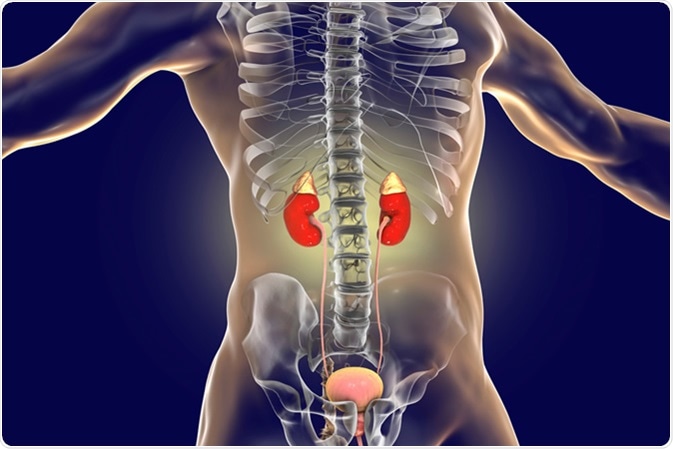
Human kidneys with adrenal glands inside the body, 3D illustration - Illustration Credit: Kateryna Kon / Shutterstock
Shape and structure
In human beings the right adrenal gland is triangular shaped while the left suprarenal gland is shaped like half a moon or semilunar in shape. Each of the glands are around 4 to 6 cm in length.
The outer part of the glands contains thick connective tissue capsule that sends thin fibers into the glandular tissues within. The glandular part is called the parenchyma. The parenchyma is divided into two major parts:
The cortex
The cortex secretes steroid hormones. The cortex contains cells that synthesize and secrete glucocorticoids, mineralocorticoids, and certain gonadocorticoids (sex steroid hormones that are also produced in the gonads). These steroids are all derived from cholesterol.
Most of the cortex cells contain lipid inclusions or lipid portions. These lipids or fats are the basic molecules from which steroids are formed. The cells with their white fat globules appear like sponges and are thus called spongiocytes.
The cortex that three layers:
- The Zona glumerulosa – Outer layer that is thin and looks like little balls of cells. They contain fewer lipids than other layers. The ZG cells secrete mineralocorticoid hormones. This hormone (mainly aldosterone) helps in maintaining the water balance and balance of electrolytes in the body. It acts on the kidneys, salivary and sweat glands to control reabsoprtion.
- The Zone fasciculata – This layer forms around 80% of the whole cortex. These cells have typical spongiocyte appearance. The ZF cells secrete glucocorticoids including hormone cortisol. Cortisol is responsible for control of carbohydrate, protein and lipid metabolism. This layer also secretes sex steroids like androgens.
- Zona reticularis – This is another thin layer. The cells are smaller than the ZF layer. This layer secretes androgens like dehydroepiandrosterone (DHEA), significant in males.
The medulla
The medulla secretes cathecholamines. The adrenal medulla has numerous capillaries and venules or thin arteries and veins.
Since these cells stain brown when exposed to chromium salts they are called chromaffin cells. There are two types of cells – E cells that sectrete Epinephrine (E) and NE cells that secrete Norepinephrine (NE). E and NE are cathecholamines that raise the heart rate, heart pumping capacity, blood pressure and rate of breathing. These are part of the “flight or fight” response in reaction to danger.
Hormones secreted by the Adrenal Glands:
The adrenal cortex secretes corticosteroids, such as glucocorticoids and mineralocorticoids. These hormones are responsible for responding to stress; using carbohydrates, fats and proteins; and regulating the salt and water balance in the body.
The adrenal medulla secretes both adrenalin and noradrenalin, also known as epinephrine and norepinephrine respectively. These hormones are involved in the body’s “fight or flight” response.
Further Reading
Last Updated: Jun 10, 2023
 Research shows citrus and grape compounds may protect against type 2 diabetes