The endocrine system secretes numerous hormones that are involved in physiological homeostasis, metabolism, development and growth, cognitive function, sexual function, and reproduction. Hormones are chemical messengers secreted directly into the blood, which carries them to organs and tissues to exert their functions.
Hormones
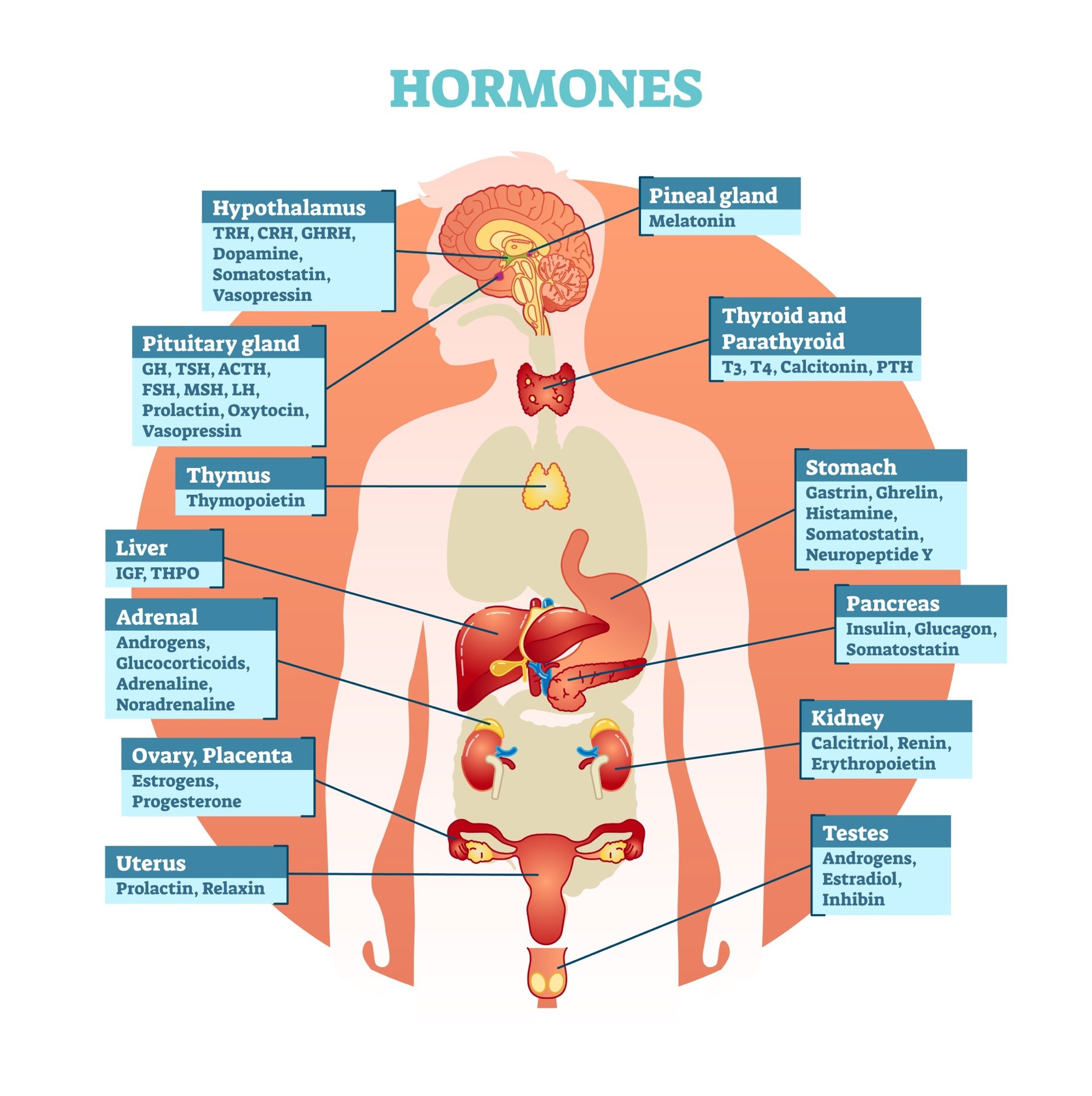
Human body hormones. Image Credit: VectorMine / Shutterstock
Hypothalamus
The hypothalamus is located in the ventral brain region and interacts with the pituitary gland through the hypothalamic-neurohypophysial tract1. It secretes several hormones, including thyrotropin-releasing hormone (TRH), gonadotropin-releasing hormone (GnRH), growth hormone-releasing hormone (GHRH), corticotropin-releasing hormone (CRH), somatostatin, and dopamine.
Pituitary Gland
The pituitary gland is often subdivided into the posterior and anterior pituitary glands. The posterior pituitary gland, which extends from axonal projections originating from the hypothalamus, secretes both oxytocin and anti-diuretic hormone (ADH) or vasopressin2.
The hypothalamic-pituitary-adrenal (HPA) axis connects the hypothalamus to the anterior pituitary gland through the infundibulum. Capillaries within the infundibulum allow hormones released by the hypothalamus to circulate directly into the anterior pituitary gland and avoid systemic circulation.
Whereas the posterior pituitary gland stores hormones produced by the hypothalamus, the anterior pituitary gland secretes hormones in response to releasing hormones secreted by the hypothalamus that either stimulate or inhibit the synthesis and secretion of anterior pituitary hormones3. Thus, the six hormones secreted by the anterior pituitary gland include adrenocorticotrophic hormone (ACTH), thyroid-stimulating hormone (TSH), growth hormone (GH), follicle-stimulating hormone (FSH), luteinizing hormone (LH), and prolactin (PRL).
Pineal Gland
The pineal gland synthesizes melatonin, a hormone involved in maintaining circadian rhythms and inducing and maintaining sleep.
Thyroid Gland
Thyroid hormones are actively released throughout an individual’s entire lifespan, with their production maintained through hormonal pathways and negative feedback loops. Following the synthesis and release of TSH by the anterior pituitary gland, the thyroid gland responds by producing and releasing triiodothyronine (T3) and thyroxine (T4), depending on the levels of T3 and T4 circulating within the bloodstream.
Parathyroid Gland
The parathyroid hormone (PTH) is primarily responsible for regulating both calcium and phosphate homeostasis throughout the body. Although PTH can provide short-term control of serum calcium levels, long-term control is regulated by the conversion of calcidiol to calcitriol, which is induced by PTH.
Pancreas
Beta cells within the pancreas synthesize and secrete insulin, a peptide hormone that regulates various metabolic processes, the most notable of which is controlling glucose levels. Insulin can adjust blood glucose levels by stimulating or inhibiting the synthesis of glycogen and increasing glycolysis in both muscle and adipose tissues2.
The alpha cells of the islets of Langerhans produce glucagon, a peptide hormone that opposes the action of insulin. Glucagon increases glucose levels by promoting glycogenolysis and gluconeogenesis.
Adrenal Glands
Located just above each kidney, the adrenal glands produce aldosterone, cortisol, dehydroepiandrosterone (DHEA), norepinephrine, and epinephrine.
Reproductive Hormones
The anti-Müllerian hormone (AMH) is actively involved in various stages of life, ranging from fetal development, during which AMH supports testes development, to puberty and adulthood, where AMH supports the early development of follicles within the ovaries.
Estrogen hormones include estradiol, estriol, and estrone, all of which are synthesized by ova within the ovaries; however, adrenal glands also secrete small amounts of estrogen.
Progesterone, which is secreted by the corpus luteum in the ovaries, is produced after ovulation and prepares the endometrium for the potential of pregnancy.
Testosterone, which is primarily produced by the testes in men but also present in women in much smaller amounts, is primarily responsible for sexual development in men.
How do your hormones work? - Emma Bryce
Sources
- Shahid, Z., Askuka, E., & Singh, G. (2023). Physiology, Hypothalamus. StatPearls [Internet]. Available from: https://www.ncbi.nlm.nih.gov/books/NBK535380/
- Campbell, M., & Jialal, I. (2022). Physiology, Endocrine Hormones. StatPearls [Internet]. Available from: https://www.ncbi.nlm.nih.gov/books/NBK538498/
- Rawindraraj, A. D., Basit, H., & Jialal, I. (2023). Physiology, Anterior Pituitary. StatPearls [Internet]. Available from: https://www.ncbi.nlm.nih.gov/books/NBK499898/
- “Reproductive Hormones” [Online]. Available from: https://www.endocrine.org/patient-engagement/endocrine-library/hormones-and-endocrine-function/reproductive-hormones
Last Updated: Mar 19, 2025
 Study shows how prostate tumors rewire metabolism to resist therapy