Lipoproteins are special particles made up of droplets of fats surrounded by a single layer of phospholipid molecules. Phospholipids are molecules of fats which are attached to a phosphorus-containing group. They are distinctive in being amphipathic, which means they have both polar and non-polar ends.
In a lipoprotein, the polar ends of all the phospholipid molecules face outwards, so as to interact with water, itself a polar molecule. This enables the lipoprotein to be carried in the blood rather than rising to the top, like cream on milk. The non-polar fat balled up inside the phospholipid layer, at the center of the lipoprotein, is thus transported to the place where it must be stored or metabolized, through the bloodstream, despite being insoluble in blood. Thus lipoproteins are molecular level trucks to carry fats wherever they are required or stored.
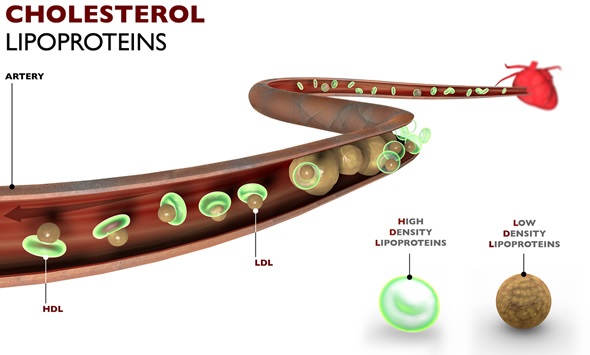
Copyright: Naeblys via Shutterstock, Image ID: 162874379
Types of lipoproteins
Different lipoproteins are differentiated based on specific proteins attached to the phospholipid outer layer, called the apolipoprotein. This also helps to make the fatty molecule more stable, and also binds to cell surface receptors in some cases, to enable the cell to take up the lipoprotein by receptor-mediated endocytosis.
The types of lipoproteins with their function are as follows:
- Chylomicrons – these are the largest and least dense of the lipoproteins, with the highest triglyceride content. They consist of a protein component synthesized in the liver, which wraps around diet-derived cholesterol and fats. It travels from the intestinal lymphatics to the large veins, and sticks to the inner surface of the tiny capillary blood vessels inside the muscles and the fat storage cells in various parts of the body. There the fat is digested, while the cholesterol remains. This is now called the chylomicron remnant. It travels to the liver, where the cholesterol is metabolized. Thus chylomicrons deliver fats and cholesterol from the intestines to the muscles, fat cells and the liver.
- VLDL, very low density lipoprotein – this is composed of protein, fats and cholesterol synthesized in the liver. It is associated with 5 different apoproteins, namely , B-100, C-I, C-II, C-III and E. It is converted to IDL and LDL by removal of the apoproteins, except for one called apoprotein B100, along with esterification of the cholesterol. They are second only to chylomicrons in the percentage triglyceride content.
- IDL – intermediate density lipoprotein, is created by the metabolism of VLDL.
- LDL, low density lipoprotein – this is the last VLDL remnant, and contains chiefly cholesterol. The only apoprotein associated with it is apoB-100. Thus all these forms carry fats and cholesterol produced in the liver to the tissues.
- HDL, high density lipoprotein – this has the highest protein: lipid ratio, and so is the densest. It has the apoprotein A-1. This is also called ‘good cholesterol’, because it carries cholesterol away from the tissues to the liver, lowering blood cholesterol levels. High HDL levels are associated with lowered risk of cardiovascular disease. HDL levels are higher with exercise, higher estrogen levels, with alcohol consumption, and weight loss.
The importance of lipoproteins
Lipoproteins show varying patterns that correlate with the risk of having a fatal cardiovascular event. High LDL, VLDL and triglyceride levels are associated with a high risk of atherosclerosis and heart disease. High HDL is correlated with reduced cholesterol levels, and a lower cardiovascular risk. Thus a high measurement of apo-A-1 correlates with a low atherosclerosis risk. HDL levels drop with cigarette smoking, and rise with regular exercise, alcohol use, estrogen levels and weight loss.
The lipid profile
An important part of the health evaluation is the lipid profile. This consists of measuring the total plasma cholesterol, the LDL, VLDL and HDL levels, as well as the triglyceride level. These numbers are studied together with other risk factors in your history, to decide whether treatment is required to bring down your cholesterol levels. High cholesterol does not produce any signs or symptoms, so a blood test is essential to evaluate the risk of atherosclerosis. All children should have one lipid profile between 9-11 years, and repeat it between 17-21 years. Adults without other risk factors should have a blood lipid profile once in 5 years at least.
The effect of diet on the lipoprotein profile
A diet high in saturated fat is associated with a high cholesterol level. However, if it contains plenty of fish oils, which are rich in omega-3 unsaturated fats, the cholesterol and triglyceride levels drop dramatically. Monounsaturated and polyunsaturated fatty acids, as in olive oil and peanut or sunflower oils, respectively, also reduce the blood cholesterol.
References
- http://oregonstate.edu/dept/biochem/hhmi/hhmiclasses/biochem/lectnoteskga/jan29.html
- http://www.cdc.gov/cholesterol/ldl_hdl.htm
- https://rpi.edu/
Further Reading
Last Updated: Jul 20, 2023
 Why keto appears to lower blood pressure for some people but not others