Conjugated linoleic acid represents a collective term for a group of geometric and positional isomers of linoleic acid that contain a conjugated double bond system instead of isolated double bonds. Since its discovery as an anticarcinogenic factor, it has attracted a fair amount of attention and has been reported to have different beneficial effects in health-related disorders.
In the early 1970s, scientists were hoping to identify mutagens and carcinogens in foods that could eventually be used to help prevent cancer. In 1985, Dr. Michael Pariza and his group from the University of Wisconsin isolated a compound with antimutagenic activity from a cooked ground beef extract, which was subsequently identified as conjugated linoleic acid.
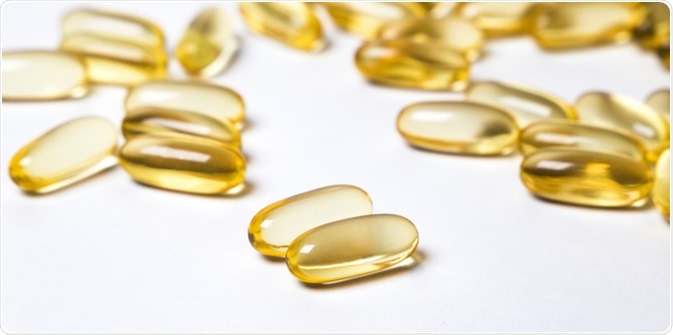
Conjugated linoleic acid (CLA) in capsules. Image Credit: Bulgn / Shutterstock
Chemistry
Conjugated linoleic acid is produced by ruminant bacteria as an intermediate of polyunsaturated fatty acids – specifically linoleic and linolenic acids. Two major groups of ruminant bacteria that employ their isomerase enzymes to produce beneficial isomers are Butyrivibrio fibrisolvens and Megasphaera elsdenii.
Conjugated linoleic acid decreases fat uptake and increases fat release in adipocytes, but also increases fatty acid beta-oxidation in muscle tissue. Furthermore, this compound can alter the cell membrane fatty acid composition by reducing the levels of monounsaturated fatty acids.
Origin of conjugated linoleic acid in food products
As a result of biohydrogenation and desaturation reactions in ruminants, food products from these animals (most notably dairy products) represent a major dietary source of conjugated linoleic acid for humans. Its concentration in dairy products usually ranges from approximately 3 to 7 milligrams per gram of fat.
Several factors such as animal diet, age, breed and seasonal factors can influence the content of conjugated linoleic acid in food products. Evidence suggests that its content increases linearly with the grass intake, thus cow’s milk produced from late spring to early fall will practically have a double amount of this compound when in comparison to milk produced during winter months.
Role in health and disease
The amount and type of dietary fat has been shown to influence the course of experimental carcinogenesis. Early studies showed that conjugated linoleic acid could affect tumorigenicity when applied directly to the tumor site, and the anticancer potential of this compound has received a significant deal of research attention in both in vitro and animal models.
Apart from that, individual isomers of conjugated linoleic acid can have other health benefits such as the reduction of atherosclerosis and the development of diabetes, as well as increased growth and bone formation. Nevertheless, additional research with adequate models is needed in order to test its efficacy in disease prevention and to form the foundations of evaluating its effects in humans.
One of the most intriguing and consistent aspects of conjugated linoleic acid is its ability to dramatically reduce body fat mass while increasing lean body mass at the same time. This was proved repeatedly in different animal models, but the same effect can be observed in certain human studies.
Conjugated linoleic acid can influence immune response through reduction of prostaglandin E2, by decreasing levels of arachidonic acid in tissues, but also by reducing the adverse effects of endotoxin (a cell membrane component of gram-negative bacteria) during infection. Its immunomodulatory effects are currently a part of intensive research endeavors.
Sources
- https://ansinet.com/
- http://jn.nutrition.org/content/133/10/3041.long
- http://ajcn.nutrition.org/content/79/6/1137S.long
- http://ajcn.nutrition.org/content/85/5/1203.long
- http://www.hh.um.es/pdf/Vol_21/21_6/Domeneghini-21-663-672-2006.pdf
- Wall R, Ross RP, Fitzgerald GF, Stanton C. Microbial conjugated linoleic acid production – a novel probiotic trait? In: Gibson GR, editor. Microbial Food Science and Technology Bulletin: Functional Foods, Volume 4. IFIS Publishing, 2008; pp. 87-98.
Further Reading
Last Updated: Jul 7, 2023