Macrophages are important cells of the immune system that are formed in response to an infection or accumulating damaged or dead cells. Macrophages are large, specialized cells that recognize, engulf and destroy target cells. The term macrophage is formed by the combination of the Greek terms "makro" meaning big and "phagein" meaning eat.
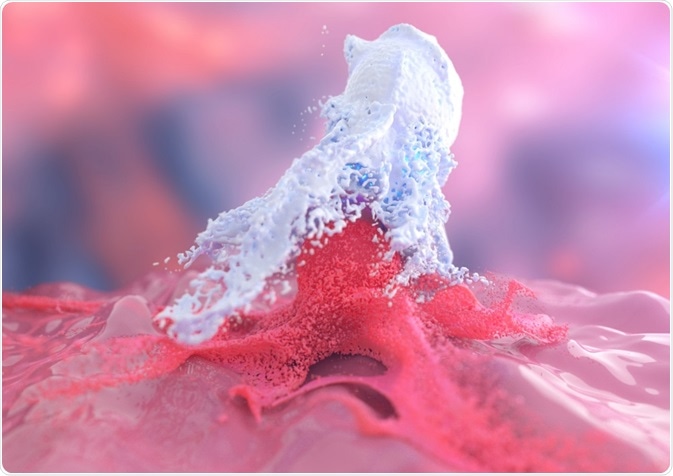 Image Credit: Alpha Tauri 3D Graphics/Shutterstock.com
Formation of macrophages
Macrophages are formed through the differentiation of monocytes, one of the major groups of white blood cells of the immune system.
When there is tissue damage or infection, the monocytes leave the bloodstream and enter the affected tissue or organ and undergo a series of changes to become macrophages. These macrophages can modify themselves to form different structures in order to fight various different microbes and invaders. In this way, macrophages provide the first line of defense in protecting the host from infection.
The macrophages present in humans are around 21 micrometers in diameter. They can survive for months at a time. They are also involved in the development of non-specific or innate immunity.
This type of immunity is a long-term immunity which is acquired when a macrophage digests a microbe and presents the microbe's antigen on its surface to alert other white blood cells to the presence of the invading particle. Other white blood cells then multiply and amount an immune response against the pathogen.
In addition, the pathogen displaying the antigen can be recognized and targeted directly by antibodies should future reinfection occur, meaning that the pathogen is in a sense "remembered" by the immune system.
Each of the macrophages has specific protein markers on the cell surface. Some examples include CD14, CD11b, EMR1, MAC-1/MAC-3, Lysozyme M, and CD68. These markers can be identified using a technical process called flow-cytometry.
Function
Macrophages may have different names according to where they function in the body. For example, macrophages present in the brain are termed microglia and in the liver sinusoids, they are called Kupffer cells.
How do Immune Cells (Macrophages) Engulf Bacteria Phagocytosis Process
Further Reading
Last Updated: Nov 18, 2022
 MXene-based hydrogel offers dual-action treatment for periodontitis