Jan 26 2005
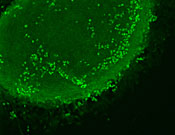 One of the most basic yet least understood processes in our bodies is how cells crawl along tissues. This behavior is essential to the formation of an embryo and other processes, but it must be tightly controlled. A disturbance can lead to the spread of cancer cells or diseases like Spina bifida and Lissencephaly, in which cells fail to reach their proper destinations.
Scientists from the European Molecular Biology Laboratory [EMBL] in Monterotondo have now made a significant step forward in understanding cell motility.
The researchers discovered that a molecule called n-cofilin is critical for regulating cell movement. Most cells in the body are normally locked to their neighbors, tightly embedded in a tissue. Their connections to their neighbors depend on fibers built from long chains of a protein called actin. For an embryo to form properly, certain types of cells have to immigrate to new locations, where they help to form the face, muscles, and skin.
Before cells 'set sail', the actin fibers that bind them to their neighbors are untied and recycled. This not only allows the cells to move, but also changes their form, because actin fibers give the cell its basic shape. Cells carefully regulate the breakdown and assembly of actin fibers because if they are cast off at the wrong time and place, for example in a tumor, cancerous cells may spread throughout the body and form metastases.
It was already known that n-cofilin can break down actin fibers in the test tube, but Walter Witke and colleagues Christine Gurniak and Emerald Perlas wanted to know if it played a role in cell migration in the mouse.
One stunning example of where the movement of a small group of cells is crucial occurs during the formation of an animal embryo. As the brain and head begin to take shape, a group of cells multiplies to form a long strip along the back of the embryo. This eventually makes a structure that looks like a piece of paper whose edges have slightly curled inwards. The curl is called the neural crest, and if cells produce n-cofilin, the edges will grow together, eventually becoming the head and the spine.
The researchers studied what happens in a strain of mouse in which n-cofilin stops functioning at the time the neural crest forms. They found that the edges of the curl cannot move together and fuse, so the head and spine remain open. This closely resembles Spina bifida, a condition that leads to severe disabilities in humans and is frequently fatal. The Monterotondo group showed that n-cofilin has to be present for neural crest cells to be untied from their neighbors and to crawl away.
"This gives us a new way to explore cell migration in the mouse," Witke says. "Mouse physiology is very close to that of humans, so by identifying the molecules involved in this process, we're one step closer to understanding human diseases that result from uncontrolled cell migration. N-cofilin is not only essential for cells to move, but for shifting them from a resting to a migrating state. Therefore, blocking the activity of n-cofilin in cancer might be an interesting strategy to try to restrict the growth and spread of malignant tumors."
 Sub-terahertz biosensors enable label-free cancer cell identification