Feb 15 2005
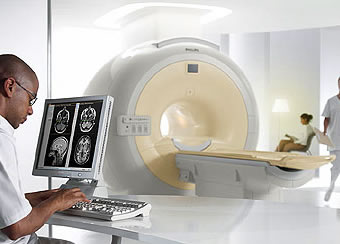 The first 'next generation' MRI (magnetic resonance imaging) body scanner in the world will be officially launched at Hope Hospital later this week (Friday 18th February).
The Achieva 3T MR Scanner has been purchased by The University of Manchester and will be used by researchers to further their studies in a wide range of medical areas.
The state-of-the-art technology involved will revolutionise the way scanning takes place and means that higher quality scans can be carried out at a much faster speed than ever before. The scanner will enable researchers to create images of structures in the body such as individual vessels in the brain, nerves and cartilage.
Researchers working in the fields of cancer, stroke and mental illness will be among the first to benefit from the scanner. By studying patients, they will be able to look at the way brain tumours and cancers grow and develop and how different kinds of treatment might work.
It will also help researchers looking into strokes and will enable them to understand the way the brain recovers in stroke patients. The scanner will also benefit researchers carrying out work into mental illness and will play a major role in the University's research into schizophrenia. The scanner will help to unravel the mysteries of how the brain works and will reveal how different parts of the brain communicate with each other.
Researchers working on abnormalities in the kidneys will also benefit from the improved scanning – research is currently underway at the University to investigate vascular abnormalities to the kidneys in patients with renal disease.
The scanner, which has been manufactured by Philips Medical Systems and features a 5.5 tonne magnet, will be launched by Professor Colin Blakemore, Chief Executive of the Medical Research Council and Professor Alan Gilbert, President and Vice Chancellor of The University of Manchester.
Professor Colin Sibley, Associate Dean for Research in the University's Faculty of Medical and Human Sciences said: "This piece of equipment will help us to unravel some of the mysteries of the brain and how it works. For the first time we will be able to see how different parts of the brain communicate with each other and this will be invaluable to many different areas of our research.
"The scanner will lead to improvements in diagnosing and treating major conditions such as stroke, cancer and mental illness. Of course, this will be of huge benefit to patients suffering from these severe medical conditions and will also ensure that The University of Manchester remains at the forefront of worldwide medical research," he added.
As well as offering higher quality images, the quick scanning time means that more patients will be able to take advantage of the equipment, such as severely ill people who have previously been unable to tolerate the longer scanning times involved.
John Atwill, Managing Director of Philips Medical Systems UK said: "The 3.0T Achieva MR system in Manchester represents the culmination of many years of fruitful collaboration between Philips Medical Systems and The University of Manchester. We chose to install our first 3.0T Achieva in a clinical setting in Manchester because of this close collaboration and the expertise in Manchester to explore the potential clinical benefits of this cutting edge technology."
David Dalton, Chief Executive, Salford Royal Hospitals NHS Trust added: "We are delighted that the 3 T MR Scanner is located here at Hope where we have the Greater Manchester Neurosciences Centre as well as clinicians specialising in oncology, stroke and renal medicine. We look forward to seeing the benefits of this exciting new development in imaging for patients."
The new 3T scanner will join the University's other magnetic resonance research scanner a 1.5 Tesla Philips Intera scanner based at the Wellcome Trust Clinical Research Facility on the University campus.
The human MRI research programme is overseen by the University's Faculty of Medical and Human Sciences through the recently created Translational Imaging Unit (TIU) which provides a 'one stop shop' for academics carrying out research in imaging.
http://www.man.ac.uk/
 Study identifies link between gut bacteria and deterioration of the brain in ALS, dementia