Jul 28 2005
According to a new study by the University of Virginia School of Medicine, taking the the herbal remedy Echinacea, to relieve the symptoms of the common cold, is a waste of time and offers no more relief than a placebo.
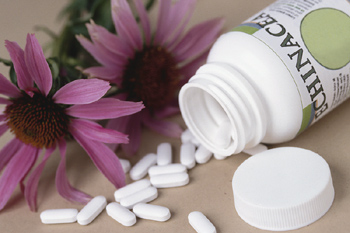
This finding, which shows no benefit from the herb, which is widely advertised as an immune system booster and promoted by advocates of "natural" remedies as a proven treatment, is just the latest of many.
As to whether these findings will affect sales of echinacea, it is unclear.
Wallace Sampson, editor of the Scientific Review of Alternative Medicine (SRAM), said in an accompanying comment, that studies disproving the effectiveness of such remedies rarely affects the production, or the public use, of the product as advocates often dismiss negative results.
Sampson says the majority of the previous tests that helped build echinacea's reputation were small, inadequately controlled studies, sponsored by the industry.
Echinacea, also known as purple coneflower, has been acclaimed by some, and in fact is recommended by the World Health Organization (WHO) as a treatment for the common cold.
In this study echinacea was tested on 399 volunteers, in order to discover whether any of three preparations, had an active ingredient that reduced the risk of infection or symptoms, if an infection took hold.
Although the researchers led by Ronald Turner of the University of Virginia, tested the echinacea species originally used by native Americans in the midwest and endorsed by WHO, they found the treatment to be no more effective than a placebo.
Turner says there are many types of echinacea preparations, so it would be difficult to test them all.
Their study he says, adds to the accumulating evidence that suggests that the 'burden of proof should lie with those who advocate this treatment'.
The National Center for Complementary and Alternative Medicine (NCAMM), a government agency that pays for research largely on the basis of the popularity of the unconventional treatment, funded this study.
According to Simpson since 1999, the National Institutes of Health has spent almost $1.5 billion in grants for research into alternative methods.
He says the NCCAM has spent almost half that amount and has found no evidence of efficacy and little evidence of inefficacy, and it is now time to use such money testing treatments that have "passed through the sieve of plausibility and are consistent with basic sciences, other applied sciences, and history, which are all, he says, 'moulded by wisdom and common sense'.
The work is published in the New England Journal of Medicine.
http://content.nejm.org/
 How multi-omics is changing what scientists can see in the human immune system