Aug 4 2005
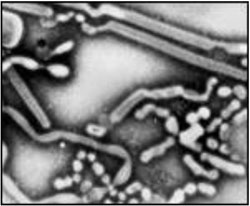 According to scientists the H5N1 strain of bird flu circulating in Asia which could mutate into a lethal strain and cause a pandemic, could be contained.
It would take, they say, three million doses of antiviral drugs, vigilance and reducing social contact to contain an outbreak of human avian flu and prevent a global pandemic that could kill millions.
Health officials have always feared the virus could mutate into a lethal strain that could rival or exceed the Spanish flu pandemic that killed between 20-40 million people worldwide.
However two teams of scientists who used computer models to simulate an outbreak of a mutated strain capable of spreading between humans, believe with careful control strategies and a mobile stockpile of anti-flu drugs, it would be possible to stop an influenza pandemic.
Professor Neil Ferguson, of Imperial College London, says their work shows that control of a human outbreak of a new strain of influenza is potentially possible, but only when the epidemic is in its earliest stages.
Ferguson says the plan would only work before the initial cluster of infections reached 50 cases.
It would mean that healthy people living in the infected area would need to be treated with antiviral drugs such as Roche's Tamiflu or Biota's Relenza. Schools and workplaces might also need to be closed and travel restricted to prevent the spread of the virus.
Ferguson says the worse case scenario would need an international stockpile of 3 million courses of antiviral drugs to be deployed, anywhere in the world, within three days.
If successful, the researchers estimate the plan could contain an outbreak within 60 days.
Meanwhile Professor Ira Longini and scientists at Emory University in Atlanta, Georgia, have constructed a similar computer model.
But instead of using the population of Thailand as Ferguson's team did, their research was based on a rural population of 500,000 people, and came to similar conclusions.
According to scientists the next pandemic, viewed by many as overdue, will probably originate in poultry in Asia.
In order to become a pandemic strain, H5N1 will have to adapt sufficiently on its own, or mix its genetic material with a human virus to become highly infectious in humans, who have no protection against it.
Ferguson's team estimate that without effective controls, the virus will have spread internationally within about 2-3 months of the first case, and half of the world's population would be infected within one year.
According to the researchers it is difficult to predict how deadly a mutated strain would be, but in patients infected with the bird flu virus in Asia, there is about a 50 percent mortality rate.
The study by Professor Ferguson is published in the science journal Nature; the results of Professor Ira Longini study are published in the journal Science.
 WHO Member States advance negotiations on the Pathogen Access and Benefit‑Sharing system