Jun 30 2009
Researchers from Helmholtz Centre for Infection Research, Germany, develop new method for better diagnostic of diarrhea causing bacteria.
Every year, diarrhea causes around five million fatalities worldwide. Most people die due to pathogenic microorganisms, such as bacteria or viruses, which were ingested into the gastro-intestinal tract through contaminated drinking water or food. Determining which bacterium is causing the illness in those cases is sometimes very complex. In cooperation with Chilean researchers, scientists from the Helmholtz Centre for Infection Research (HZI) in Braunschweig, Germany, have now developed a fine-tuned diagnostic method. It is based on detecting short, repetitive DNA segments in the genome of bacteria. Every single bacterial strain has such characteristic repeats. "With this method we are able to identify bacterial strains as well as clarify their genetic relationships. Furthermore, we can show how new pathogenic variants develop," says Manfred Höfle, researcher at the HZI. The results have now been published in the current issue of the scientific journal "Applied and Environmental Microbiology". The work is part of the two European Union funded projects "Healthy Water" and "AQUA-chip". Manfred Höfle is coordinator of both projects that deal with various aspects of the microbiological safety of both, drinking water and sea water.
Various bacteria that live in drinking water or sea water can cause severe human diseases. One of them are vibrios: its species Vibrio cholerae is more commonly known as the causative agent of Cholera that spread in Europe until the 20th century. Interestingly, not all Vibrio cholerae strains are pathogenic to humans. Only those strains cause severe diarrhoea known as Cholera that produce a certain bacterial toxin which attacks the intestinal wall. A less known, though also dangerous member of the genus Vibrio, is Vibrio parahaemolyticus. It is a highly contagious pathogenic germ with only a dozen ingested bacteria causing severe diarrhoea. This strain is a threat for the pacific region and reached the east coast of the United States in the 21st century. Since the end of the 1990s, Vibrio parahaemolyticus epidemics have led to thousands of cases of illness in Chile. In the future, due to ballast water or climate change, the species may also gain importance in Europe. As in the Cholera bacterium, various Vibrio parahaemolyticus strains exist with varying infectivity. Distinguishing those strains has been a challenge until now.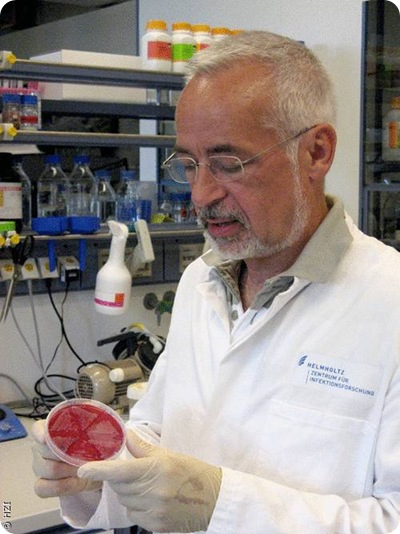
The newly developed method makes it now possible to characterize and distinguish hundreds of bacteria strains in a short time. The method is based on the existence of short, repetitive DNA segments in the genome of all living species. As in a tandem bike, those segments are lined up on the DNA strand, called "tandem repeats". They are characteristic for every bacterial strain. To identify a certain strain, the HZI researchers use short DNA fragments, marked with certain dyes. Each dyed DNA fragment recognizes a single tandem repeat, binding at it. As a result, the researchers receive, for example, six red fragments binding a tandem of six repetitions. Then, the researchers analyzed the tandem repeats marked with dyed fragments: Every bacteria strain differs in pattern and size of the measured tandem repeats.
"With this method, we are able to differentiate more then 120 Vibrio parahaemolyticus strains," says Manfred Höfle. This is important for infectious diseases in which it is necessary to know which strain is the causative agent. Further information are whether it is just one or more strains and where they derive from. The latter can help to prevent spreading of the disease with corresponding sanctions. "The intake of Vibrio parahaemolytics often occurs through raw clams that have filtered contaminated sea water. With this method, we are able to say from which clam species the germ originates." The new technique can also be used to characterize other bacterial pathogens and to investigate how pathogenic bacteria evolve in the environment. "Hereby, this high resolution method makes an important contribution towards a fast and precise recognition of microbial pathogens with pandemic potential."
Full bibliographic information: Multiple-Locus Variable-Number Tandem-Repeat Analysis for Clonal Identification of Vibrio parahaemolyticus Isolates by Using Capillary Electrophoresis. Erika Harth-Chu, Romilio T. Espejo, Richard Christen, Carlos A. Guzmán, and Manfred G. Höfle. Appl. Environ. Microbiol. 2009; 75: 4079-4088
 Chemotherapy-induced gut changes trigger anti-metastatic immune response