The theory and practice of acupuncture originated in China. It was first mentioned and recorded in documents dating a few hundred years before the Common Era.
Earlier instead of needles sharpened stones and long sharp bones were used around 6000 BCE for acupuncture treatment. These instruments could also have been used for simple surgical procedures like lancing an abscess etc.
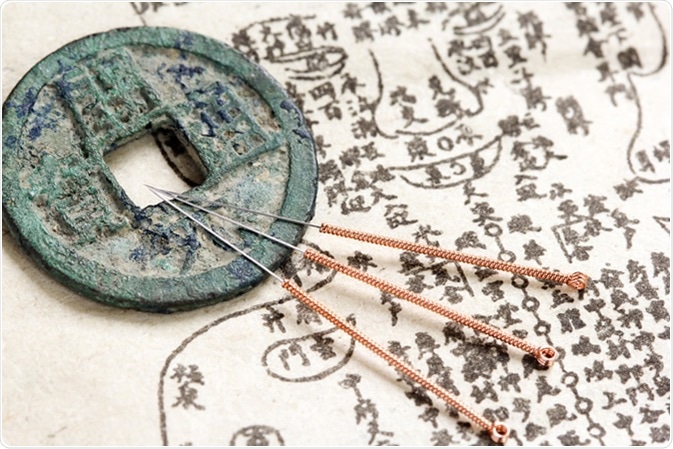
Acupuncture needles and ancient medicine illustration showing acupuncture points on human body - Image Credit: Pixeljoy / Shutterstock
Records of documented acupuncture procedures
Documents sealed in 198 BCE within the Ma-Wang-Dui tomb in China have no references to acupuncture procedures but has references to system of meridians.
The discoveries at the Ma Wang Dui Tombs
The tradition of acupuncture theory believes that energy flows within the human body and this energy can be channelized to create balance and health. This energy flow is called qi and pronounced “chee”.
Acupuncture theory believes that this qi moves throughout the body along 12 main channels known as meridians. These meridians represent the major organs and functions of the body. These meridians however do not follow the exact pathways of nerves or blood flow.
Further the tattoo marks seen on Ötzi the ‘Ice Man’ who died in about 3300 BCE are similar to some form of stimulatory treatment that involves the meridians. The Ice Man was found when the Alpine glacier melted.
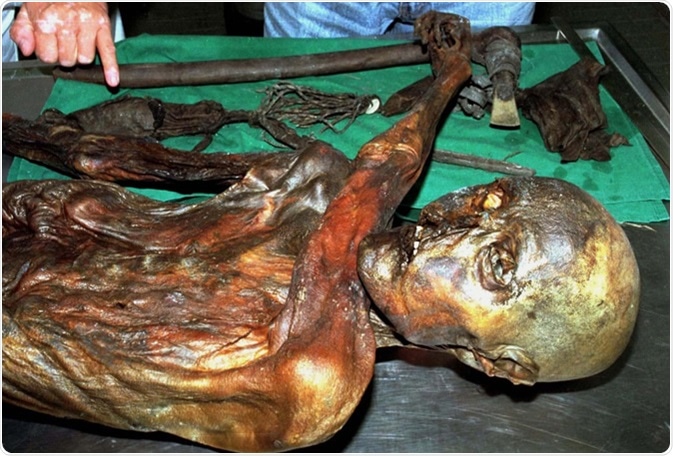
Ötzi had a total of 61 tattoos consisting of 19 groups of black lines ranging from 1 to 3 mm in thickness and 7 to 40 mm long.
Earliest documentation that refers to acupuncture procedures is The Yellow Emperor’s Classic of Internal Medicine, dating from about 100 BCE. In this book the knowledge is in the form of questions made by the Emperor that his learned minister, Chhi-Po has replied to. The book includes the detailed knowledge regarding the concepts of channels (meridians or conduits in which the Qi flows. The details of precise sites of acupuncture points however were developed later.
Development of acupuncture
Acupuncture developed over the next few centuries and gradually became one of the standard therapies used in China. It was complemented and supported by use of massage, diet, herbs and heat therapy or moxibustion.
It was in the fifteenth century that Bronze statues with acupuncture points that are in use today were depicted. These were used for teaching and examination purposes.
Between the 14th and 16th centuries the Ming dynasty flourished (1368–1644). During this time The Great Compendium of Acupuncture and Moxibustion was published with principles of acupuncture on which modern practices of this tradition rests. The book goes on to describe 365 points that represent openings to the channels through which needles could be inserted to modify the flow of Qi.
Decline of acupuncture
From the 17th century on, the interest in this tradition declined. It was considered irrational and was laced with superstitions. The Emperor’s decree in 1822 excluded acupuncture from the Imperial Medical Institute. The rural healers and some scholars held on to the knowledge of this practice.
With rise of Western medicine in the 20th century, acupuncture practices further fell into disrepute. In 1929 it was outlawed in China along with other forms of traditional medicine.
Revival of acupuncture
The Communist Government in 1949 revived the traditional forms of medicine including acupuncture. Acupuncture research institutes were established in the 1950s throughout China and the practice became available in several hospitals.
The practice spread to several other countries. Korea and Japan received the knowledge in the 6th century. European physician Ten Rhijne who worked for East India Company described the practice medically in around 1680. Within the first half of the 19th Century both America and Britain developed interest in this ancient therapeutic form.
It was in 1971 that a member of the US press corps was treated with acupuncture during recovery from an emergency appendectomy in China which he was visiting. He described the experience in the New York Times and created interest in the success of the procedure.
Acupuncture was finally accepted in the USA when an NIH consensus conference reported that there was positive evidence for its effectiveness, at least in some conditions.
Further Reading
Last Updated: Jun 20, 2023
 Global study reveals growing use of integrative therapies in cancer care