Skip to:
Hippocampus is a brain structure embedded deep in the temporal lobe of each cerebral cortex. It is an important part of the limbic system, a cortical region that regulates motivation, emotion, learning, and memory.
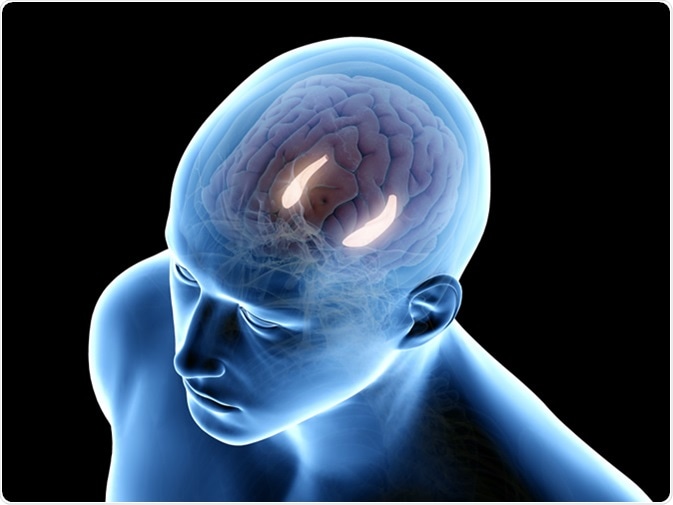
3d rendered medically accurate illustration of the hippocampus. Image Credit: Sebastian Kaulitzki / Shutterstock
What is hippocampus?
Hippocampus is a S-shaped structure within the medial aspect of the temporal lobe that can be identified as a layer of densely packed neurons. It receives afferent inputs from the cingulate gyrus, dentate gyrus, contralateral hippocampus, parahippocampal gyrus, septal area, indusium griseum, and diencephalon. Regarding efferent pathways, nerve fibers from the hippocampus proceed directly from the subiculum to the entorhinal cortex and amygdala, as well as through the fornix to different anterior brain structures.
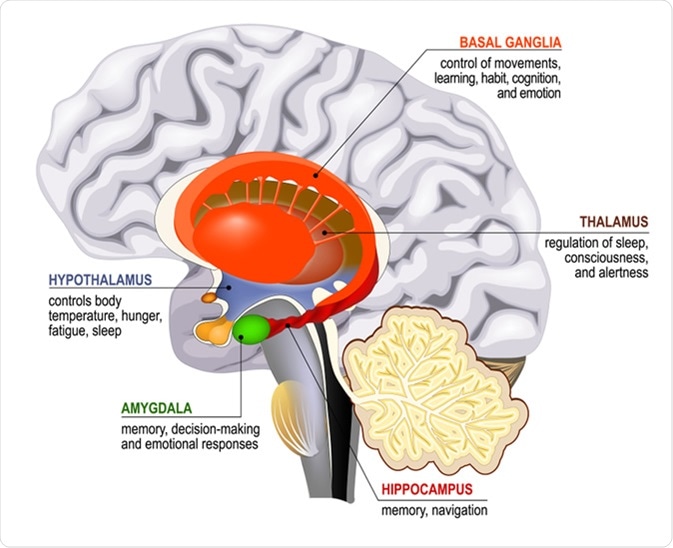
Limbic system. Cross section of the human brain. Mammillary body, basal ganglia, pituitary gland, amygdala, hippocampus, thalamus - Illustration Credit: Designua / Shutterstock
What are the functions of hippocampus?
Being an integral part of the limbic system, hippocampus plays a vital role in regulating learning, memory encoding, memory consolidation, and spatial navigation.
Hippocampus and memory
Hippocampus is divided into three regions: CA1, CA2, and CA3. These regions form the trilaminar loop, which is the processing center of long-term memory. Long-term potentiation (LTP), which is a form of neural plasticity, occurs in the hippocampus, and LPT is a vital brain mechanism involved in memory storage. The complex processes of memory encoding in the hippocampus and retrieval of experiences from the frontal lobe involve two prominent pathways: polysynaptic and direct pathways. In the polysynaptic pathway, hippocampus receives afferent inputs via axons of the entorhinal cortex, which terminate in the dentate gyrus. Form there, neurons of the dentate gyrus send mossy fibers to the neurons of pyramidal cells located in CA3. These pyramidal cell neurons are further divided into two branches: one branch reaches the opposite side of the hippocampus via corpus callosum; the other branch connects to CA1 through Schaffer collateral pathways. From there, the projections leave the hippocampus to return to the inferior temporal cortex, temporal pole, and prefrontal cortex. The polysynaptic pathway is important for the semantic memory (facts and concepts), and the direct pathway is important for the episodic (recollection of events) and spatial memory (recognition).
Hippocampus and learning
Pyramidal cells of the hippocampus play an essential role in classical eye blink conditioning, which is a standard model for studying associative learning. Studies involving delay eye blink conditioning have revealed that pyramidal cells form a predictive paradigm of time-amplitude sequence of the learned behavioral response. The rate of acquisition can be impaired or increased by hippocampal manipulations. In this form of learning process, hippocampus plays an important role in trace conditioning wherein a short interval is imposed between the condition and unconditioned stimuli. After eye blink conditioning, a long-lasting neuronal plasticity is generated in the hippocampus, which is needed for the learning process in the trace eye blink conditioning.
Hippocampus and spatial navigation
One of the major functions of hippocampus is forming cognitive map, which is a type of mental representation related to acquisition, coding, storing, recalling, and decoding of information on relative locations within a specific environment. Place cells, a type of pyramidal cell, are mainly involved in hippocampus-mediated spatial navigation. These cells are activated when an animal enters a particular place in its environment (place field); however, these cells remain silent when an animal is moving outside the place field. Besides place field, the firing rate of place cells depends on the direction of movement, direction of destination, or other task-related factors.
Hippocampus and behavior
Hippocampus plays a vital role in flexible and goal-directed behavior. An intact hippocampal activity is required for forming and reconstructing relational memory (required for remembering arbitrary associations between objects or events) associated with flexible cognition and social behavior. Many studies have revealed that any damage to hippocampus can impair flexible use of information and produce maladaptive behavior.
The role of hippocampus in behavioral inhibition is also well-established in the literature. The link between hippocampus and inhibition has been derived mainly from two basic observations: 1st observation is that damage to hippocampus makes animals hyperactive; and 2nd observation is that damage to hippocampus reduces the learning ability of animals to inhibit responses that they have learned previously.
Hippocampus acts as an evaluation center associated with behavioral inhibition, obsessional thinking, scanning, and spatial map formation. However, the hippocampus does not actively participate in controlling behavior, once an experience is characterized. External stress-induced increased corticosterone level eventually reduces the firing rate of the hippocampus.
Recently, a new hippocampal function has been put forward. It has been found that low-frequency firing/activity in the hippocampus can influence the functional integration between spatially separated regions in the cerebral cortex, leading to increased sensory responses, such as vision, hearing, and touch.
Further Reading
Last Updated: Aug 20, 2019
 AHA calls for lifelong brain health strategy to prevent cognitive decline