Paraplegia is a medical condition involving impairment in motor or sensory function of the lower extremities, which is a classification of paralysis, the universal term to describe the loss of movement or sensation following damage to a nerve in the body.
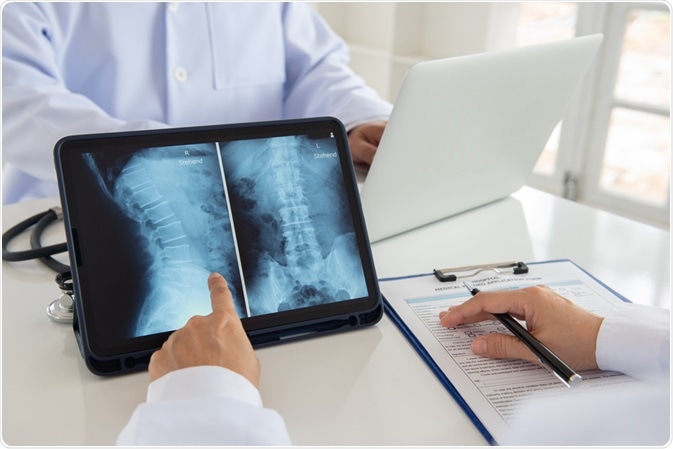 Image Credit: create jobs 51 / Shutterstock.com
Causes of of paraplegia
Paraplegia is predominantly the result of a spinal cord injury due to an accident or other trauma. Most common accidents include motor vehicle accidents and falls in those aged over 65.
Spinal injuries aren’t always immediately apparent and numbness or paralysis can be delayed or immediate. Additional injury can occur from resultant swelling and bleeding. For this reason, it is important that medical attention is sought out immediately, as the time frame is critical for optimal recovery and assessment.
Additionally, congenital conditions such as spina bifida, where the neural elements of the spinal canal are affected, are also a known cause. Damage can also ensue from tumors or blood clots, however this is less common.
Paraplegia is most prevalent in males as they are assumed to have a greater tendency towards risky behavior.
Loss of function in of paraplegia
The extent of function lost due to paraplegia corresponds to the extent of damage to the spinal cord and the area affected. Areas of the spinal cord that result in paraplegia are the thoracic, lumbar or sacral regions.
An injury to the upper thoracic (T1 to T8), which is approximately adjacent to the chest, often results in poor trunk control. This can include impairment in breathing. Damage to the lower thoracic (T9 to T12) allows for good trunk function and posture. Lumbar and sacral damage results in poor function of flexors and hips.
Categorization of paraplegia
If the arms are also affected by paralysis, quadriplegia is the proper terminology, whereas if only one limb is affected the correct term is monoplegia.
Paraplegia is further categorized into complete or incomplete. Complete paraplegia is absolute damage to the region of the spinal cord. An individual with complete paraplegia may have total sensory and motor function loss. On the other hand, incomplete paraplegia defines partial damage. For example, someone with incomplete paraplegia may have sensory function but no movement, or vice versa.
Paraplegic Definition, Explained, Causes, Recovery, Prognosis | Paraplegia | Spinal Cord Injury
Management of paraplegia
While some people with paraplegia can walk to a degree, many are dependent on wheelchairs or other supportive measures. Some individuals may also experience pain and muscle spasms to a varying degree.
Impotence and various degrees of urinary and fecal incontinence are very common in those affected. Many use catheters or a bowel management programs (often involving suppositories, enemas, or digital stimulation of the bowels) to address these problems.
With successful bladder and bowel management, paraplegics can prevent the vast majority of accidental urinary or bowel discharges.
If an individual is suspected of having a back or neck injury, they should not be moved from their position and remain still as complications and permanent paralysis can ensue. Contacting emergency medical assistance is recommended.
Support for paraplegia
Given adequate support, equipment and adaptations to the work/ home environment are available; paraplegics are perfectly capable of living productive, fulfilled lives.
There are several foundations and support groups that help paraplegic individuals, including:
- Back-Up Trust
- Buoniconti Fund
- Canadian Paraplegic Association
- CareCure Community
- Christopher & Dana Reeve Foundation
- Miami Project
- ThreeSixtyFive Foundation
- Spinal Cord Injuries Australia
- Spinal Cord Injury Peer Support
- Spinal Cord Injury Support
- Sam Schmidt Paralysis Foundation
References
Further Reading
Last Updated: Nov 21, 2022