Ribavirin is a guanosine analog that produces broad-spectrum activity against different RNA and DNA viruses.
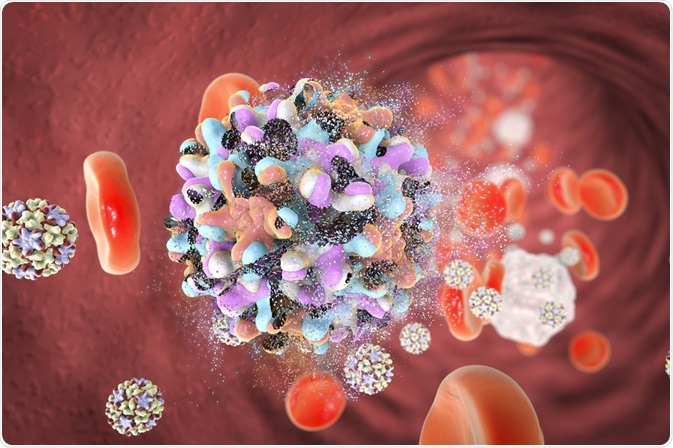
Image Credit: Kateryna Kon / Shutterstock.com
Four decades after its initial discovery, this drug still proves useful for the treatment of a number of viral infections and may also be promising as an anticancer drug. Nevertheless, the uncertain nature of ribavirin’s antiviral mechanism of action has been a stumbling block to developing more efficacious derivatives for clinical use.
The discovery of ribavirin
Ribavirin was first discovered and developed in 1970 by researchers from the International Chemical & Nuclear Corporation (ICN), which is modernly known as Valeant Pharmaceuticals. Chemists Joseph T. Witkovski and Ronald K. Robins had a primary role in synthesizing this compound.
Ribavirin was initially approved for use in humans to treat pediatric respiratory syncytial virus infections. Through the years, the efficacy of ribavirin for this indication has proved to be controversial, as shown in a number of studies that published conflicting results.
In 1972, it was reported that ribavirin was active against different DNA and RNA viruses in culture systems and animals. Some examples included herpes simplex, vaccinia virus, measles, influenza A and B, parainfluenza, rhabdoviruses, arenaviruses, bunyaviruses, and possibly retroviruses.
Research towards understanding the exact antiviral mechanism of ribavirin has a complex and contentious history, with a myriad of distinct mechanisms that have been proposed. In 2001, one mechanism was demonstrated by Craig E. Cameron, Shane Crotty, and Raul Andino. During their poliovirus experiments, Cameron, Crotty, and Andino observed that ribavirin's antiviral activity is exerted through a process known as lethal mutagenesis.
Severson and colleagues investigated the effect of ribavirin treatment on the Hantaan virus. An observed decrease in viral mRNA and protein production levels was attributed to mutagenesis during transcription, which ultimately leads=s to unstable or nonfunctional mRNAs. Moreover, a high number of insertions were found.
History of ribavirin usage in hepatitis C
The first attempts to use ribavirin as monotherapy to treat hepatitis C were recorded in the early 1990s. Pilot studies were undertaken due to the fact that ribavirin previously demonstrated its broad-spectrum antiviral activity against RNA viruses, and that HCV is related to flavivirus with a positive-sense RNA genome.
Patients treated with ribavirin monotherapy exhibited improvements in serum alanine aminotransferase levels. During the course of this study, patients infected with HCV genotype were found to be over 67% more responsive to ribavirin. On the other hand, little effect has been shown on HCV RNA levels, with no patients achieving viral clearance.
No other significant advancements in the treatment of hepatitis C were published until 1998, which is when the combination of ribavirin and interferon-alpha gained approval. Clinically, ribavirin showed a small, additive antiviral effect in combination with interferon; however, its main effect was dose-dependent prevention in virological relapse.
Triple therapy regimens, which often involve the use of ribavirin with telaprevir and boceprevir, gained approval in May of 2011. The role of ribavirin in the success of this approach appeared to be due to its ability to prevent both the relapse and the emergence of low-level and high-level protease inhibitor resistance.
References
Further Reading
Last Updated: Jan 17, 2023