Smallpox was once one of the most severe infectious diseases that was endemic throughout the world for most of the recorded history. It is caused by variola virus (a DNA virus and a member of the Poxviridae family), and characterized by three phases: incubation, prodrome, and rash. This disease killed and disfigured innumerable millions of people globally.
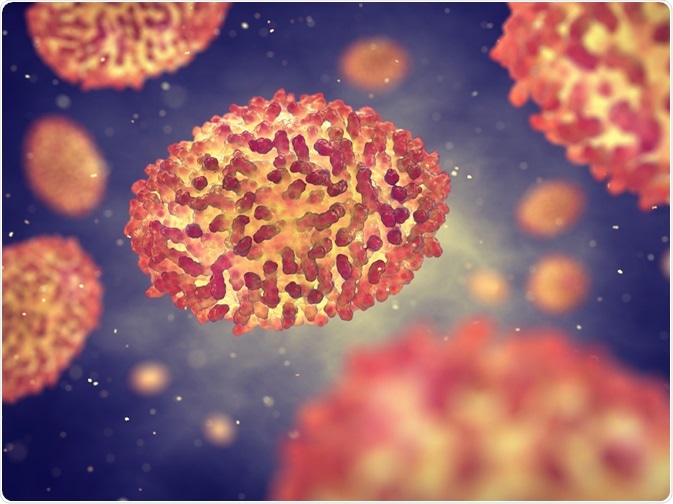
Smallpox also known as Variola was an infectious disease caused by the Variola virus, 3d illustration. Image Credit: nobeastsofierce / Shutterstock
The origin of smallpox
Historians believe that smallpox appeared around 10,000 B.C. during the first agricultural settlements in northeastern Africa. From there it spread to India by means of ancient Egyptian merchants. Furthermore, observations of typical skin rashes on Egyptian mummies dating from 1100 to 1580 B.C. give credence to theories that ancient Egypt was an early region with endemic smallpox.
Unambiguous descriptions of the disease were documented in 4th-century China, 7th-century India, and the Mediterranean region, as well as 10th-century southwestern Asia. It is estimated that smallpox was introduced to Europe between the 5th and 7th centuries, with frequent epidemics during the Middle Ages.
The disease was generally confined to the Eurasian landmass before the 15th century; however, European colonists introduced smallpox to the Americas (but also Africa and Australia) between the 15th and 18th centuries with devastating case-fatality rates that approached 90%. It is generally believed that this was instrumental in the fall of the empires of the Aztecs and the Incas.
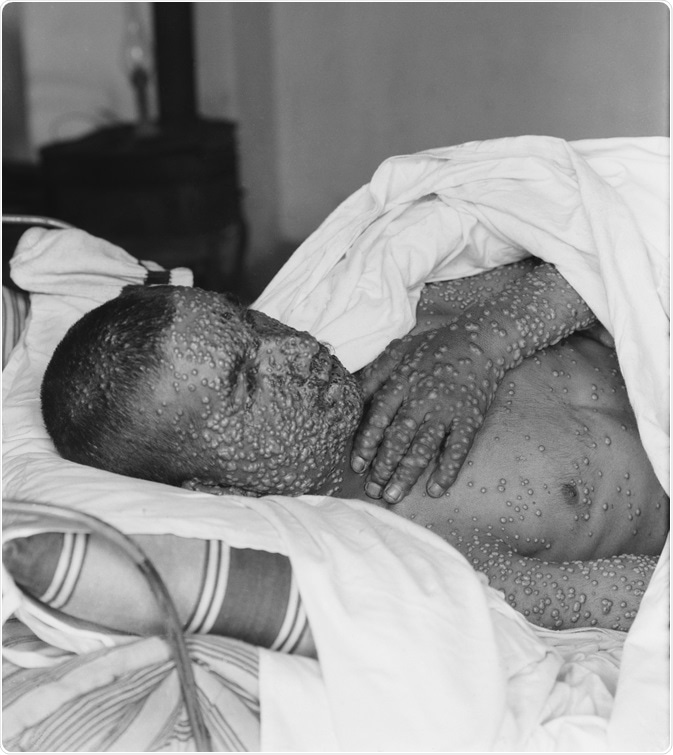
The heavily pockmarked face, arms and hands of a smallpox victim in Palestine, ca. 1900-1925. Image Credit: Everett Collection / Shutterstock
By the end of the 19th century, a milder and less lethal form of smallpox (also known as variola minor) became apparent in the USA. Originally described as Amass (alastrim in South America), this variant of the virus eventually got recognized in Brazil during the 1970s, as well as in Ethiopia and Somalia during the 1970s.
The Eradication Of Smallpox | Invisible Killers
Variolation and vaccination
The first protection against smallpox consisted in rubbing infectious material from patients with smallpox into the scratched skin of children. Lady Montagu brought this method (known as variolation) from Turkey to England in 1721. Albeit dangerous, it was adopted in Europe during the 18th century (mainly by the aristocracy) after the successful treatment of the two daughters of the Princess of Wales.
By the end of that century, variolation has been widely accepted throughout the world as an effective way to prevent smallpox. The pervasive use in Great Britain (and North American colonies) significantly reduced the impact of the virus in the upper classes, but not in the population as a whole.
Edward Jenner (1749-1823) was the first to use cowpox in order to protect against smallpox in 1796. This virus caused only mild infections in humans but induced an immune response that provided cross-protection against smallpox infection - the principle that underlies the development of all subsequent vaccines based on an attenuated organism.
Dissemination of the new technique, despite fierce opposition, was rapid throughout Europe and the United States. During more than 60 years the vaccination was carried out from “arm to arm” with a certain risk of transmission of syphilis; hence from 1864 onward, the vaccine was primarily produced on cows to avoid this risk.
As the smallpox vaccine was the first vaccine to be widely deployed in humans, it seems quite fitting that smallpox was the first human infectious disease to be eradicated by vaccination, which was a milestone achieved in 1979. Nevertheless, the variola virus remains a risk as routine vaccination is no longer undertaken.
Could Smallpox Ever Come Back?
Further Reading
Last Updated: Mar 1, 2021
_583053316cb445adb3bf38b558ab3812-80x70.jpg) Study reveals poxvirus's unique DNA clamp for gene activation
Study reveals poxvirus's unique DNA clamp for gene activation