Myelin is a sheath-like material that forms an insulating and protective coating around nerve fibers. Myelin is vital to the normal functioning of the nervous system.
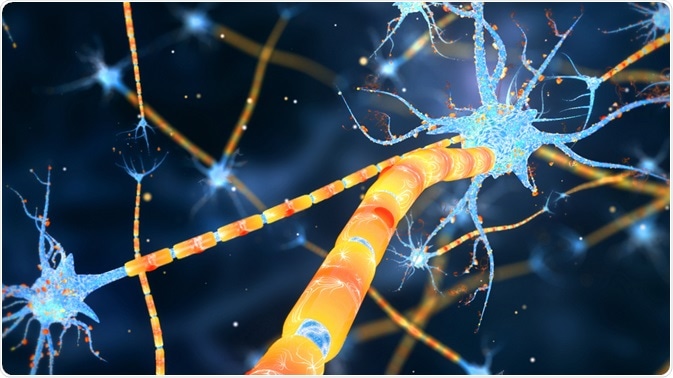
Image Credit: viktorov.pro / Shutterstock.com
What is myelin?
The nerve cell is made up of a cell body and a long, projecting nerve fiber called the axon that is responsible for the transmission of electrical impulses from the cell body to receiving neurons, glands, and muscles. Myelin is considered a defining feature of vertebrates, or animals with a spinal column, although similar sheaths have also evolved in some invertebrates. The myelin sheath of nerve fibers was first discovered and described by Rudolf Virchow in 1854.
Myelin is composed of about 40% water and the dry mass is composed of about 80% lipids and 20% protein. The mainly lipid composition of the myelin gives it a white hue, hence the reference to the brain’s “white matter.” The main lipid found in myelin is a glycolipid called galactocerebroside.
Other major myelin constituents include myelin basic protein (MBP), proteolipid protein (PLP), and myelin oligodendrocyte glycoprotein (MOG). Within myelin are cross-linked hydrocarbon chains composed of sphingomyelin which strengthen the myelin sheath.
2-Minute Neuroscience: Myelin
What is the function of myelin?
As a nerve carries electrical impulses from one end to the other, myelin helps to stop the impulse from leaving the axon and increases electrical resistance, therefore enhancing signal conduction.
Myelin insulates the axon by assembling specialized structures at the nodes of Ranvier. This myelination of nerves greatly increases the speed that signals (referred to as action potentials) are transmitted between nerve cells. In unmyelinated axons, the action potential travels along the axon in a continuous manner, whereas in myelinated axons, a current is only found at the nodes of Ranvier, where the membrane of the axon is exposed.
Sodium channels that generate action potentials are abundant at the nodes of Ranvier. At these nodes, there is also an abundance of specific molecules that activate and maintain the clusters of sodium channels. Examples of these molecules include neurofascin 186 (a cell adhesion molecule) and a scaffolding protein called bIV-spectrin. These molecules are organized and assembled by the myelin sheath.
The presence of both the myelin sheath and sodium channels at the nodes of Ranvier means the action potential “jumps” from one node to the next, allowing the impulse to travel along the axon rapidly. This process is referred to as saltatory conduction.
What occurs when myelin is damaged?
Defective myelination of a nerve is the leading cause of neurological disease.
Demyelination refers to the damage and loss of myelin sheaths that previously surrounded nerves. Demyelination may occur due to inflammatory, metabolic or genetic factors. Regardless of the cause, a loss of myelin leads to significant nerve dysfunction and slowed or blocked nerve conduction between the brain and the rest of the body.
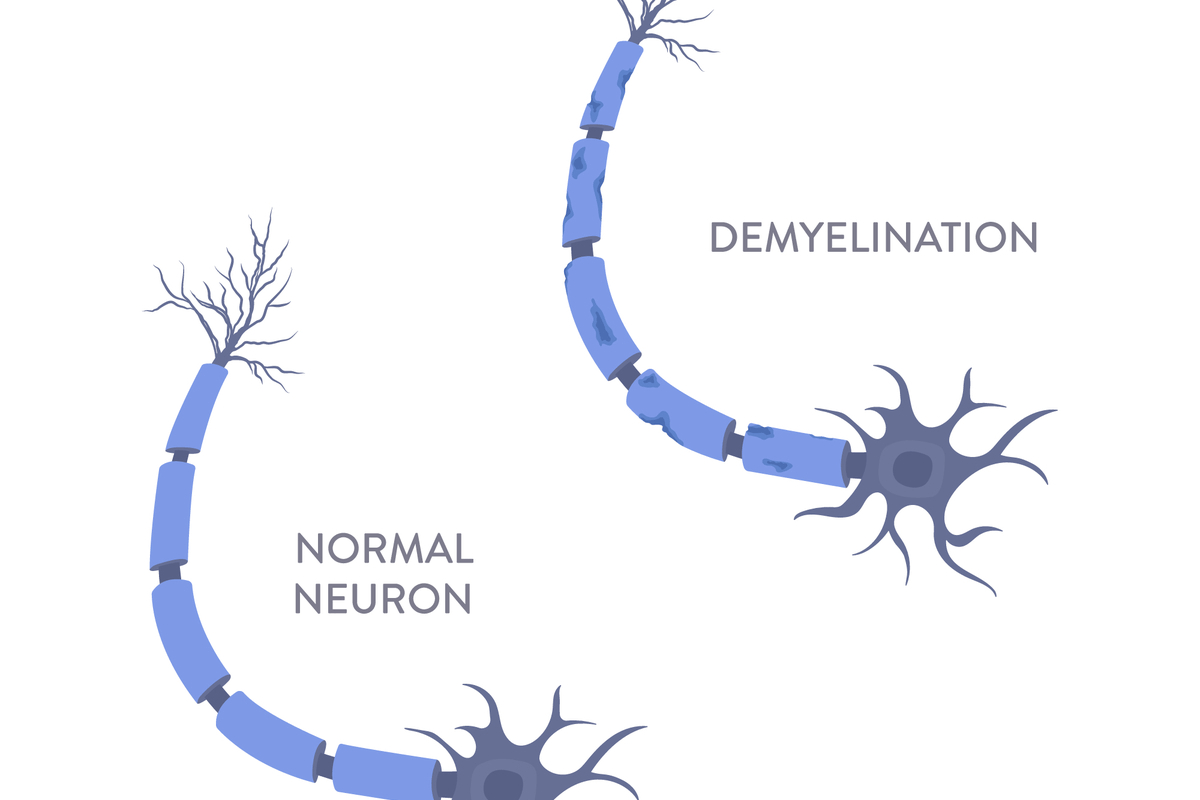
Image Credit: art4stock / Shutterstock.com
One of the most well-known demyelinating diseases is multiple sclerosis (MS), an autoimmune disorder where demyelinating lesions of the central nervous system (CNS) occur across the brain, which causes symptoms such as pain, cognitive and motor skill dysfunction, and visual disturbances.
Approximately 80% of of MS patients develop relapse-remitting MS, during which neurological symptoms occur in episodes, with no deterioration seen between those episodes. Around 10 years after the initial onset of the condition, about half of these patients go on to develop progressive neurological deterioration, which is otherwise referred to as secondary progressive MS.
The remaining 20% of MS patients experience a continuous neurological deterioration with no periods where symptoms seem to improve. This type of MS is known as primary progressive MS.
References
Further Reading
Last Updated: Sep 24, 2022
 Prenatal air pollution exposure may slow newborn brain development