Apr 12 2004
Researchers at Scripps Institution of Oceanography at the University of California, San Diego, have documented for the first time in San Diego seawater the presence of a neurotoxin that has been known to poison marine mammals, birds and human consumers of shellfish.
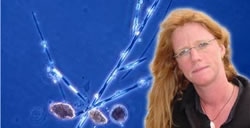 During the past few years, an increasing number of sea lions have been found sick or dead on San Diego beaches. Many have been poisoned by domoic acid, a neurotoxin produced by a common marine phytoplankton. Until now, however, confirmation of domoic acid production has occurred only further north.
Scripps researchers Lilian Busse and Elizabeth Venrick reported that there were moderate levels of domoic acid in the phytoplankton contained in seawater samples collected on Feb. 18 and Feb. 25 off Scripps Pier. The toxin is produced by a genus of diatoms called Pseudonitzschia. Its presence coincided with a late February bloom of the species Pseudonitzschia australis and may be related to several reports of sea lion strandings from Malibu Beach to San Diego made during that same time period.
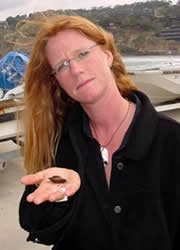 Despite the finding, researchers stressed that the risk to public health in San Diego is low. In complementary samples of mussel tissues, the California Department of Health Services detected six parts per million of domoic acid. That concentration is well within state safety guidelines. A reading of 20 parts per million would trigger an alert from the agency to issue a public advisory. There is no set standard for safe domoic acid levels in seawater.
"It is of great scientific interest but is not a cause for public alarm," said Venrick, co-chair of the Integrative Oceanography Division at Scripps.
Busse agreed, adding, "It's not that domoic acid hasn't been out there before but it's the first time it's been tested for and detected in seawater off San Diego."
Coincident with the elevated domoic acid levels off San Diego, Busse identified elevated levels at Newport Beach and San Clemente, although these concentrations, like San Diego, appear to have been short-lived.
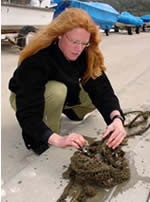 The research team is participating in a multi-institutional monitoring project that includes weekly samplings of local water and mussels. Regular testing off San Diego began in October 2003. The purpose of the endeavor is to characterize large aggregations, or blooms, of Pseudonitzschia and another type of phytoplankton, the dinoflagellate Alexandrium, which produces a potentially hazardous substance called saxitoxin.
Pseudonitzschia blooms take place periodically on the West Coast of North America and elsewhere and the genus is found in most coastal marine environments. The production of domoic acid by several species of Pseudonitzschia is thought to be triggered by a combination of environmental influences. It may be related to the diatom's interaction with trace metals such as iron and copper, which occur naturally in marine environments. The domoic acid is transferred to seabirds and marine mammals by small prey fish, such as anchovies, which themselves may be unaffected by the toxin. It can also be concentrated in shellfish, including mussels and oysters.
Domoic acid was first recognized in California after a dramatic seabird kill in 1991. It also is known to contaminate mussels and may be transmitted to humans with symptoms that include vomiting, diarrhea and confusion, but have only rarely led to death.
In September 1991, the deaths of more than 100 brown pelicans and cormorants in Monterey Bay was linked to domoic acid poisoning. Since then, the toxin has been associated with other deaths of marine mammals and seabirds in Monterey and the Santa Barbara Channel.
Though this is the first time domoic acid has been found in San Diego seawater, the Department of Health Services has detected low concentrations of domoic acid in the tissue of mussels on previous occasions dating back to 1992.
The two-year project is funded by the University of California Marine Council. In all, researchers are monitoring more than 500 miles of California coastline for the project. Busse said the study, which also includes investigators from UC campuses in Santa Barbara and Santa Cruz, will illustrate the amount of coherence among toxic blooms along the California coast, helping determine whether they are local occurrences or large-scale events. The study could also establish connections between the blooms and environmental conditions in coastal waters as well as dolphin and whale beachings.
Laura Mydlarz, a graduate student at UC Santa Barbara, performed the chemical analysis that led to the recent confirmation of domoic acid.
"It is not known if the production of domoic acid is intensified or if the toxin is spreading south from the central coast," said Busse. "The increased frequency of reports along the coast, and now off San Diego, may be the result of increased awareness and better detection techniques."
This study could also indicate whether such blooms have been on the increase in recent years. Another component of the project is an analysis of seawater samples collected in California waters from previous decades. Busse said that she has found that specimens of the diatoms that produce domoic acid have been in San Diego waters in high abundance dating back to 1918.
 Lubiprostone shows signs of slowing kidney function decline in chronic kidney disease