Jan 24 2005
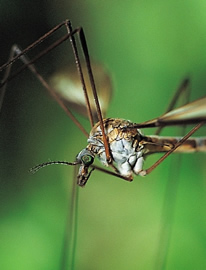 Mosquitoes are much in the news these days, thanks to West Nile virus, the bug-borne exotic disease spread via migrating birds.
Now scientists from the United Kingdom's
Rothamsted Research Centre, the largest agricultural research centre in the United Kingdom are asking why some people always seem to get bitten by mosquitoes more than others? These scientists believe they may have found the answer and their work could lead to the development of novel insect repellents.
Research student James Logan has found that some people give off “masking” odours that prevent mosquitoes from finding them. His research builds on earlier studies on cattle, led by Rothamsted’s Professor John Pickett, which showed that the number of flies on a herd depended on certain cows being present. The scientists found these key unattractive individuals gave out different chemical signals from the other cows. When these individuals were moved to another field the number of flies afflicting the herd increased.
James, working in collaboration with Professor Jenny Mordue at the University of Aberdeen, tested the behavioural reaction of yellow fever mosquitoes to odour from human volunteers. James said: “The mosquitoes were placed into a y-shaped tube and given the choice of moving upwind down either branch. The air flowing down one branch was laced with odour from the volunteer’s hands.”
Their results suggest that differential attractiveness is due to compounds in unattractive individuals that switch off attraction either by acting as repellents or by masking the attractant components of human odour. This theory differs from that of other research groups who have suggested that unattractive individuals lack the attractive components. The researchers are now testing these theories further using foil sleeping bags to collect whole body odours from volunteers. James said, “By identifying these key components and understanding how they work we could be closer to new methods of protection from these biting pests that cause losses in livestock and irritation and illness in humans.”
James said, “We hope that the work with cattle and mosquitoes will lead to methods of controlling such biting pests that cause losses in livestock and irritation and illness in humans.”
 HORIBA UK launches new philanthropic initiative to advance scientific research and broaden STEM participation