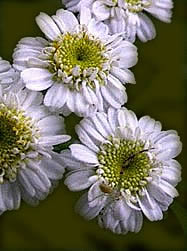
 A daisy-like plant known as Feverfew or Bachelor's Button, a traditional remedy for reducing fevers and a treatment for nervousness, hysteria and low spirits, is the source of an agent that kills human leukemia stem cells like no other single therapy, scientists at the University of Rochester Medical Center's James P. Wilmot Cancer Center have discovered. Their investigation is reported in the online edition of the journal, Blood.
It will take months before a useable, pharmaceutical compound can be made from parthenolide, the main component in Feverfew. However, UR stem cell expert Craig T. Jordan, Ph.D., and Monica L. Guzman, Ph.D., lead author on the Blood paper, say their group is collaborating with University of Kentucky chemists, who have identified a water-soluble molecule that has the same properties as parthenolide.
The National Cancer Institute has accepted this work into its rapid access program, which aims to move experimental drugs from the laboratory to human clinical trials as quickly as possible.
"This research is a very important step in setting the stage for future development of a new therapy for leukemia," says Jordan. "We have proof that we can kill leukemia stem cells with this type of agent, and that is good news."
Parthenolide is the first single agent known to act on myeloid leukemia at the stem-cell level, which is significant because current cancer treatments do not strike deep enough to kill mutant cells where the malignancy is born.
In other words, even the most progressive leukemia treatment, a relatively new drug called Gleevec, is effective only to a degree. It does not reach the stem cells, so "you're pulling the weed without getting to the root," Jordan says.
Feverfew has been used for centuries as an herbal remedy to reduce fevers and inflammation, to prevent migraine headaches, and to ease symptoms from arthritis. (A person with leukemia, however, would not be able to take enough of the herbal remedy to halt the disease.)
Investigating stem cells that give rise to cancer is an urgent new initiative, as is identifying stem-cell treatments that might end the disease process. Jordan and Guzman are among only a handful of stem cell biologists nationwide who are specifically studying cancer stem cells. In recent years, scientists have identified cancer stems cells in blood cancers and in brain and breast tumors – although the idea that cancer stems cells exist has been around for at least 40 years.
In the current study, the UR group began investigating Feverfew after other scientists showed that it prevented some skin cancers in animal models. Intrigued by the plant's anti-tumor activities, the UR team analyzed how a concentrated form of parthenolide would act on the most primitive types of acute myelogenous leukemia cells, chronic myelogenous leukemia cells and normal cells.
In laboratory experiments, they also compared how human leukemia stem cells reacted to parthenolide, versus a common chemotherapy drug called cytarabine. The result: parthenolide selectively killed the leukemia cells while sparing the normal cells better than cytarabine.
Scientists believe parthenolide might also make cancer more sensitive to other anti-tumor agents. And, the UR group was able to demonstrate the molecular pathways that allow parthenolide to cause apoptosis, or cancer cell death, increasing the chances of developing a new therapy.
Jordan is director of the Translational Research for Hematologic Malignancies program at the Wilmot Cancer Center and associate professor of Medicine and Biomedical Genetics. Guzman is senior instructor of hematology/oncology.
Other co-investigators include: Randall Rossi, associate scientist; Lilliana Karnischky, laboratory technician; Xiaojie Li, technical associate; Derick Peterson, Ph.D., assistant professor of biostatistics, and Dianna Howard, M.D., at the University of Kentucky Medical Center.
%2c_analyze_by_microscope-Jarun_Ontakrai_8864dd9cfb3b4dff9a913aede7a7c915-80x70.jpg) Study explains how leukemia creates inflammatory lung environments
Study explains how leukemia creates inflammatory lung environments