May 26 2009
A biological anthropologist from Appalachian State University working with an undergraduate student from Appalachian, an evolutionary biologist from UNC Greensboro, and a team of archaeologists from Deccan College (Pune, India) recently reported analysis of a 4000-year-old skeleton from India bearing evidence of leprosy. This skeleton represents both the earliest archaeological evidence for human infection with Mycobacterium leprae in the world and the first evidence for the disease in prehistoric India.
The study, published May 27 in the open-access, peer-reviewed journal PLoS ONE, demonstrates that leprosy was present in human populations in India by the end of the mature phase of the Indus Civilization (2000 B.C.) and provides support for one hypothesis about prehistoric transmission routes for the disease. This finding also supports the hypothesis that the Sanskrit Atharva Veda, composed before the first millennium B.C., is the earliest written reference to the disease and that burial traditions in the second millennium B.C. in one northwestern Indian village bear some resemblance to practices in Hindu tradition today.
As infectious diseases go, leprosy is still one of the least well-understood, in part because the Mycobacterium is difficult to culture for research and it has only one other animal host, the nine banded armadillo. An Indian or African origin for the disease has often been assumed based on historical sources that support an initial spread of the disease from Asia to Europe with Alexander the Great's army after 400 B.C. Skeletal evidence for the disease was previously limited to 300-400 B.C. in Egypt and Thailand.
A report on genomics of Mycobacterium published in the magazine Science by Monot and colleagues in 2005, indicated the disease may have originated in Africa during the Late Pleistocene and that M. leprae spread out of Africa sometime after 40,000 years ago, when human population densities were small. A counter hypothesis was proposed in the same volume of Science by Pinhasi and colleagues suggesting that the same data could be interpreted as evidence for a Late Holocene migration of the disease out of India after the development of large urban centers.
Dr. Robbins and colleagues report on a case of leprosy in a skeleton buried around 2000 B.C. in Rajasthan, India, at the site of Balathal. From 3700-1800 B.C., Balathal was a large agrarian settlement at the margins of the Indus (or Harappan) Civilization. The mature phase of the Indus Civilization during the latter half of the third millennium B.C., was a period of social complexity characterized by urbanization, a system of writing, standardized weights and measures, monumental architecture, and trade networks that stretched to Mesopotamia and beyond.
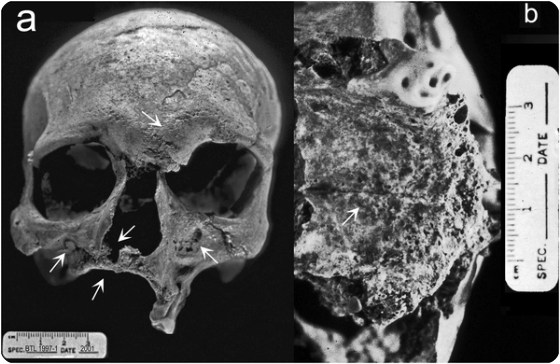
The presence of leprosy in India toward the end of this period indicates that M. leprae existed in South Asia at least 4000 years ago. This suggests that there may be some validity to Pinhasi and colleagues hypothesis that the disease spread between Africa and Asia during a period of incipient urbanization, increasing population density, and regular inter-continental trade networks. Dr. Robbins is currently attempting to recover ancient DNA from the skeleton to determine if the strain of M. leprae infecting the individual from Balathal is similar to strains common in Africa, Asia and Europe today. If it is successful, this work could shed additional light on the origin and transmission routes of this disease.
Understanding more about the disease can help clear up some of the many popular misconceptions about leprosy. It is generally associated with outcast and neglected people suffering their contagion on the margins of urban centers in late Biblical or Medieval times. In reality, leprosy is transmitted only through prolonged close contact with nasal droplets or infected regions of the body. It is not highly contagious and the infection can remain latent for decades. In fact, most people infected with Mycobacterium leprae have few or very mild symptoms. Because leprosy is not highly contagious and its survival is likely dependent upon dense populations, the association with urban environments is possibly the only accurate part of the popular perception.
The presence of leprosy at Balathal 4000 years ago also supports translations of the Eber's papyrus in Egypt and a Sanskrit text in India (the Atharva Veda) that refer to the disease as early as 1550 B.C. The Atharva Veda is a set of Sanskrit hymns devoted to describing health problems, their causes and treatments available in ancient India. Translations of leprosy have been questioned because it is difficult to perform a differential diagnosis on descriptions in such ancient texts particularly since diagnosis was not why the conditions were being described. The evidence from Balathal indicates that it is possible that the authors were describing leprosy as the disease was present in the subcontinent in prehistoric times.
Furthermore, in contemporary Hindu tradition burial is uncommon unless an individual is a highly respected member of the community (like an ascetic) or is an individual seen as unfit to be sacrificed through cremation. These latter individuals are buried, including outcastes, pregnant women, children under 5, victims of magic or curses, and lepers. During the second millennium B.C., when there was disintegration of Indus settlements and new, smaller settlements sprang up all over the western half of peninsular India, adult burial becomes rare, children under 5 begin to predominate in the skeletal assemblages, and this early leper was one of only five individuals buried at the site of Balathal (the others were middle-aged women, an ascetic from the Early Historic period, and a fragmentary clavicle found with the leprous skeleton). Thus there is a similarity in terms of the demography of the burial populations from the second millennium and Vedic tradition.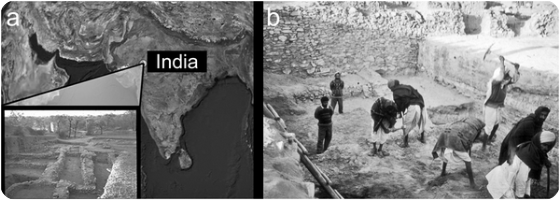
In addition, another feature of this burial that resembles Vedic symbolism is the burial site itself. The leper's skeleton was interred within a large stone enclosure that had been filled with vitrified ash from burned cow dung, the most sacred and purifying of substances in Vedic tradition. The presence of this skeleton at Balathal, the manner in which it was interred, and the preponderance of children in burial assemblages from this time period throughout western India suggest deep time for the origin of these practices still common in Vedic tradition today.
Citation: Robbins G, Tripathy VM, Misra VN, Mohanty RK, Shinde VS, et al. (2009) Ancient Skeletal Evidence for Leprosy in India (2000 B.C.). PLoS ONE 4(5): e5669. doi:10.1371/journal.pone.0005669
 Parents report safety risks with children’s at-home medical devices