Jul 21 2009
Parabon NanoLabs, a leading designer and manufacturer of breakthrough products at the nanoscale, announced today its award of a National Science Foundation (NSF) Small Business Innovative Research (SBIR) grant.
The grant will be used to demonstrate the viability of a new class of anticancer molecules that are engineered to automatically self-assemble from interlocking strands of synthetic DNA. It was a combination of innovations - DNA nanotechnology fabrication and grid computing sequence optimization - that led to Parabon NanoLabs' award.
Unlike other therapeutics, Parabon's compounds are deliberately engineered to solve specific therapeutic goals using an approach that effectively replaces the current paradigm of "drug discovery" with that of "drug design." By affixing molecular subcomponents (e.g., antibodies, pharmaceuticals and enzymes) to strands of DNA that are pre-sequenced to attach to one another to form composite constructs, Parabon NanoLabs researchers produce therapeutics that are able to precisely target and destroy individual cancer cells, without damaging surrounding healthy tissue. The highly competitive SBIR award from NSF will fund pre-clinical experiments, designed in collaboration with researchers at a leading pharmaceutical company, to validate the approach and demonstrate the efficacy of these novel compounds. 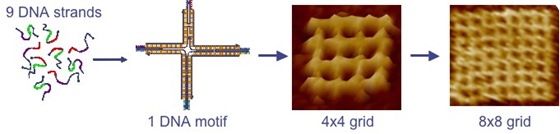
Key to Parabon's approach is the use of synthetic DNA as a programmable molecular substrate. Although DNA is best known as a carrier of genetic information, individual strands of synthetic DNA can be constructed to have any sequence of bases (commonly represented by the letters A, C, G and T). Because certain sequences of DNA are mutually attractive, these synthetic strands can be "programmed" with sequences that cause them to "swim to the right spot," with respect to one another, and then bind to form nanostructures of virtually any shape. By attaching DNA strands to other types of molecular subcomponents (e.g., antibodies to recognize tumor cells and pharmaceuticals comprising a kill payload), nanostructures can be richly functionalized to form novel therapeutics that are able to seek out and destroy specific tumor cells without affecting surrounding tissue.
Parabon NanoLabs has advanced both the fabrication technology required to produce such therapeutics and the computational tools to design them. In particular, the Company has developed a CAD (computer-aided design) application, called inSēquio, which facilitates the design and sequencing of therapeutic nanostructures by harnessing the computational power of thousands of computers on the Parabon Frontier Grid Platform. In development for three years, inSēquio utilizes grid computing to solve what had been the major impediment to progress in the field of DNA nanotechnology: the intractable task of calculating the sequences of DNA required for self-assembly and functionalization of target nanostructures.
 US cancer institute studying ivermectin’s ‘ability to kill cancer cells’