The result is the first structure that creates a multipurpose nanotechnology tool for medical imaging and therapy. The structure is described in a paper published online this week in the journal Nature Nanotechnology.
"This is the first time that a semiconductor and metal nanoparticles have been combined in a way that preserves the function of each individual component," said lead author Xiaohu Gao, a UW assistant professor of bioengineering.
The current focus is on medical applications, but the researchers said multifunctional nanoparticles could also be used in energy research, for example in solar cells.
Quantum dots are fluorescent balls of semiconductor material just a few nanometers across, a small fraction of the wavelength of visible light (a nanometer is 1-millionth of a centimeter). At this tiny scale, quantum dots' unique optical properties cause them to emit light of different colors depending on their size. The dots are being developed for medical imaging, solar cells and light-emitting diodes.
Glowing gold nanoparticles have been used since ancient times in stained glass; more recently they are being developed for delivering drugs, for treating arthritis and for a type of medical imaging that uses infrared light. Gold also reradiates infrared heat and so could be used in medical therapies to cook nearby cells.
But combine a quantum dot and a gold nanoparticle, and the effects disappear. The electrical fields of the particles interfere with one another and so neither behaves as it would on its own. The two have been successfully combined on a surface, but never in a single particle.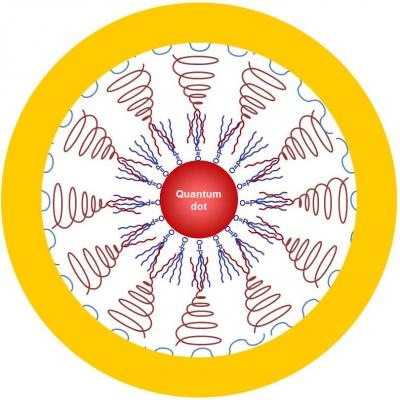
The paper describes a manufacturing technique that uses proteins to surround a quantum dot core with a thin gold shell held at 3 nanometers distance, so the two components' optical and electrical fields do not interfere with one another. The quantum dot likely would be used for fluorescent imaging. The gold sphere could be used for scattering-based imaging, which works better than fluorescence in some situations, as well as for delivering heat therapy.
The manufacturing technique developed by Gao and co-author Yongdong Jin, a UW postdoctoral researcher, is general and could apply to other nanoparticle combinations, they said.
"We picked a tough case," Gao said. "It is widely known that gold or any other metal will quench quantum dot fluorescence, eliminating the quantum dot's purpose."
Gao and Jin avoided this problem by building a thin gold sphere that surrounds but never touches the quantum dot. They carefully controlled the separation between the gold shell and the nanoparticle core by using chains of polymer, polyethylene glycol. The distance between the quantum dot core and charged gold ion is determined by the length of the polymer chain and can be increased with nanometer precision by adding links to the chain. On the outside layer they added short amino acids called polyhistidines, which bind to charged gold atoms.
Gao compares the completed structure to a golden egg, where the quantum dot is the yolk, the gold is the shell, and polymers fill up the space of the egg white.
Using ions allowed the researchers to build a 2- to 3-nanometer gold shell that's thin enough to allow about half of the quantum dot's fluorescence to pass through.
"All the traditional techniques use premade gold nanoparticles instead of gold ions," Gao said. "Gold nanoparticles are 3 to 5 nanometers in diameter, and with factoring in roughness the thinnest coating you can build is 5-6 nanometers. Gold ions are much, much smaller."
The total diameter of the combined particle is roughly 15-20 nanometers, small enough to be able to slip into a cell.
Incorporating gold provides a well-established binding site to attach biological molecules that target particular cells, such as tumor cells. Gold could also potentially amplify the quantum dot's fluorescence by five to 10 times, as it has in other cases.
The gold sphere offers one further benefit. Gold is biocompatible, is medically approved and does not biodegrade. A gold shell could thus provide a durable non-toxic container for nanoparticles being used in the body, Gao said.
 Repeated exposure to aged vape plumes could negatively impact lung health