Linkam Scientific Instruments, a market leader in temperature-controlled microscopy, has reported on the use of its temperature-controlled stages for CLEM and fluorescence microscopy to assist in endocytic sorting in the School of Biochemistry at the University of Bristol.
Paul Verkade is a Professor of Bioimaging in the School of Biochemistry at the University of Bristol. His research focuses on developing techniques and tools for Correlative Light Electron Microscopy (CLEM), particularly to study endocytic sorting.
In addition to his research and teaching roles, Dr. Verkade has organized and taught numerous courses and workshops on topics including high-pressure freezing, Correlative Light Electron Microscopy (CLEM), and immuno-EM, and has contributed to EMBO practical courses on CLEM.
Looking at his research in more detail, Dr. Verkade discusses his work.
"The research in my group focuses on intracellular segregation processes, especially in the endocytic system (e.g. segregation of recycling cargo away from degradative). In order to study these processes, we use a lot of live light microscopy to follow these dynamic events.
However, the resolution of the light microscope is too low to visualise certain aspects (eg. recycling membrane tubules are about 50 nm in diameter).
Thus, we want to capture specific stages of the live imaging and analyse those in more detail in the electron microscope in so-called Correlative Light Electron Microscopy experiments. There are several ways to perform those experiments, and we use Linkam stages in two of those workflows."
"In order to preserve the ultrastructure in its native condition, we have to freeze our samples very rapidly (for instance, chemical fixation destroys the membrane tubules). We can then check the state and fluorescence on these frozen samples using the Linkam CMS196 - Correlative Microscopy stage.
If the sample is OK, we can then further process it, either using cryo TEM or perform freeze substitution and resin embedding.
It would be interesting to mention that Linkam is very cooperative in making special adaptations, in our case modifying the grid cassette holder to accommodate thicker samples which we have acquired using High Pressure Freezing, rather than the standard EM grids."
"The second Linkam stage we use is a cooling stage LTS120. This is used for our "photoconversion" microscope, whereby, by illuminating our fluorescent sample very heavily, we create oxygen radicals that can be turned into an electron-dense precipitate.
However, by shining so much light on our sample we heat it as well. Without efficient cooling of the sample using the water-cooled Linkam stage, we would burn our sample, and it would melt /explode. Again, this is an essential tool in our CLEM workflow."
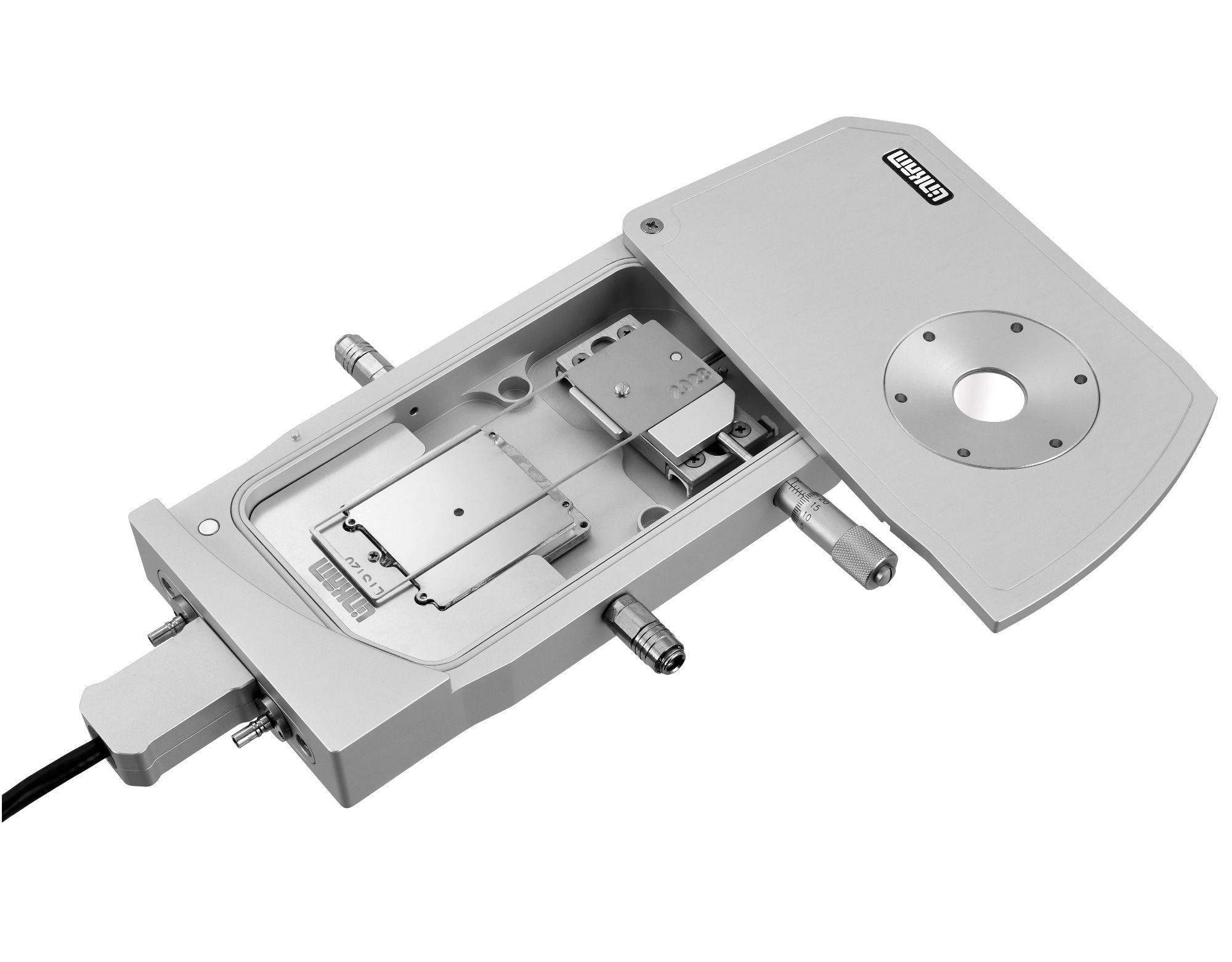 Image Credit: Linkam Scientific Instruments
References
- Olmos, Y., et al. (2015). ESCRT-III controls nuclear envelope reformation. Nature, 522(7555), pp.236–239. DOI: 10.1038/nature14503. https://www.nature.com/articles/nature14503.
- Methods in Cell Biology, Volume 124: Correlative Light and Electron Microscopy Il. Shared with Thomas Müller-Reichert.
- Methods in Cell Biology, Volume 111: Correlative Light and Electron Microscopy. Shared with Thomas Müller-Reichert.
About Linkam Scientific Instruments
Linkam develops and manufactures a broad range of temperature and environmental control stages for both OEMs and end-users. From high to cryo temperatures as well as humidity, electrical connections, gas purging, vacuum, and pressure, for enhanced sample analysis. Linkam stages are used with light microscopes and a wide range of analytical techniques including Raman, FTIR, WAX/SAX, and many more to visualize and characterize the properties of materials.
Linkam has stages for research applications including Pharmaceutical, Chemical, Biological, Materials Science, Geology, Food Science and many more. The hot stages, environmental control add-ons, electronics, and software are all designed and built on-site thereby enabling us to quickly respond to suggestions made by current Linkam users, and so enabling us to continually develop and improve our designs as well as offering custom solutions.
Linkam stages are found in thousands of laboratories worldwide with the most successful microscope heating stage, the THMS600, selling over 6,000 units alone. Linkam is the market leader in temperature-controlled microscopy.
Sponsored Content Policy: News-Medical.net publishes articles and related content that may be derived from sources where we have existing commercial relationships, provided such content adds value to the core editorial ethos of News-Medical.net, which is to educate and inform site visitors interested in medical research, science, medical devices and treatments.