Autoinjectors are now being built to handle larger volumes, allowing biologic therapies to move from the infusion chair to the home. This article looks at what is driving this shift and the technology and methods used to test these devices.
Many biologic therapies have historically meant a trip to the clinic and an extended IV infusion for patients. However, this has changed in recent years as pharmaceutical companies increasingly develop autoinjectors that can deliver larger volumes and high-viscosity biologics.
These developments allow patients to self-administer at home according to their own schedule, without the need for a clinical visit or an infusion chair.
This shift improves patient autonomy and requires a range of engineering and testing considerations that must scale with the larger drug volume.
From 1 to 2.25 mL, 5 mL and beyond
Conventional autoinjectors are designed to deliver 1 to 2.25 mL of drug product. Large-volume autoinjectors generally follow the same core principles, delivering 3 mL or more of drug product.
Devices currently under evaluation by major pharmaceutical companies feature volumes as high as 5.5 mL, with devices up to 10 mL in development.
Major adjustments are needed to accommodate these increases in fluid volume and viscosity. Different design considerations come into play, including the injection mechanism and the components needed to house and support a larger primary container.
These devices must be comprehensively tested as a complete system before a patient uses them. This is key to understanding how they will perform in a real-world scenario.
Autoinjector testing typically follows standards such as the FDA's draft guidance on Essential Drug Delivery Outputs (EDDOs) and ISO 11608-5, incorporating factors such as needle depth, activation force, dose accuracy, injection time, and audible feedback.
Large volume autoinjectors are also assessed against these fundamental outputs as the underlying measurements.
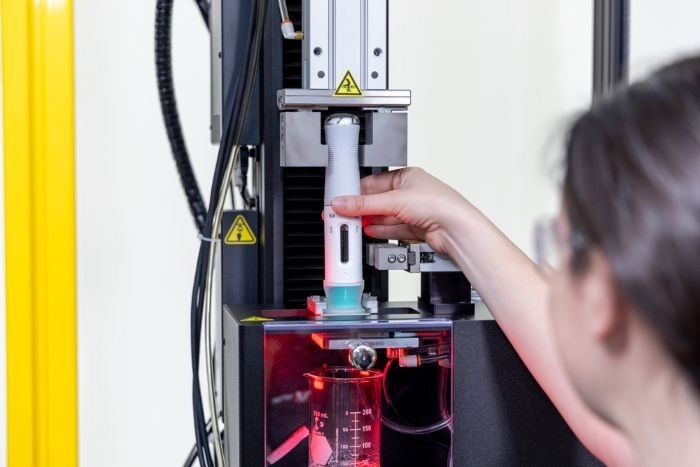
Image Credit: Instron - USA
The need for a flexible testing approach
The Instron® Autoinjector Testing System has been developed as a standard platform configurable to accommodate a wide range of device profiles from smaller-volume autoinjectors up to large-volume devices.
There are several key considerations when working with large-volume device testing.
Cartridge-based devices
Some autoinjectors use a cartridge as the primary container as opposed to a prefilled syringe (PFS). This is especially common with large-volume devices.
For example, the SHL Magnitude (formerly Maggie) device’s cap must be unscrewed to engage the needle and connect the fluid pathway prior to beginning the injection. Testing this kind of device requires biaxial capability, which can be added to the system via a Torsion Add-On.
Audible feedback
Many autoinjectors use an audible click to inform the patient that an injection has started and finished.
Large-volume autoinjectors occasionally use a continuous sound for the duration of the injection; however, completion is indicated by silence. Using an integrated microphone to capture this audio alongside dispensed volume, force, and other test data affords testers a more comprehensive picture of how the device communicates with the user during a real injection.
Needle depth and delivery tracking
The system uses a machine vision camera to measure injection depth and injection time. This approach is used across the entire range of autoinjectors and is robust enough to accommodate the wider range of injection times or viscosities that may be presented by large-volume devices.
One platform, minimal change parts
Large-Volume Autoinjector Testing & Partial Torsion Cap Removal | Autoinjector Testing System
Video Credit: Instron - USA
Every drug delivery device is unique, with different feedback cues, cap mechanisms, and force and volume profiles, so it is not practical to build a bespoke test system for each device.
Instron treats the Autoinjector Testing System as a standard platform, adapting it via add-ons and configuration changes to best accommodate the device being evaluated. Test methods are also developed to accommodate the specific requirements of the device being tested.
One of the design priorities underpinning the system is ensuring a minimal number of change parts to make switching between device types on the same test system as straightforward as possible.
This is important for labs assessing a range of devices because a simple changeover process means spending less time reconfiguring equipment while improving repeatability across testing.
Large volume configuration is key to meeting these needs. The large volume version of the Autoinjector Testing System is designed to accommodate autoinjector sizes from 1 mL to 5.5 mL, using the same minimal change part approach to switch across this wider range.
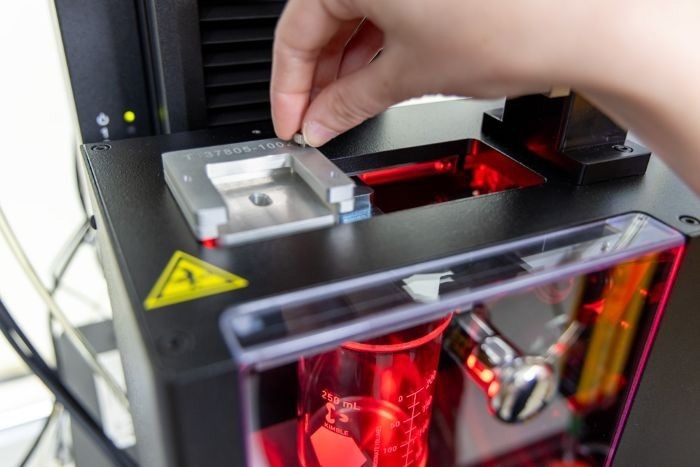
Operator changes the insert to accommodate testing of different devices. Image Credit: Instron - USA
The future of drug delivery systems testing
As of September 2026, no large-volume autoinjector combination product has been released to market, meaning that an approved drug is not currently being delivered via one of these devices.
Manufacturers currently offer device platforms that allow pharmaceutical companies to use them in development, but the drug products themselves are still in the research and development phase.
Research and development is largely driven by pharmaceutical R&D teams assessing whether a large-volume, self-administered format is the correct delivery approach for a specific drug candidate.
This is an emerging space where device testing plays a central role in shaping decisions that have not yet been finalized.
Autoinjectors able to deliver larger volumes represent a tangible shift in the potential administration of biologics, moving high-volume, high-viscosity therapies out of the clinic and into the patient's hands.
A testing platform built around adaptability as opposed to a fixed, single-purpose setup will be key to supporting developments in this space as more large volume devices move from R&D into later-stage development.
Acknowledgments
Produced from materials originally authored by Meredith Bernstein from Instron.
About Instron - USA
A global leader in the materials testing industry, Instron manufactures mechanical testing systems designed to meet the needs of the medical device and pharmaceutical industries for performing static, fatigue, and impact testing. Instron provides single-source convenience through localized service and support, offering assistance with IQ/OQ, performance verification, system calibration, training, and preventative maintenance.
Sponsored Content Policy: News-Medical.net publishes articles and related content that may be derived from sources where we have existing commercial relationships, provided such content adds value to the core editorial ethos of News-Medical.net, which is to educate and inform site visitors interested in medical research, science, medical devices, and treatments.