In this interview, industry expert Andrew Pacelli explains how smarter fluidics decisions can prevent costly redesigns, improve reliability, and help diagnostic systems perform consistently from development through scale-up.
From your experience, what do diagnostic development teams most often underestimate when it comes to fluidics?
I think one of the biggest things teams underestimate is that they are designing an entire fluidic system, not just a singular component. There can be a tendency to focus heavily on the pump while overlooking the smaller components around it, such as tubing, adapters, tips, valves, fittings, and connectors. All of those components are part of the fluid path and can significantly impact the performance of the pump and the system as a whole.
The characteristics of the fluid itself are also extremely important. Factors such as viscosity and consistency affect how the fluid behaves as it moves through each wetted component. You might be able to demonstrate that a pump performs well on the bench, but the real challenge is making sure you can achieve that same dispense consistently once the pump is integrated into the final instrument. That is why it is important to think about fluidics as a complete system rather than evaluating individual components in isolation.
When should teams begin thinking seriously about their fluidic architecture, and what are some early warning signs that decisions could cause problems later?
Teams should start thinking about fluidics at the point of inception, alongside the development of the instrument or assay. That is when you have the most freedom to explore different architectures without significant costs. Once the design is locked, changing the tubing, fittings, pump, or other components becomes much more difficult.
Some of the warning signs are cost-driven shortcuts or late changes to core specifications such as volume or speed. These can indicate that the fluidic architecture was not fully considered early enough and can create performance or supply risks later in the product lifecycle.
What fluidic challenges tend to emerge when a diagnostic system moves from the bench into higher-volume, real-world operation?
The biggest change is that the field introduces variables that are much easier to control in a laboratory environment. An instrument might eventually be installed anywhere in the world, so differences in altitude, atmospheric pressure, temperature, and humidity can all affect fluidic performance.
There are also differences in how instruments are actually used. An instrument operating 24/7 is going to experience different wear and reliability demands from one that runs for an eight-hour shift. Service and operator interactions can also introduce additional variables.
Then there is simply the effect of scale. When you move from a relatively small number of instruments in a controlled development environment to thousands of units in the field, you start to see very specific combinations of circumstances that you may never have encountered during laboratory testing.
When FMI begins working with a diagnostic engineering team, how do you understand the application and determine which fluidic approach is the right fit?
We start with the requirements rather than immediately starting with a particular technology. Internally, we use what we call an application data sheet, or ADS, and our sales engineering team works through the application in detail before a product is selected.
This includes information such as dispensing volume, whether the application requires metering versus dosing, inlet or outlet pressure, back pressure, accuracy requirements, and whether pulsation can be tolerated. All of those technical factors influence which pump or fluidic technology is appropriate.
Once we have that information, we can start eliminating approaches that do not meet the requirements. For example, if the application cannot tolerate pulsation, that immediately removes certain technologies. If a very specific dispensing volume or level of accuracy is required, this further narrows the options.
Importantly, the goal is not to make the application fit our product line. If another technology is more appropriate, we will say so. For example, if disposability or a single-use fluid path is the priority, a peristaltic pump may be the better approach. The ADS helps ensure the technology meets the requirements, rather than the other way around.
What should engineering teams characterize or validate before they feel confident locking in their fluidic architecture?
My recommendation is to get as close as possible to testing with the real fluid, in the real instrument, under the conditions in which that instrument will actually operate.
One of the common things we see is testing being performed using water, or specifically DI water, because it is convenient during development. The pump might behave exactly as expected with water, but when you introduce the actual reagent, assay, or other application fluid, its characteristics can change the performance of both the pump and the wider fluidic system.
Teams should also validate across the real operating range, including factors such as temperature, altitude, pressure, and the actual dispensing volumes the instrument will use. Precision and accuracy need to remain consistent across those conditions.
Ultimately, you want to confirm that the required dispense can be achieved inside the final instrument, not just on the bench.
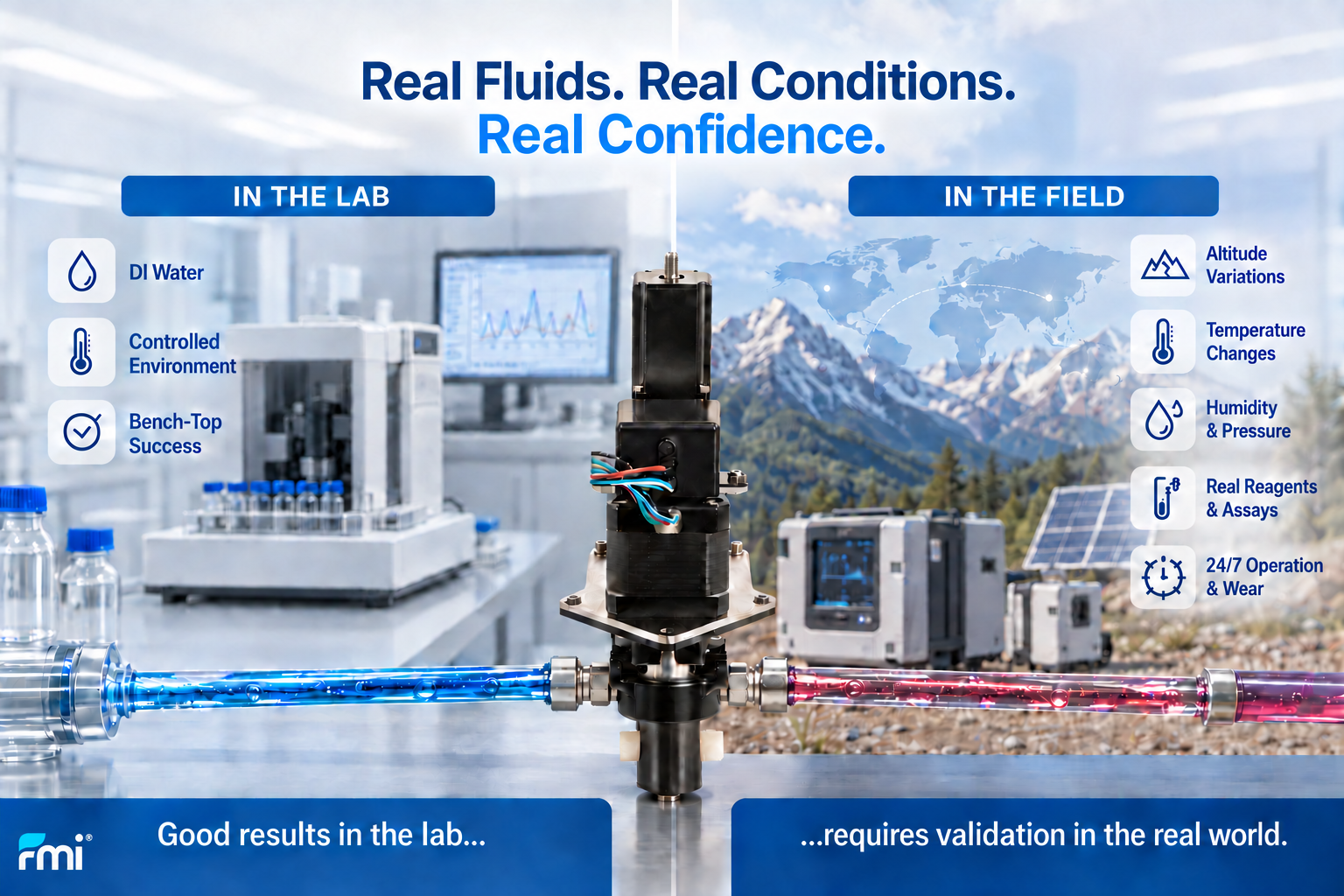
Image Credit: Fluid Metering, Inc.
How do fluidics considerations change when upgrading an established diagnostic platform rather than developing a completely new system?
With an established platform, you have much less flexibility because you are working within a structure that already exists. Rather than defining the fluidic architecture from the beginning, you are generally trying to match existing performance, electrical, reliability, and integration requirements.
That becomes particularly important in diagnostics because these platforms can be highly regulated. A significant change to an assay-path component can require additional testing and potentially re-registration or re-approval, so you need to carefully validate that the change does not introduce additional risk.
With a completely new development, you have more freedom to experiment and make adjustments. With an existing platform, the ideal solution is often something as close as possible to a drop-in replacement that avoids a wider redesign or unnecessary regulatory work.
When a diagnostic platform is scaled to higher volumes or a larger installed base, what new fluidic risks may emerge?
At that point, variance really becomes the enemy. When you move from perhaps 100 instruments to 10,000, small unit-to-unit variations that were effectively invisible at low volumes can start to become significant.
A component might work perfectly during development but behave differently across a production population of 20,000 or 30,000 units. Even a failure rate of 0.1% can become important at scale, particularly in diagnostics, where the consequences of a critical failure can be severe.
That is why teams need to consider variance before full-scale production and test as many realistic operating scenarios as possible.
How can teams balance fluidic performance with maintenance, serviceability, integration, and long-term operating costs?
It is imperative that engineers balance these factors when making a design choice because the product with the lowest initial purchase price is not necessarily the least expensive option over the life of the instrument.
You might have a technology that achieves the necessary accuracy but includes a wearable component that requires an annual maintenance cycle; every time that component needs to be replaced, you may need a service representative or engineer to visit the instrument. Across a large installed base and a long product lifecycle, those costs can add up significantly.
That is why I think teams should model the total cost of ownership, rather than looking only at the bill of materials (BOM) cost. For example, a syringe pump may have a lower upfront cost but require recurring maintenance such as barrel swaps.
FMI's FENYX® Varaible Dispense Pump has a higher upfront cost but is maintenance-free. The right comparison, therefore, includes not only the initial component cost but also maintenance, service calls, downtime, and who ultimately bears those costs over the life of the instrument.
You really want to understand those trade-offs at the time you make the fluidic decision, rather than discovering them once the platform is already in the field.
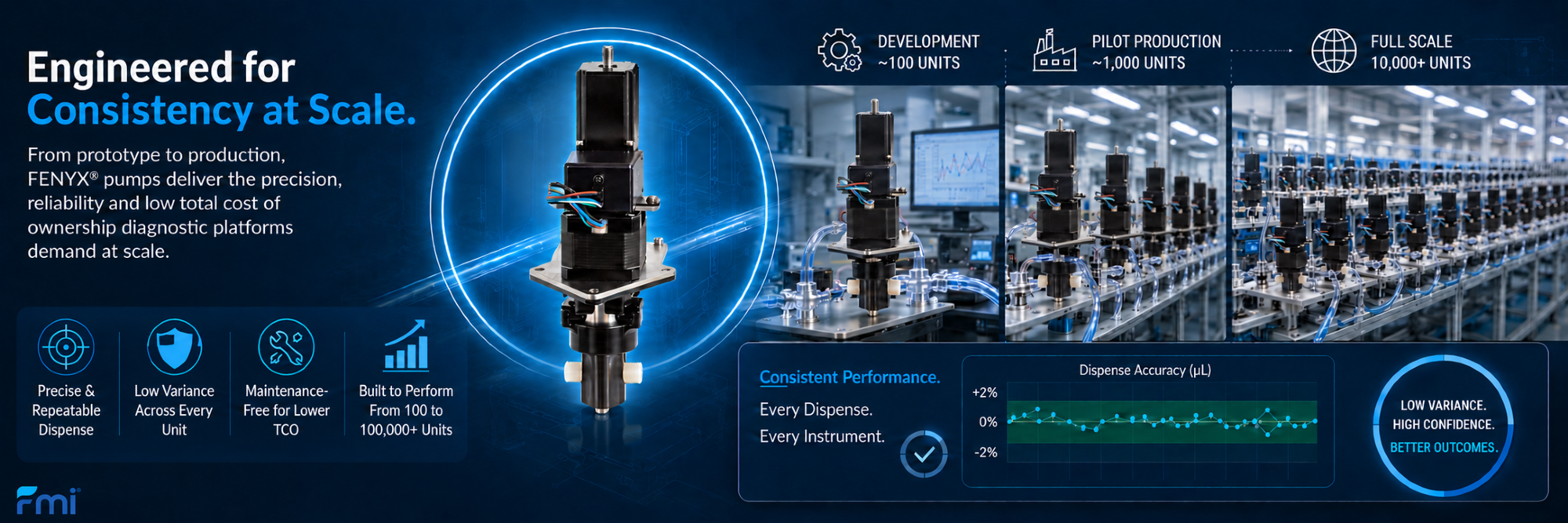
Image Credit: Fluid Metering, Inc.
For teams using the Diagnostic Fluidic Readiness Checklist, which areas should they examine most critically?
I would focus on the things that are easiest to overlook early in development: real-fluid characterization, the environmental conditions the instrument will experience, serviceability, and lifecycle or supply risks.
The value of the checklist is that it gives teams a structured way to work through those questions before the design becomes difficult or expensive to change. In many cases, the most useful outcome is simply identifying a critical question that the team had not previously thought to ask.
Interested in getting a copy of the Checklist? Click here
If you could leave diagnostic engineering teams with one question to ask about their own fluidic architecture, what would it be?
The question I would ask is: Have you validated this with your actual fluid, in your actual operating environment, at the volume you are actually planning to ship?
It is easy to feel confident based on testing with an adjacent fluid or under conditions that are close to the final application. But if those tests do not reflect how and where the instrument will actually operate, unexpected problems can still appear later. Making sure that question is answered upfront helps drive the right product selection and gives you much greater confidence in the final fluidic architecture.
About Andrew Pacelli 
Andrew Pacelli holds a Bachelor of Engineering in Mechanical Engineering from Virginia Tech.
At Fluid Metering, he progressed from Technical Sales Engineer to Key Account Manager, supporting OEM development, product evaluations, customer adoption, technical presentations, and collaboration between customers and engineering and R&D teams.
About Fluid Metering, Inc.
Fluid Metering, Inc. is a leading manufacturer of precision fluid control solutions, with a legacy of innovation dating back to 1959. As the pioneer of the first valveless rotating and reciprocating piston metering pump, Fluid Metering has continually refined its technology to meet the evolving needs of advanced applications.
Today, the company specializes in the design and production of high-performance dispensing pumps and metering systems, delivering exceptional accuracy, precision, and reliability across a wide range of industries. ISO 9001:2015 certified.