In this interview, industry experts Florian Plouviez and Kévin Roux discuss how biomaterials, extrusion, and additive manufacturing are used to develop and scale medical devices for regenerative medicine and soft tissue reconstruction.
Can you introduce yourselves and explain your roles at Lattice Medical?
Kévin Roux: I’ve been at Lattice Medical for eight years. I’m a materials engineer, and a large part of my role involves working on the equipment and helping transfer processes from R&D into industrial production. That means looking not only at whether something works at the prototype stage, but also whether the process can eventually be scaled and reproduced in a manufacturing environment.
Florian Plouviez: I’ve been at Lattice Medical for around three and a half years, and I’m the business manager. I handle much of the business activity around the biomaterials part of the company, including sales, contract manufacturing, and product development. A large part of my work also involves supporting customers and helping translate their development needs into projects that can move toward manufacturing.
What is Lattice Medical trying to achieve in regenerative medicine and soft tissue reconstruction?
Florian Plouviez: Lattice Medical is a French company created in 2017 with the goal of developing innovative approaches in regenerative medicine. One of the first major areas we focused on was breast reconstruction for women who have undergone cancer treatment.
Our aim is not necessarily to replace existing approaches, but to provide another way to support healing and reconstruction using biomaterials. We work with polymer matrices that are designed to help enhance tissue reconstruction, with the objective of ultimately allowing reconstruction using the patient’s own tissue.
That work has led to several projects. MATTISSE is focused on breast reconstruction, while RODIN is intended for deeper layers of the skin, particularly fat and soft tissue. More broadly, our medical devices are developed using additive manufacturing technology.
Kévin Roux: We also have Lattice Services, where we produce filament for 3D printing. This includes implantable filament as well as medical-grade filament for skin-contact applications. Over time, extrusion has therefore become an important part of our expertise.
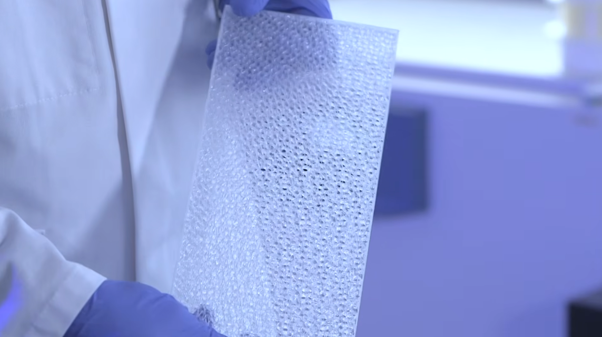
Image Credit:Thermo Fisher Scientific
What are the biggest scientific and engineering challenges when moving from an idea to an industrialized medical device?
Kévin Roux: One of the most important things is to design a prototype that can eventually be industrialized. We cannot only think about what works for R&D; from the beginning, we also need to consider whether the design and process will be feasible later with the equipment and manufacturing methods available to us.
The other major challenge is working with medical-grade materials. We need to identify materials that are already certified for implant applications and consider those requirements early in development. Thinking about those constraints before moving further into the project is essential, and that is one of the most challenging parts of the process.
Florian Plouviez: From the customer perspective, we see the same challenge very often. A process may work very well during an academic, research, or R&D phase, but the next question is whether it can be translated into an industrial process.
That means considering equipment that is validated and suitable for medical-grade or medical device manufacturing, as well as biomaterials that are certified, GMP-grade, or otherwise appropriate for the application. It is always a balance between developing the prototype and designing something that can ultimately be industrialized.
Click here to watch Analyze That episode 16 - Inside the lab: How Lattice Medical develops advanced biomaterials
Why has extrusion become such an important part of your work?
Kévin Roux: Initially, we were offering pure filament without anything added to it. However, some customers wanted more functionality from those materials, such as incorporating ceramics into the filament.
That led us to consider how we could introduce this functionality using a twin-screw extruder. We began conducting R&D to incorporate hydroxyapatite (HA) into our printable filament and achieved strong internal results, including good biocompatibility.
From there, we started thinking beyond producing custom implants for individual customers. We saw that there was demand for this type of material more broadly, so we began developing these more specific filaments as products in their own right.
Florian Plouviez: That development really came from market feedback. We already had several biomaterials in our range, including materials intended for bone reconstruction. Customers were telling us that although those materials were suitable for osteointegration and bone regeneration, they wanted to go further by adding ceramics, loading the material, or otherwise functionalizing it.
That pushed us toward developing loaded and functionalized filaments, but it also increased our ability to respond to custom requests where research teams need something that simply does not exist on the market.
What role does the Thermo Scientific™ Process 11 twin-screw extruder play in developing these materials?
Kévin Roux: The Process 11 twin-screw extruder gave us a way to blend additional components into our printable filaments and develop materials with specific functionality. It became particularly useful when we started incorporating HA and experimenting with more advanced formulations.
Florian Plouviez: One of the main advantages is its versatility. We can use it when we need to functionalize a polymer matrix or blend it with fibers or powders, and it is suitable for both research and production-related work.
For research teams, we often need to work with relatively small quantities. At the same time, when we move toward production, we still need sufficient throughput to manufacture useful quantities. Having equipment that can support both ends of that spectrum is particularly valuable because it allows us to work with research teams during early development and then continue supporting the project as the required volumes increase.
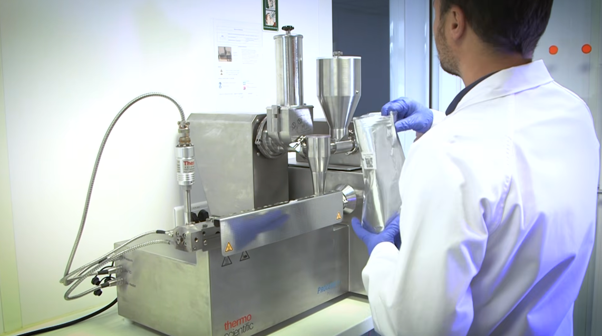
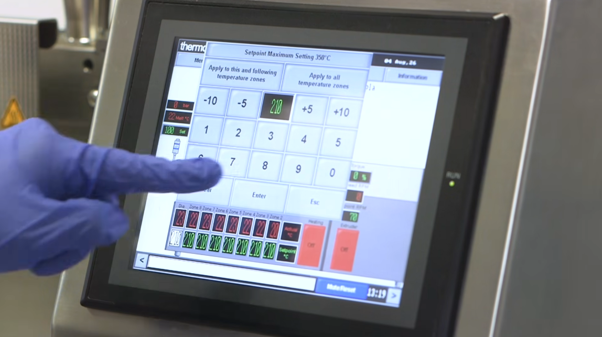
Image Credit:Thermo Fisher Scientific
Why is the ability to work with small quantities so important in biomaterials development?
Kévin Roux: At the beginning of Lattice Medical, we did not have our own extrusion equipment, so we had to look externally. We bought pellets and approached a conventional extrusion provider, but they required around 10 kilograms of material for a first trial.
The problem was that one kilogram of those pellets could cost several thousand euros. That represented a very significant investment for a young company. After the extrusion process, we only obtained around 500 g of filament, which was a major disappointment.
That experience was one of the reasons we decided to internalize the process and look for equipment better suited to R&D and pre-industrial production. With the equipment we use now, we can begin with around 500 g of material and obtain roughly 300 g of filament. We lose much less material through purging and parameter calibration, which is extremely important because every gram is money.
Florian Plouviez: The same consideration applies to customers. With custom extrusion, any unavoidable material loss is ultimately a loss for the client as well. If you begin with one kilogram and lose 300 g, that can be very significant when the biomaterial is expensive.
Small quantities are also fundamental because many customers are academics, research teams, startups, or medical device companies carrying out iterations and trials. They cannot necessarily afford to buy several kilograms simply to test an idea.
The implants themselves are also generally small because they are intended to degrade inside the body, so the required material volumes are often limited. Being able to support both small-scale R&D and larger production requirements therefore creates value across the development process.
Click here to watch Analyze That episode 16 - Inside the lab: How Lattice Medical develops advanced biomaterials
How do you see biomaterials and additive manufacturing evolving over the next five to 10 years?
Florian Plouviez: Over the last two years, particularly since launching loaded filament, we have seen much greater demand for functionalized materials and filaments. That is also reflected in scientific publications and wider activity in the field.
I think we will continue to see more functionalization, more blending and more use of copolymers. Hydrogels are another interesting area, particularly when combined with scaffolds. There is a lot of potential in identifying the right synergies between these materials and additive manufacturing.
Kévin Roux: There are also developments beyond extrusion itself. Once we have produced the material, we still need to 3D print it, and 3D printers continue to evolve every year.
AI could also change the way these processes are controlled. In extrusion, for example, systems may become better at detecting when something is going wrong or automatically adjusting parameters.
For Lattice Medical, we also expect to increase our product range and produce larger volumes as the number of customers grows. We are expanding our team and moving toward our own larger facility and cleanroom, which should give us much more capacity and allow us to respond to increasing demand under highly controlled production conditions.
How is Lattice Medical expanding its role beyond its own medical devices?
Florian Plouviez: One of the important changes over the last two years has been the development of our CDMO activity, where we support co-development and manufacturing for other medical device companies.
We already manufacture our own medical devices, including MATTISSE and RODIN, so we have built expertise around creating medical devices, prototyping them, working with biomaterials and extrusion, and then progressing toward manufacturing.
We can now use that knowledge to help other teams. Some projects come from academic groups that have achieved proof of concept and are starting to create a company. Others are already startups or established medical device businesses, but they may not want to invest immediately in their own cleanroom or full-scale manufacturing facilities.
We can provide that infrastructure and expertise, including manufacturing in an ISO 7 cleanroom. In that sense, biomaterials can be the starting point of the development funnel, with production and manufacturing following once the concept has matured.
What motivates you to continue working in regenerative medicine and medical device development?
Florian Plouviez: For me, a lot of the motivation comes from working directly with researchers and research teams and feeling that we can have an impact on their work. I am not a scientist myself, so my contribution is different, but by supporting medical device development and manufacturing, we may help projects eventually reach the market.
We can also give researchers access to materials that allow them to investigate new ways of helping patients. The applications can span many areas, including esthetics, sports medicine, orthopedics, and reconstruction after cancer treatment. Knowing that the work can contribute in some way to those outcomes is very motivating.
Kévin Roux: From the R&D team’s perspective, I think many people at Lattice Medical joined because of the MATTISSE project and its focus on breast reconstruction. There is obviously the technical side of the work, but there is also the idea of helping people reconstruct their bodies and feel better.
That sense of purpose is important across the team. We are now more than 20 people, and I think many of us are motivated by the idea that the technologies and medical devices we develop can ultimately improve patients’ lives.
Analyze That episode 16 - Inside the lab: How Lattice Medical develops advanced biomaterials
Inside the lab: How Lattice Medical develops advanced biomaterials
About Florian Plouviez 
Florian Plouviez holds a Master’s in International Business, Marketing and Innovation and a degree in Marketing and Sales from IAE Lille. At Lattice Medical, he progressed from Business Developer to Business Manager, leading commercial strategy, sales, marketing, partnerships, and development of medical device and 3D-printing filament solutions.
About Kévin Roux 
Kévin Roux studied at the École Nationale Supérieure des Ingénieurs en Arts Chimiques et Technologiques. Since 2018, he has worked at Lattice Medical as an R&D Process Engineer, with expertise spanning 3D printing, differential scanning calorimetry, and scanning electron microscopy.
About Thermo Fisher Scientific

Thermo Fisher products give you outstanding capabilities in materials science research and development. Driving innovation and productivity, our portfolio of scientific instruments enable the design, characterization and lab-to-production scale of materials used throughout industry.
X-ray fluorescence spectrometers, FTIR spectrometers and X-ray photoelectron spectrometers enable researchers and material analysts to probe the chemical composition of materials ranging from ultra thin-films to bulk powders used in product development and materials troubleshooting. We offer a line of rheometry and viscometry instruments, as well as single- and twin-screw extruders, for laboratory benches that enable you to measure the physical property of semi-solids and liquids for shear flow and yield stress.
No other company offers the breadth of products and the depth of analytical capabilities for materials science and engineering.
Vibrational spectroscopy
Our line of Nicolet FTIR spectrometers have led the analytical instrument industry for over fifty years with reliable, robust and flexible solutions. Thermo Scientific Raman spectrometers enable point analysis, confocal microscopy and chemical imaging.
X-ray photoelectron spectroscopy
For the analysis of surfaces and thin film structures, our line of XPS spectrometers feature ease-of-use, automation and multi-technique operation for material science and R&D labs. For an in-depth look into our surface analysis capabilities and resources, visit xps-simplified.com.
Electron microscopy and X-ray microanalysis
Every day, Thermo Fisher customers from around the globe seek solutions to complex challenges about product quality, manufacturing efficiency, and material properties with electron microscopy, ion beam, and SEM/EDS, WDS, and EBSD capabilities that enable the next breakthrough discovery.
X-ray fluorescence
Rapidly characterize materials for qualitative and quantitative chemistry specifications with the gold standard for accurate, nondestructive elemental analysis across a wide range of materials.
X-ray diffraction
Our line of ARL EQUINOX X-ray diffractometers provides high-performance results in a wide range of industrial and research applications including academic research, chemicals, pharmaceuticals, polymers, semiconductors, thin films, metals and minerals.
Rheology & viscometry
Thermo Scientific rheometers and viscometers are designed to accurately measure the properties of fluids and other complex materials. They are recognized for accuracy and ease of use in quality control, product development, and research applications. Our viscometers allow you to quickly determine the flow behavior of fluids and are designed for your application.
Extruders & torque rheometers
Ideal for materials compounding experiments and pilot-scale extrusion production, our minicompounders and 11mm parallel twin-screw extruders and torque rheometers are well-suited for research and development in the polymer, pharmaceutical, bioscience, and nanotechnology sectors.
Optical emission spectrometry
Perform rapid elemental analysis of solid metallic samples with optical emission spectrometry using Arc/Spark excitation. This technique meets the most demanding analysis needs of the metals industry from production control to R&D, from incoming material inspection to scrap sorting.