Plasma phosphorylated tau at threonine 217 (pTau 217) is the most effective blood biomarker for Alzheimer's disease (AD), with strong concordance with amyloid-β (Aβ) and tau PET imaging. It also shows the largest fold difference between amyloid-negative and amyloid-positive individuals.
Emerging evidence, however, suggests that plasma pTau 217 does not originate solely from the central nervous system (CNS). Elevated pTau 217 has been observed in non-AD conditions such as amyotrophic lateral sclerosis (ALS) and chronic kidney disease (CKD), indicating peripheral influences or contributions from conditions unrelated to AD pathophysiology.
These findings underscore the crucial need for assays that preferentially identify brain-derived pTau 217 (BD-pTau 217) to increase AD specificity in blood-based biomarker testing, particularly when pTau 217 is applied to heterogeneous populations with varied underlying comorbidities.
Recent research suggests that immunoassays targeting low-molecular-weight (LMW), CNS-derived pTau species are less affected by peripheral comorbidities and better discriminate between AD and non-AD neurodegenerative disorders.
The researchers employed and evaluated the SPEAR UltraDetect™ BD-pTau 217 Assay, which targets CNS-specific pTau 217 species, in a memory clinic cohort and a cohort of young healthy adults.
Using plasma samples from the Global Alzheimer's Platform (GAP) cohort, the researchers show strong amyloid pathology discrimination, with a substantial (4.56X) difference between amyloid-negative and amyloid-positive groups.
The assay had 100 % quantifiability, measuring BD-pTau 217 in all samples, including young healthy people, beyond its functional lower limit of quantification (LLoQ).
The researchers tested the short-term stability of the BD-pTau 217 baseline measurement in healthy adults across multiple samples collected at biweekly intervals. They found excellent longitudinal consistency compared with a comparator assay.
Collectively, these findings confirm BD-pTau 217 as a refined plasma biomarker with improved CNS specificity by reducing peripheral effects.
The SPEAR UltraDetect™ BD-pTau 217 Assay accurately quantifies this low-abundance biomarker in plasma samples from both healthy and diseased patients. This supports its widespread use in research and clinical applications across the Alzheimer's disease continuum.
Introduction
As neurological research progresses, blood-based biomarkers are transforming Alzheimer's disease research and clinical development by allowing for scaled, minimally intrusive monitoring of brain pathology.
Among these indicators, plasma pTau 217 has emerged as a powerful predictor of amyloid and tau pathology, outperforming other phosphorylated tau isoforms in various investigations.
Despite its high performance, plasma pTau 217 is not exclusively derived from the CNS. Recent studies have found elevated pTau 217 in peripheral diseases such as ALS, with elevated levels of pTau 181 and pTau 217 detected in serum and skeletal muscle, implying suggestions from degenerating peripheral neurons and denervated muscle fibers.1
Similarly, kidney failure, including CKD, has been linked to higher plasma pTau 217 levels, but pTau 217/Tau ratios appear unaffected.2,3
Unpublished results presented at AAIC 2025 found that pTau 217 levels were higher in capillary blood than in venous plasma. This could be due to contamination by local blood breaks or peripheral components during the collecting process.
These findings suggest that non-CNS sources and pre-analytical variables can mask early AD-related changes in plasma pTau 217, especially in screening and early-stage illness settings where pTau 217 levels are low.
As a result, assays that primarily detect brain-derived pTau 217 (BD-pTau 217) may improve diagnostic accuracy by decreasing exposure to peripheral and physiological confounders.
The SPEAR UltraDetect™ BD-pTau 217 Assay uses Successive Proximity Extension Amplification Reaction (SPEAR) technology to detect low-molecular-weight pTau 217 species that are unique to the CNS.
This wash-free test uses only 1 µL of diluted plasma to achieve ultra-high sensitivity and precision, while minimizing interference from peripheral tau species.
This article evaluates the analytical and clinical performance of the SPEAR UltraDetect™ BD-pTau 217 Assay using three datasets.
- A GAP cohort of memory clinical patients, evaluated for amyloid pathology discrimination
- A cohort of healthy persons aged 20–69 (average age 44.2) to determine the quantifiability of this assay in a young healthy population
- A baseline measurement stability study in healthy people to determine eligibility for longitudinal monitoring
Materials and methods
Study participants
GAP cohort
Plasma samples were collected from patients in the Global Alzheimer's Platform (GAP) Bio-Hermes study who had amyloid PET-verified status.
The cohort included both amyloid-negative (A-) and amyloid-positive (A+) people with clinical diagnoses ranging from mild cognitive impairment (MCI) to likely Alzheimer's dementia (probable AD).
Clinical cohort
Plasma samples were collected from commercial suppliers of healthy people aged 20 to 69 (average age 44.2).
Healthy baseline stability cohort
Plasma samples were collected from nine neurologically healthy adults at Massachusetts General Hospital over three visits, spaced two weeks apart.
Samples obtained at different time points were evaluated under similar conditions for the SPEAR UltraDetect™ BD-Tau 217 test and the comparator Simoa® ALZpath pTau 217 assay to assess the stability of baseline measurement.
Immunoassays and procedures
SPEAR assay
The SPEAR UltraDetect™ BD-pTau 127 test (Cat# SPR90027, SPR90024, Spear Bio, Woburn, MA) was used. Spear Bio provided guidelines for processing EDTA plasma samples with the Formulatrix® F.A.S.T™ liquid handler and QInstruments® BioShake® iQ.
Simoa® Assay
The Simoa® ALZpath pTau 217 Advantage PLUS assay kit (Cat # 104570, Quanterix, Billerica, MA) was used. EDTA plasma samples were analyzed on a Simoa HD-X Analyzer® according to the manufacturer's instructions.
Results
Discrimination of amyloid pathology in the GAP memory clinic cohort
Plasma BD-pTau 217 levels evaluated with the SPEAR assay revealed a 4.6-fold difference between the medians of amyloid-negative (A-) and amyloid-positive (A+) groups (Figure 1A and 1B).
The wide separation led to a very accurate classification of A- and A+ individuals, with an area under the curve (AUC) of greater than 0.94.
The test showed 100 % quantifiability, with all samples, including A- samples, measuring beyond the assay's functional lower limit of quantification (LLoQ) of 25 fg/mL (Figure 1C).4
The test demonstrated great precision, with an average intraplate coefficient of variation (CV) of 4.1 % (Figure 1D), indicating that the detected differences are biological signals rather than analytical noise.
Quantifiability in younger healthy individuals
Plasma BD-pTau 217 is an extremely low-abundance biomarker, making it difficult to detect in healthy people. Quantifying BD-pTau 217 in younger asymptomatic patients is crucial for the biomarker's use in screening and early detection applications.
In a group of 34 healthy adults aged 20–69 (average age 44.2), the SPEAR assay likewise demonstrated 100 % quantifiability with an average CV of 5.7 % (Figure 2), indicating adequate sensitivity and precision for quantifying plasma BD-pTau 217 even in young, healthy populations.
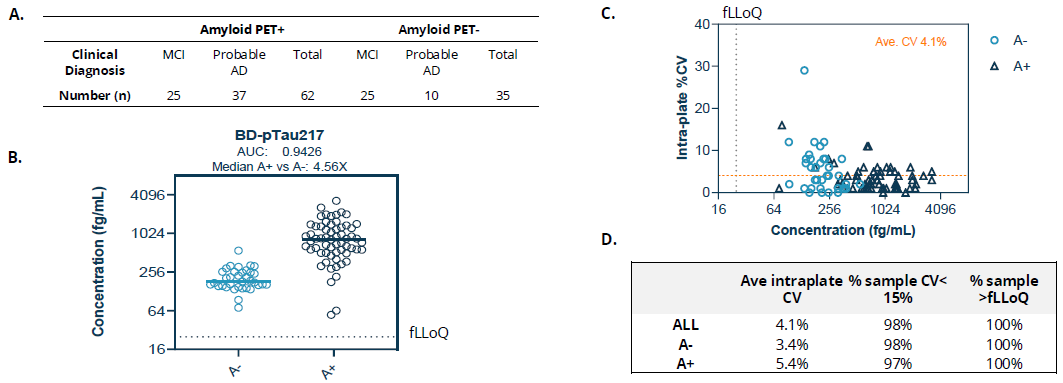
Figure 1. (A) Amyloid PET scan status and clinical diagnosis of 97 participants. MCI: mild cognitive impairment; AD: Alzheimer’s dementia. (B) BD-pTau 217 concentrations measured in plasma samples grouped in Amyloid negative (A-) and amyloid positive (A+) by their PET status. The fold-difference between the median values, as indicated by the solid lines of the two groups, is shown. The dashed line represents the functional lower limit of quantification (fLLoQ).
(C) Blue and orange dashed lines depict the functional LLoQ (25 fg/mL) and average intra-plate CV (4.1 %). (D) Summarized average intra-plate CV and % samples measured above fLLoQ in all participants, and in the A- and A+ groups, respectively. Image Credit: Spear Bio
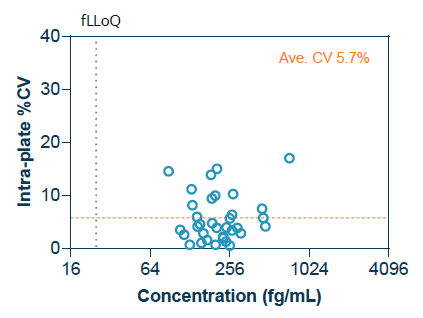
Figure 2. Concentration and intra-plate CV of 34 plasma samples from healthy individuals aged between 20 and 69 (average age 44.2). Blue and orange dashed lines depict the functional LLoQ (25 fg/mL) and average intra-plate CV (5.7 %). Image Credit: Spear Bio
Stability in measuring baseline BD-pTau 217 levels under physiological conditions
To assess suitability for longitudinal applications, BD-pTau 217 levels were evaluated in plasma samples from healthy volunteers across three two-week intervals. The SPEAR Assay yielded highly similar results across all three collections, with 11.6 % intra-subject variability (Figure 3A).
In contrast, the Simoa pTau 217 assay demonstrated significantly larger swings, with intra-subject variability of 18.9 % during the same sampling period (Figure 3B), indicating a greater vulnerability to short-term physiological variation or peripheral effects.
Importantly, all samples in this study were analyzed under identical analytical conditions, and both assays show comparable intra-plate CVs (7.3 % for SPEAR compared to 7.7 % for Simoa). Figure 3 shows that the observed stability of BD-pTau 217 is due to biological robustness rather than analytical imprecision.
These findings demonstrate that the SPEAR UltraDetect™ BD-pTau 217 assay provides a stable baseline measurement of BD-pTau 217 levels, a prerequisite for detecting true longitudinal changes associated with disease progression or therapeutic intervention.
Discussion
While plasma pTau 217 has revolutionized AD biomarker research, new evidence suggests that not all circulating pTau 217 is derived from the brain.
Peripheral neuropathies, kidney failure, and pre-analytical variables have all been linked to high plasma pTau 217 levels independent of AD pathology, possibly complicating interpretation, especially in early disease, screening, and population-based investigations.
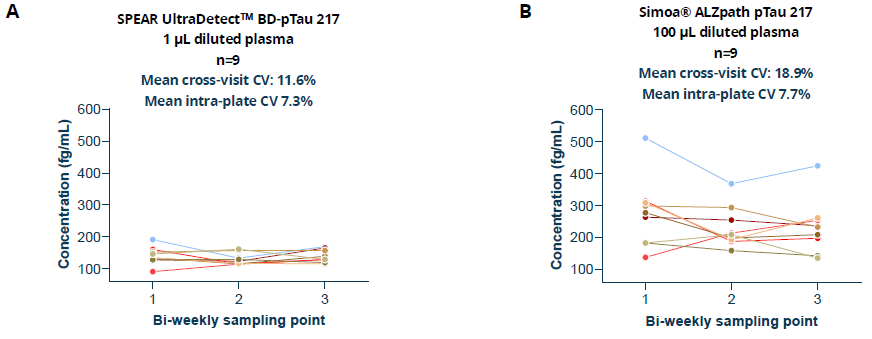
Figure 3. Plasma samples collected from neurologically healthy adult donors across three visits spaced at biweekly intervals and analyzed using (A) the SPEAR UltraDetect™ BD-pTau217 assay and (B) the Simoa® ALZpath pTau 217 assay. Mean intra-individual (or cross-visit) CV and mean intra-plate CV are shown. Image Credit: Spear Bio
Recent research has demonstrated that assays that enrich for CNS-derived, LMW pTau species are less influenced by ALS and have superior diagnostic accuracy in distinguishing AD from non-AD neurodegenerative disorders.1
Consistent with these discoveries, the emerging data shows superior stratification of amyloid positive using plasma BD-pTau 217 as opposed to total pTau 217.5 This evidence emphasizes the importance and relevance of improved CNS specificity of pTau biomarkers.
The SPEAR BD-pTau 217 assay shows a large fold separation between A- and A+ groups, a critical determinant of diagnostic accuracy that enables more reliable classification with a single cut-point. This implies that BD-pTau 217 has diagnostic utility equivalent to or even superior to pTau 217.
Plasma BD-pTau 217, a subset of pTau 217 in circulation originating from the CNS, is found at extremely low concentrations. This biomarker presents sensitivity problems for even the most powerful ultrasensitive devices.
Two commercially available assays, the NULISAqpcr BD-pTau217 Assay and the MSD S-PLEX Human BD-Tau (pT217) Assay,6,7 show approximately 50 % quantifiability and no detectability in plasma samples from healthy individuals, highlighting the low abundance and analytical challenges for this biomarker.
In contrast, the SPEAR test reliably assessed all healthy and illness samples well beyond its LLoQ across numerous independent cohorts, making it the only BD-pTau 217 assay capable of achieving 100 % quantifiability in every sample collection. This is crucial for realizing the potential of BD-pTau 217 in screening and early detection applications.
This assay displays outstanding precision, as expected from the SPEAR UltraDetect platform, with an average CV of 4–6 %.
Notably, the assay's resilience to peripheral and physiological confounders improves its ability to identify modest longitudinal variations in BD-pTau 217, attributable to disease progression or therapeutic intervention.
The SPEAR assay requires only 1 µL of diluted material, enabling the widespread use of micro-sampling technologies such as dried plasma spot (DPS). The data indicates that BD-pTau 217 can be used as a refined biomarker that enhances the strengths of plasma pTau 217 while improving AD specificity.
The SPEAR BD-pTau 217 assay integrates unparalleled sensitivity, high precision, and resistance to peripheral and physiological confounders, allowing for robust detection of biomarker changes in asymptomatic populations, strong amyloid discrimination, and exceptional baseline stability for long-term monitoring.
Spear Bio recommends the SPEAR UltraDetect BD-pTau 217 Assay as a best-in-class research tool for detecting amyloid pathology throughout the Alzheimer's disease continuum, including asymptomatic screening in prevention or early-stage studies, disease stratification in diagnostic research, and treatment monitoring in therapeutic development.
References
- Janelidze, S., et al. (2025). A comparison of p‐tau assays for the specificity to detect tau changes in Alzheimer’s disease. Alzheimer’s & Dementia, 21(4). DOI: 10.1002/alz.70208. https://alz-journals.onlinelibrary.wiley.com/doi/10.1002/alz.70208.
- Janelidze, S., et al. (2023). Mitigating the Associations of Kidney Dysfunction With Blood Biomarkers of Alzheimer Disease by Using Phosphorylated Tau to Total Tau Ratios. JAMA Neurology. DOI: 10.1001/jamaneurol.2023.0199. https://jamanetwork.com/journals/jamaneurology/fullarticle/2803026.
- Algeciras‐Schimnich, A. (2024). Effect of kidney function on plasma pTau217 concentrations using different pTau217 assays. Alzheimer’s & Dementia, 20(S2). DOI: 10.1002/alz.088364. https://alz-journals.onlinelibrary.wiley.com/doi/10.1002/alz.088364.
- Spear Bio. SPEAR UltraDetect™ BD-pTau 217 assay datasheet. 2026. https://go.spear.bio/hubfs/Data%20sheets/Datasheet_ SPEAR%20UltraDetect%20BD-pTau%20217%20v1.pdf
- Chong, J. R., et al. (2025). Plasma brain-derived p-Tau217 outperforms other p-Tau species in detecting abnormal brain amyloid in an Asian cohort of older people with cerebrovascular disease burden. MedRxiv. DOI: 10.64898/2025.12.09.25341888. https://www.medrxiv.org/content/10.64898/2025.12.09.25341888v2.
- Alamar Biosciences. (2026). New - NULISAqpcr BD-pTau217 Assay. Available at: https://alamarbio.com/nulisaqpcr-bd-ptau217-assay/.
- MSD (Meso Scale Discovery) (2026). S-PLEX Human BD-Tau (pT217) Kit | Meso Scale Discovery. Available at: https://www.mesoscale.com/products/s-plex-human-bd-tau-pt217-kit-k151axgs/.
About Spear Bio
Spear Bio is an innovative leader in providing scalable solutions for ultra-sensitive protein biomarker measurements. Spear Bio’s proprietary technology, Successive Proximity Extension Amplification Reaction (SPEAR), employs a unique 2-factor authentication mechanism to precisely measure protein biomarkers at attomolar level from sub-microliter sample volume. Spear Bio is focused on leveraging its technology’s unprecedented sensitivity to transform protein research and early disease diagnosis.
Sponsored Content Policy: News-Medical.net publishes articles and related content that may be derived from sources where we have existing commercial relationships, provided such content adds value to the core editorial ethos of News-Medical.net, which is to educate and inform site visitors interested in medical research, science, medical devices and treatments.