ISO 11040-8 is the international standard controlling standards and test methods for finished prefilled syringes. Unlike earlier standards in the ISO 11040 series that address single parts, ISO 11040-8 analyzes the prefilled syringe as a combination product, testing holistic device performance under scenarios that mirror actual clinical use.
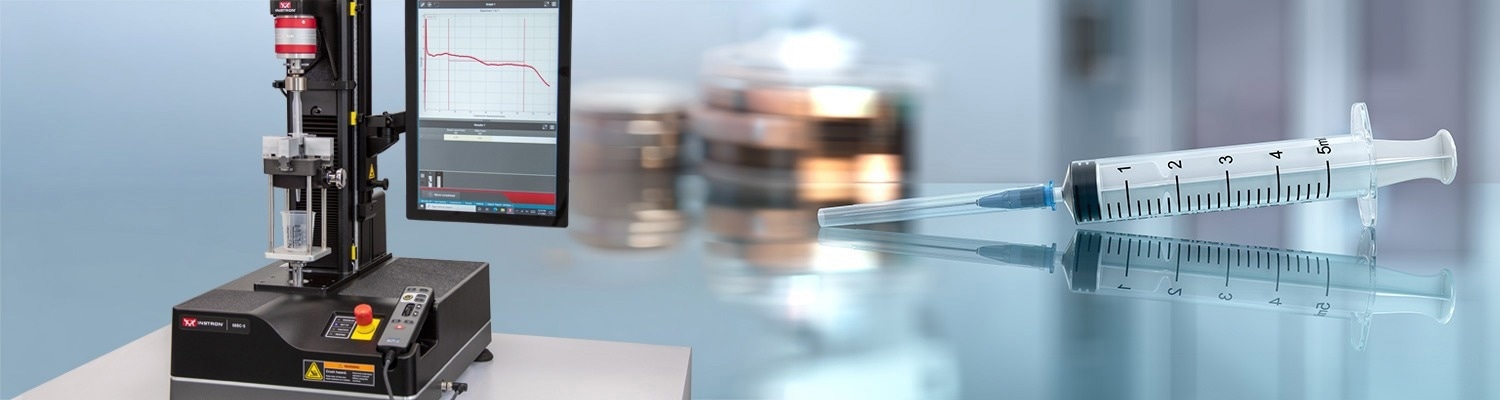
Image Credit: Instron - USA
The standard applies to syringes used for both manual injections and in needle-based injection devices, such as autoinjectors. This distinction is critical: testing must be completed with all components required for use (plungers, needles, etc.) in place, as near to real-world settings as possible.
The 2026 revision updates the 2016 first edition and incorporates important improvements to test methodologies, definitions, and scope, all aimed at enhancing design verification processes and harmonizing with the industry's shift toward combined product integration.
Key changes in the 2026 revision of ISO 11040-8
1. Expanded definition of intended use
The most fundamental change in the new standard is a much wider definition of intended use and a more explicit requirement that it drives every described test process.
Under the revised standard, intended use must account for:
- Therapeutic indication
- Criticality of administration (e.g., emergency use versus routine dosing schedule)
- Route of distribution (subcutaneous versus intramuscular)
- Patient population and human factors
- Clinical versus home-use environment
- Transportation and environmental conditions
These considerations can and should have a direct impact on test methods if adequate justification is documented. For example, a device designed for emergency administration may necessitate Break Loose and Extrusion Force tests at high rates to account for the unpredictability of urgent delivery conditions.
2. Break loose and Extrusion Force testing now defined in Annex A
Break Loose and Extrusion Force tests have been split from ISO 11040-4 Annex E.1 and are now codified as a distinct Annex A in ISO 11040-8. The underlying methodology is substantially consistent with the previous version, although numerous key explanations have been added.
- Data capture rate: The recommended data capture rate for this testing is 500 Hz.
- Test speed: 100 mm/min remians appropriate, but the standard recommends adjusting test speed based on intended usage. For devices used in needle-based injection systems, speeds ranging from 120–420 mm/minute may be adequate.
- Air bubble extrusion: The standard now acknowledges a possible load drop at the conclusion of plunger travel during air bubble extrusion and requires that this force be excluded when reporting extrusion force.
For organizations currently conducting this testing, these changes will mostly necessitate software method updates rather than hardware changes.
3. Liquid leakage and burst resistance consolidated into Annex C
The revised standard incorporates liquid leakage past the plunger and burst resistance testing into a new Annex C. In particular, burst resistance has been reclassified as a supplementary test, primarily required for prefilled syringes used in needle-based injection systems.
The following table summarizes the main differences between the two methods:
Source: Instron - USA
| Testing Parameter |
Liquid Leakage |
Burst Resistance |
| Needle Closure |
Ensure proper needle closure
is in place (tip cap, RNS, etc.) |
Actively seal the needle tip with a suitable method or tool |
| Means of Applying Force |
Plunger intended for use |
Comparable plunger fixture |
| Test Pressure |
300 kPa |
Expected maximum pressure in use +20% |
| Hold Duration |
30–35 seconds |
Expected injection duration |
| Failure Criteria |
Visual leakage past plunger stopper |
Visual leakage or physical cracking/breakage |
4. New test method: Administration time (Annex D)
Annex D introduces a new, conditionally applicable test method for administration time, which is the standard's most significant addition.
This test assesses simplicity of administration by monitoring the time required to fully dispense a dosage using a continuous or defined force profile.
It is especially important for biologics and other high-viscosity drug formulations, where the patient's ability to manually administer a dose or the compatibility of an autoinjector must be thoroughly tested.
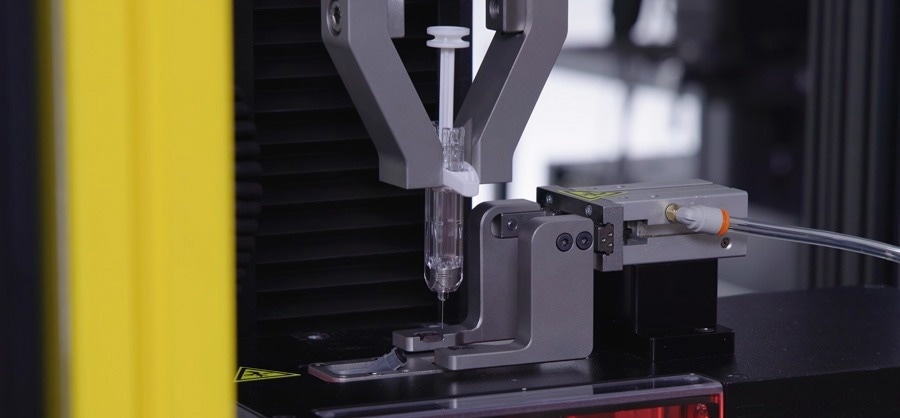
Image Credit: Instron - USA
Why this matters now
Device makers are increasingly designing syringe characteristics to meet high-injection-force challenges, such as shorter needle lengths and ultra-thin-walled needles. Administration time testing offers a standardized way to compare new advances with existing technologies in the context of their intended use.
Equipment requirements
The fixture setup is comparable to Break Loose and Extrusion Force testing, but load control is necessary to maintain force during injection. Although the standard does not define a control tolerance, modern test systems are often capable of ±1 N.
The method has applications beyond design verification; device manufacturers can use it to generate baseline data across a wide variety of fluid viscosities, assisting with early-stage characterization and derisking drug-device collaboration decisions.
Practical implications for quality and R&D teams
The 2026 update to ISO 11040-8 reflects a larger industry shift: pharmaceutical companies are increasing in-house device expertise and involving device stakeholders earlier in the development process. This standard facilitates such change by providing:
- More deterministic test methodologies that reduce ambiguity in design verification
- Clearer intended-use framing that allows teams to tailor test parameters with documented justification
- Preliminary characterization capability for prefilled syringe platforms at earlier development stages, reducing the burden of later-stage testing
For organizations currently testing the 2016 version, the move will primarily involve software method changes, particularly in data capture rate, speed parameters, and force-exclusion logic for air-bubble extrusion. Most labs are unlikely to experience significant hardware modifications.
Acknowledgments
Produced using materials originally authored by Landon Goldfarb.
About Instron - USA
A global leader in the materials testing industry, Instron manufactures mechanical testing systems designed to meet the needs of the medical device and pharmaceutical industries for performing static, fatigue, and impact testing. Instron provides single-source convenience through localized service and support, offering assistance with IQ/OQ, performance verification, system calibration, training, and preventative maintenance.
Sponsored Content Policy: News-Medical.net publishes articles and related content that may be derived from sources where we have existing commercial relationships, provided such content adds value to the core editorial ethos of News-Medical.net, which is to educate and inform site visitors interested in medical research, science, medical devices and treatments.