ORGAPRED, a France-based core facility specializing in Patient-Derived Tumor Organoid (PDTO) research, has selected the CYTOQUBE high-throughput 3D imaging system from Hamamatsu Photonics France to support personalized oncology drug screening and therapeutic discovery. The system enables rapid multi-color analysis of PDTOs and strengthens ORGAPRED’s ability to evaluate treatment efficacy on these models.
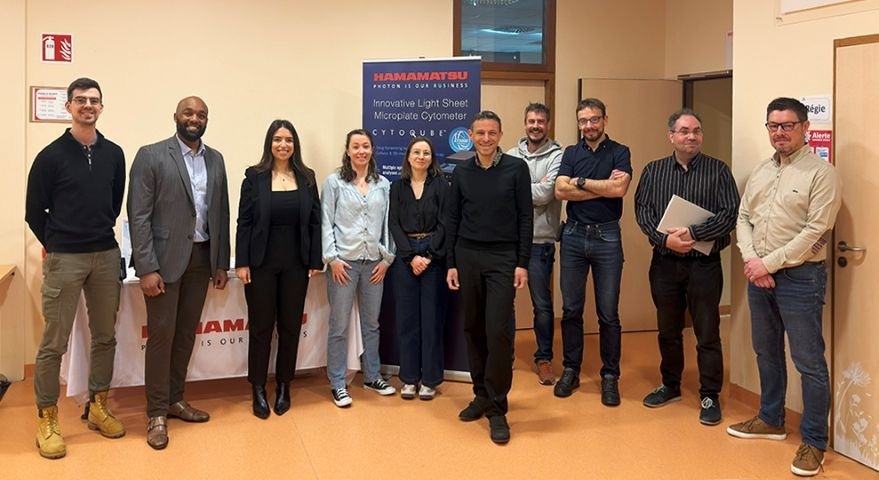 The Hamamatsu x ORGAPRED team. From the left: DESMARTIN Guillaume, EMICA Bruno, KOSSAYER Ghenwa, LECOUFLET Lucie, FLORENT Romane, D’ANGELO Jean Marc, Divoux Jordane, WEISWALD Louis-Bastien, POULAIN Laurent, LE GOFF Jérémie. Image Credit: ©Hamamatsu Photonics
Supporting personalized cancer treatment research and drug discovery
ORGAPRED is an innovative core facility dedicated to the production of PDTOs (also called tumoroids) to support personalized medicine and oncology research. Patient tumor samples are used to generate tumoroids, which are cultured for several weeks and distributed into 384-well
plates for drug testing. The CYTOQUBE system enables rapid 3D multi-color imaging to assess PDTO viability and cell death, providing a comprehensive evaluation of treatment response.
With CYTOQUBE, we can analyze tumoroids in three dimensions across entire plates, much faster than with conventional imaging approaches. This allows us to compare drug responses more efficiently, to support personalized oncology research, and to accelerate the identification of new effective therapeutic strategies.”
Dr. Romane Florent, Research Engineer, ORGAPRED
A collaboration developed over time
The relationship between Hamamatsu Photonics France and ORGAPRED began in 2021 and progressed through scientific exchanges, conferences, and technical evaluations. In March 2025, an on-site system evaluation supported ORGAPRED’s funding application and subsequent public tender process, which was awarded in December 2025.
Demonstrated performance advantages
During evaluation, the CYTOQUBE system demonstrated intuitive operation, simplified protocol creation, automated tumoroid segmentation, and clear data visualization. The system performs a 3-color 3D analysis in less than 30 minutes, independent of plate format (96, 384, or 1536 wells).
By comparison, conventional confocal microscopy workflows may require more time due to multi z-stack acquisition.
 Dotphoton and Hamamatsu Photonics are partnering to provide the ultimate raw image compression and address the ever-growing biomedical image data volume