As quality expectations continue to grow, it is becoming increasingly important to ensure that products meet customers’ standards. Crucial parameters for quality control include density, specific gravity, and refractive index. Using density meters and refractometers can help make sample analysis more efficient and reliable. This article provides seven tips for achieving accurate analysis.
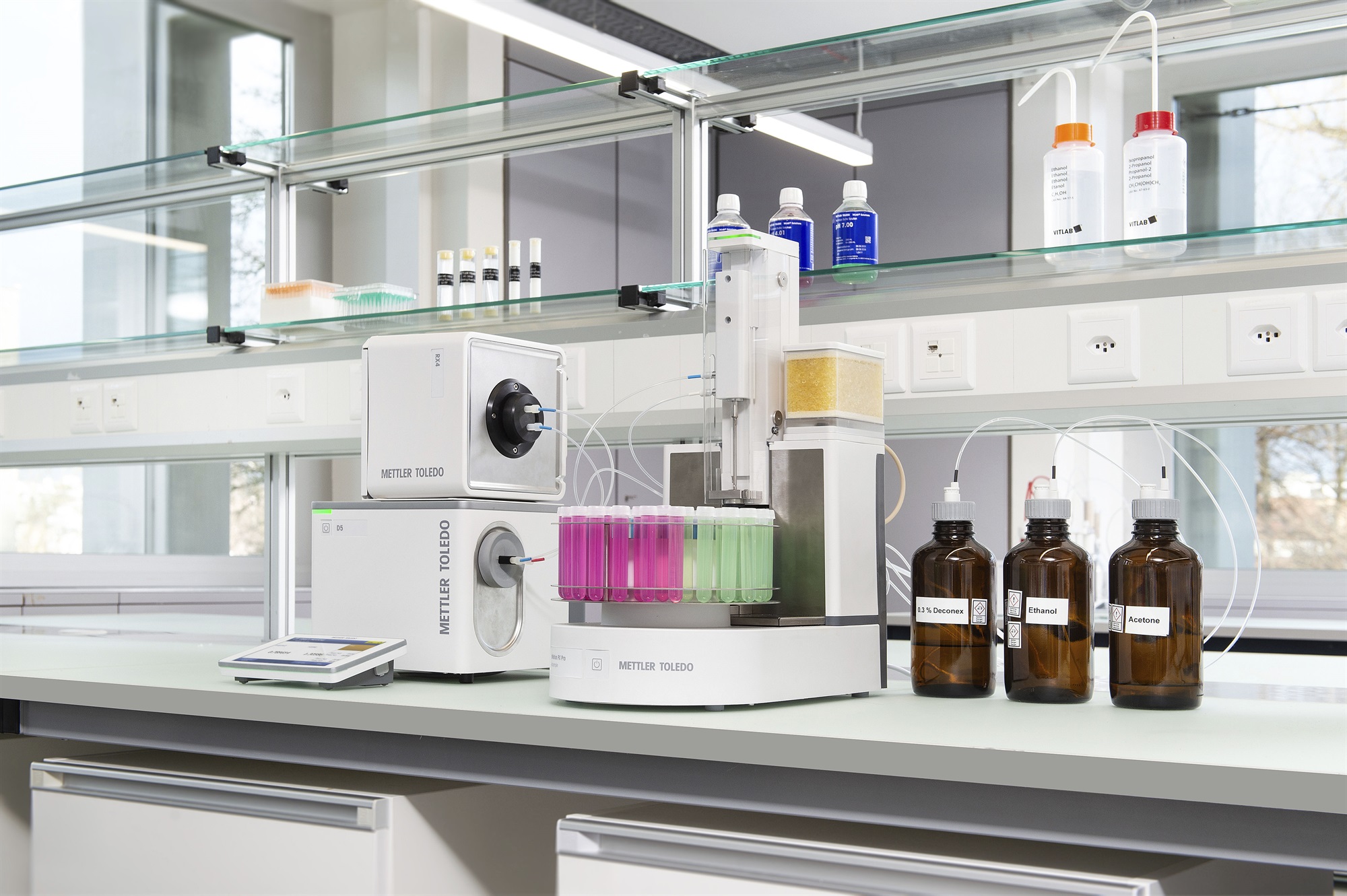
Image Credit: Mettler Toledo
1. Measure with density meters and refractometers to remove tedious sample preparation steps
When using a METTLER TOLEDO Density Meter, samples are transferred into a syringe that is manually mounted on the syringe presser and inserted into the density meter inlet. No additional sample preparation steps are required.
However, for the most accurate results, ensure non-homogeneous samples are stirred well, and verify that no air is trapped in the syringe by pressing the plunger slowly and continuously. The optional syringe pressing tool can be used for easy, slow, and repetitive sampling.
When using a refractometer, samples are transferred directly to the sample stage, eliminating lengthy sample preparation. However, some non-homogeneous solutions or suspensions may settle if left to stand; make sure they are stirred before sampling and that no bubbles are introduced during stirring.
2. Take extra care to confirm that there are no air bubbles in the sample
Air bubbles can cause false measurements that skew your data and are hard to remove. Some METTLER TOLEDO Density Meters are equipped with an integrated video view, providing operators with a clear view of their sample and guaranteeing trustworthy results.
Additionally, repeating measurements several times and slightly repositioning the sample between measurements ensure that any air bubbles that did not escape the sample do not affect the final result.
Refractometers can have trouble with air bubbles that get trapped between the prism and the sample. To limit air-bubble interference, ensure the measuring cell is clean before adding a new sample, then rub the prism surface with the material used to add the sample. Like with density meters, repeating measurements and moving the sample can prevent air bubbles from skewing the results.
The fully automatic multiple-measurement function is an additional tool available on both density meters and refractometers that helps ensure repeatable measurements.
3. Utilize fully automatic functions to avoid reading and calculation errors in results
METTLER TOLEDO offers fully automatic functions for density meters and refractometers. To make the most of these features, define your result limits, and the automated functions will determine if each measurement is within the limits. Additionally, the built-in conversion tables will convert measurements and display the results in the desired unit, preventing reading and calculation errors.
4. Prevent erroneous results by properly cleaning your equipment
When it comes to density meters, even a small quantity of rinsing liquids or leftover residues in the cell can cause substantial measuring errors. Before rinsing, always remove the sample from the measuring cells and tubes and perform two rinses with the appropriate solutions.
After rinsing, dry the cell completely using a drying pump. For extra confidence in your results, measure the air density and compare it to the known value at that temperature to confirm that the cell is completely dry.
To effectively remove a sample from a refractometer, use a syringe. Unlike tissues and cleaning wipes, a syringe can be reused multiple times, which reduces waste. When cleaning, always rinse with the appropriate rinsing solutions, wipe the prism or cell dry with a soft tissue, and wait 10 seconds before adding the next sample.
5. Calibrate your instruments regularly to verify the accuracy of your results
Preventing systematic errors is crucial to achieving accurate results. Both density meters and refractometers should be tested daily with water and periodically with a certified standard. If the test systematically fails, improve your standard cleaning procedures and adjust the instrument.
6. Use LabX to save time and avoid transcription errors
METTLER TOLEDO’s Excellence refractometers are compatible with LabX software. LabX allows all data to be stored centrally in an SQL database and can be connected remotely via Ethernet. This saves valuable bench space and allows the operator to perform all operations directly at the instrument terminal.
LabX also offers expanded result management capabilities, including CSV file export, additional calculations, and result review.
Automate your workflow
Workflow automation helps to minimize operator errors while saving time and effort, increasing measurement repeatability and reducing long-term costs. Automated solutions such as the METTLER TOLEDO InMotion PX allow excellent repeatability and thorough cleaning procedures. The pressurized filling system prevents sample evaporation and bubble formation and can handle samples ranging from low to high viscosity.
By following these seven tips, you can improve measurement accuracy, reduce errors, and achieve more reliable results. Simplified sampling, proper cleaning, regular calibration, and workflow automation all contribute to better quality assessment and greater efficiency.
About Mettler-Toledo International Inc.
METTLER TOLEDO is a leading global manufacturer of precision instruments for a wide range of applications in laboratory, research and development (R&D), quality control and production. The company serves multiple industries, including food & beverages, pharmaceutical and chemical.
METTLER TOLEDO's broad portfolio is developed to fulfill the requirements of different R&D, laboratory and quality control applications:
- Laboratory Weighing Solutions – The perfect combination of high performance and ease-of-use to provide fast and precise weighting with the solutions such as balances, moisture analyzers and mass comparators
- Analytical Instruments – Instruments for Titration, pH Meters and Electrodes, Density Meters, Refractometers, UV/VIS Spectrophotometers and Thermal Analysis ensure reliable measurement and fully documented workflow for every quality control lab
- Manual and Electronic Pipettes – Rainin pipettes and consumables deliver outstanding performance and an advanced liquid handling solutions for life science
- Automated Reactors and In Situ Analysis – Automated reactors, in situ reaction analysis, and inline particle monitoring accelerate the development of new chemicals
- LabX Software – Software to digitalize your laboratory workflows by connecting and controlling METTLER TOLEDO™ benchtop instruments and robotic automation through a centralized, seamless, and scaleable platform fully intergrated with your ecosystem (e.g. LIMS, MES).
METTLER TOLEDO Connects to the World

Sponsored Content Policy: News-Medical.net publishes articles and related content that may be derived from sources where we have existing commercial relationships, provided such content adds value to the core editorial ethos of News-Medical.net, which is to educate and inform site visitors interested in medical research, science, medical devices and treatments.