Scaling a twin-screw extrusion process is generally thought of as a proportional adjustment that involves increasing screw diameter, increasing feed rate, and maintaining temperature. Although these modifications are important, they are insufficient to ensure process equivalence.
Extrusion scaling depends on maintaining comparable mechanical, thermal, and residence-time histories at a larger scale than during development; it does not scale by geometric enlargement alone. Mechanical energy input determines shear exposure, while shear affects melting and distributive mixing.
Residence-time distribution influences the duration of material exposure to thermal and mechanical stress. Thermal balance governs whether such exposure promotes controlled transformation or results in degradation. Variations in these conditions can alter the final product’s material history and critical quality attributes.
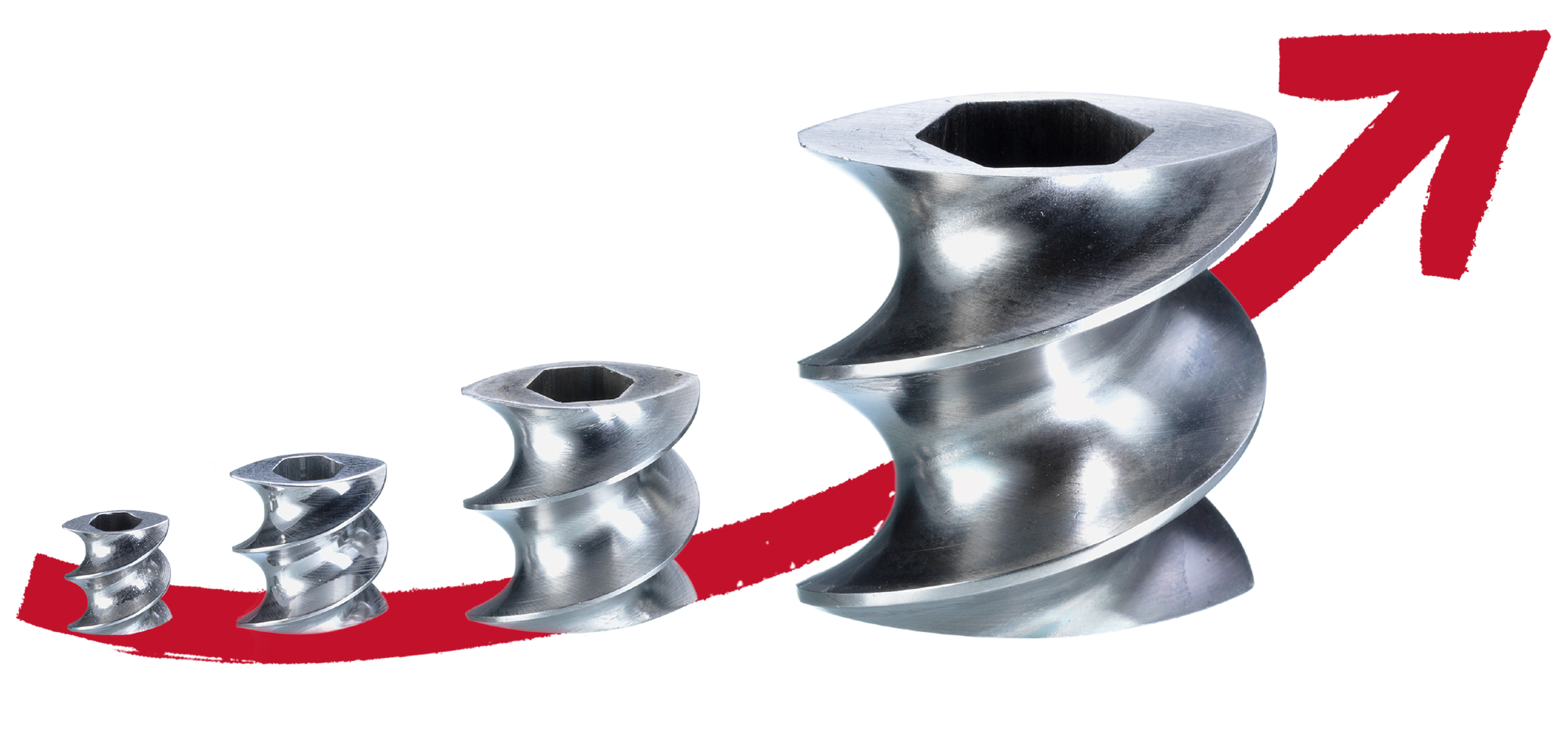
Image Credit: Thermo Fisher Scientific – Production Process & Analytics
Geometric similarity enables physical equivalence
Twin-screw extrusion is dictated by both geometry and parameter settings. The relationships between outer screw diameter (D0), inner diameter (Di), barrel length (L), and screw configuration determine the transport and mixing regime within the barrel.
To maintain comparable physics across scales, geometric relationships must be preserved across instruments, from small to large scales:
- Consistent L/D ratio
- Consistent D0/Di ratio
- Comparable free volume per unit length
- Equivalent screw configuration philosophy
The internal shear field, fill behavior, and transport mechanisms are defined by these relationships. When preserved, material undergoes comparable shear rates, distributive mixing, and residence patterns. Changes in these relationships result in different transport and mixing conditions, even when screw speed and feed rate are scaled proportionally.
Volumetric scale-up strategies assume that geometric similarity across instruments maintains filling levels and shear conditions.1 Differences in geometry can therefore reduce the predictive value of scaling relationships. This principle is supported by processing literature.
Mixing efficiency and material transport are integral to screw configuration and barrel geometry.2 Although geometric similarity cannot guarantee successful scale-up, it does help establish the foundation for achieving predictable scale-up.
Surface-to-volume constraints and thermal balance
An increase in extruder diameter causes volume to scale proportionally to the cube of the diameter (D3), whereas surface area scales only in relation to the square of the diameter (D2). As a result, the relative heat-transfer surface available per unit material decreases with larger scale.3 Larger systems dissipate heat less efficiently relative to throughput, and viscous dissipation becomes a more substantial contributor to melt temperature.
Regression-based scale research across 11 mm, 16 mm, and 24 mm systems shows that feed rate adjustment by itself does not maintain material experience at larger diameters.3
Preserving comparable specific mechanical energy consumption requires adjustments to screw speed as diameter increases. The operating window expands with scale, but its position and boundaries shift.
Development procedures that rely substantially on external heat extraction introduce thermal conditions that may be difficult to reproduce at larger diameters. More scalable operation requires mechanical energy input and stable fill behavior to establish thermal equilibrium. Processes that approximate adiabatic behavior during development facilitate more predictable translation across scales.1
Steady state as a prerequisite for transfer
Increasing diameter cannot correct instability observed at the laboratory scale. When feed rates are especially low, specific feed load (SFL) may fall below representative fill levels. This can result in a reduced residence time distribution, the development of plug-flow tendencies, and material transport dominated by feed displacement rather than controlled mixing.1
While these conditions may seem stable, they do not reflect the regime required at a larger scale. Research analyzing volumetric scale-up under low-throughput conditions demonstrates that residence-time equivalence diminishes when fill level is insufficient.1 Regimes governed by plug-flow tendencies at the development scale can result in mismatched specific mechanical energy behavior and altered axial mixing during transfer.
For this reason, processes that appear stable at smaller laboratory scales pose a greater risk during transfer. Predictable scale-up requires stable steady-state operation at representative fill levels.
What scaling actually changes
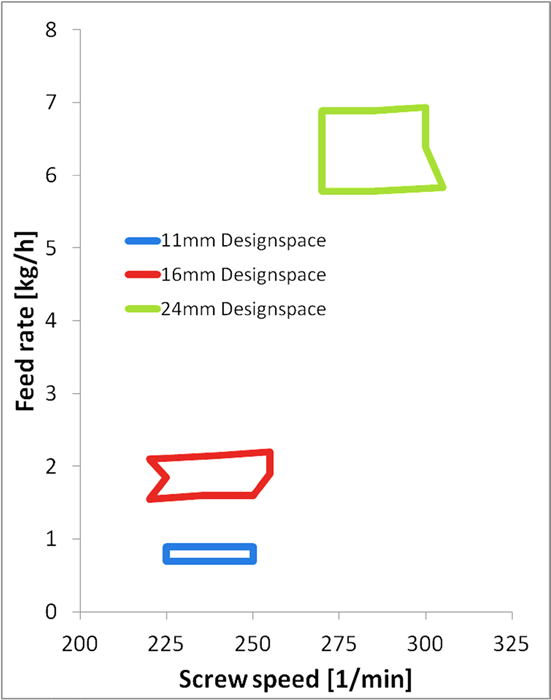
Figure 1. These operating windows were derived from experimental runs across 11 mm, 16 mm, and 24 mm extruders. Image Credit: Thermo Fisher Scientific – Production Process & Analytics
The shape and position of each window illustrate a critical constraint: increasing diameter decreases heat-transfer efficiency relative to material volume. To maintain material experience, screw speed must be modified alongside feed rate.
Consequently, development teams must first verify energy input and residence behavior at the next scale before laboratory-scale conditions can be translated proportionally. Rather than being a simple translation, scale-up is an adjustment that requires recalibration within physical constraints.
References and further reading
- Jeroen Van Renterghem, et al. (2019). Assessment of volumetric scale-up law for processing of a sustained release formulation on co-rotating hot-melt extruders. International journal of pharmaceutics, 569, pp.118587–118587. DOI:10.1016/j.ijpharm.2019.118587. https://www.sciencedirect.com/science/article/abs/pii/S0378517319306325
- Paulsen, K., Leister, D. and Gryczke, A. (2018) Investigating process parameter mechanism for successful scale-up of a hot-melt extrusion process. Application Note LR71. Karlsruhe: Thermo Fisher Scientific. Available at: https://documents.thermofisher.com/TFS-Assets/CAD/Application-Notes/LR71-e-Investigating-Process-Parameter-Mechanism.pdf.
- Jakob, B. and Geilen, T. (2012) Relevant process parameters for twin-screw compounding. Application Note LR70. Karlsruhe: Thermo Fisher Scientific. Available at: https://documents.thermofisher.com/TFS-Assets/MSD/Application-Notes/LR70-relevant-process-parameters-twin-screw-compounding.pdf.
- Wesholowski, J., et al. (2019). Scale-up of pharmaceutical hot-melt-extrusion: Process optimization and transfer. European Journal of Pharmaceutics and Biopharmaceutics, 142, pp.396–404. DOI:10.1016/j.ejpb.2019.07.009. https://www.sciencedirect.com/science/article/abs/pii/S0939641119300475?via%3Dihub
About Thermo Fisher Scientific – Production Process & Analytics
 You increase food quality, ensure product integrity, or accelerate the development of the next generation of environmentally friendly energy solutions. In a highly competitive global marketplace, however, you face new internal and external pressures. Stringent regulatory mandates. Heightened consumer expectations. You need a partner with the stability and reliability to integrate proven solutions with your business complexities.
We’ve been at the forefront - and by your side - for over fifty years.
We identify. We verify. We simplify.
From the lab to the line and field, we enable our customers to make the world healthier, cleaner, and safer with world-class Thermo Scientific™ products and services.
Our innovative portfolio for Industrial and Safety Applications covers:
Advanced imaging: Our x-ray sources are deployed in a wide range of applications, for the testing, imaging, and inspection of items ranging from batteries, printed circuits boards and semi-conductor devices to animal fluoroscopy and dental prosthetics quality control. They have the short wavelengths and high energies required to penetrate through many different materials and provide a non-destructive, easy-to-use, reliable technology, in the laboratory, in healthcare settings or on-line. Learn more.
Bulk elemental analysis: For more than 85 years, Thermo Fisher Scientific has been a global supplier of spectrochemical instruments for major industries such as metallurgy, transportation, cement, mining, food, pharmaceuticals, chemicals, petroleum and batteries. We offer unparalleled capabilities in optical emission spectrometry (OES), laboratory X-ray fluorescence (XRF), X-ray diffraction (XRD) and spectrometer automation (SMS):
- OES analyzers are ideal for use in quality control for the direct, elemental analysis of solid metals. More.
- XRF instruments offer complete systems for the analysis of solids, liquids and powders. An XRD system integrated inside the same XRF instrument allows the determination of the phase content in many minerals and materials. More.
- XRD systems provide cost-effective solutions for high-quality powder diffraction analyses and can also be a complementary technology to XRF spectrometry. More.
Food inspection: Enabling the highest levels of food safety, Thermo Fisher Scientific provides industry leading detection supported by unparalleled applications and global support.
Our integrated solutions maximize the probability of contamination detection and process accuracy at critical control points to support overall equipment effectiveness. Take a closer look!
Gauging
- Li-Ion battery solutions: Our solutions enable customers to develop and manufacture advanced battery technology by providing real-time insights into the characteristics of electrode coating and separator film production to support the delivery of safe and effective batteries to market. More.
- Food packaging: Through our in-line thickness and basis weight measurement solutions, we enable our customers to improve the quality and performance of food packaging materials. Our instruments provide precise measurement and process control as well as intuitive data insights to produce aseptic packaging through safeguarded measurement of barrier layers and automatic profile control in multi-layer applications. More.
- Metals gauging: Through our in-line non-contact thickness and coating weight measurement solutions, we enable our customers to optimize quality and maximize productivity during high-speed production of steel plate and sheet. Our instruments provide precise real-time measurement and process control that meet the tightest specifications of any application, while maximizing raw material use, whether producing from iron ore or scrap or whether end products are several inches or less than a millimeter thick. More.
Material characterization:
- Rheometers/viscometers: Our rheometers and viscometers are designed for easy and intuitive handling, intelligently guiding operators through all steps for failure-free measurement. Users can take advantage of enhanced useability and workflows enabled by “Connect Assist” technology as well as intuitive touch screen displays for easy visualization of measurement results directly from the instrument. They are designed to accurately measure the flow and deformation properties of fluids, semi-solids, and even solid materials - giving you the fast, repeatable data needed for today’s quality control, product development, and research applications. More.
- Compounding/extrusion: Requiring only a small amount of material to conduct experiments, lab-scale extruders allow you to conduct numerous trials efficiently, cost effectively, all while conserving precious laboratory space. Our twin-screw extruders offer flexible configurations for small batches, ideally suited for pilot-scale production or low-volume manufacturing. Reliably scale-up and reduce time to market with the controlled, continuous processing of lab-scale extruders. More.
Process analyzers: Our slurry sampling, on-line particle & elemental analyzers solutions support you with accurate, real time & continuous data to ensure process control, automation, and optimization of minerals processing plants. Increased recovery, and reagent usage are enabled by dedicated analysis and representative sampling. 50 years of experience in mining solutions enable us to customize solutions – not just products – for our clients to solve their ongoing analytical challenges. Furthermore, our integrated solutions help contributing to the 2050 net zero target for decarbonization. Have a closer look!
Sponsored Content Policy: News-Medical.net publishes articles and related content that may be derived from sources where we have existing commercial relationships, provided such content adds value to the core editorial ethos of News-Medical.net, which is to educate and inform site visitors interested in medical research, science, medical devices and treatments.