Throughout drug development, protein signatures are increasingly used to support target engagement studies, investigate mechanisms of action, and track pharmacodynamic (PD) responses.
PD research necessitates specialized assays that can provide precise and repeatable quantification across vast sample cohorts, even if discovery proteomics can find potential biomarkers from thousands of proteins.
Changes in sample preparation, chromatography, or mass spectrometry platforms are frequently necessary to translate biomarkers from discovery to targeted analysis. The risk that peptide retention durations, detectability, or quantitative performance will not transfer between workflows is increased by these modifications, which also raise method-development effort.
To provide consistent sample preparation and chromatography across both discovery and targeted LC-MS applications, the Evosep Proteomics ecosystem combines Evokit™, a standardized sample preparation solution, with Evosep Eno™, a standardized liquid chromatography system.
Automated sample preparation with integrated process controls is used to process Evokits on Evosep Lupo™. In a single pipeline, these technologies facilitate the transfer of biomarker candidates from discovery proteomics to targeted pharmacodynamic tests.
This article presents a discovery-to-targeted workflow on the Evosep Eno using a dilution series of human K562 cell line lysate, with targeted multiple reaction monitoring (MRM) verification on a SCIEX 7500+ and discovery on a SCIEX ZenoTOF 8600 (Figure 1).
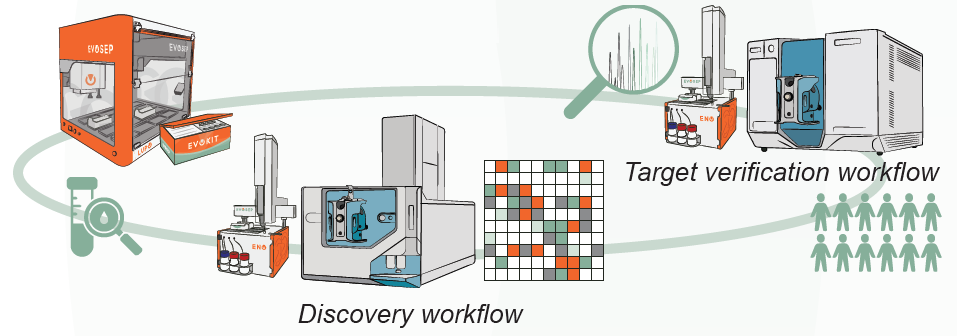
Figure 1. Standardized discovery-to-targeted workflow with Evokits on Evosep Lupo and the Evosep Eno. Image Credit: Evosep
Method details
K562 cell lysate was processed using Evokit Digest, 1x96 (EV3802, Evosep), and integrated process control digest (PCD) and system suitability control (SSC) samples on an Evosep Lupo (EV3000, Evosep).
A total of 30% of the digest was then loaded onto Evotips for the 500 ng protein input used in the discovery studies. A dilution series of 1 to 500 ng protein input was aliquoted into the Evokit sample plate for focused analysis, and 30% of each digest was loaded onto Evotips.
Using Evosep Eno and an Evosep Performance column (EV1182, Evosep) kept at 40 °C, LC-MS/MS analyses were carried out at 200 SPD. A SCIEX ZenoTOF 8600 with an OptiFlow Pro source running at 4500 V and 200 °C was used for the discovery study (curtain gas 40 psi, GS1 20 psi, GS2 60 psi).
ZT Scan DIA with a 5 Da Q1 window and a 10 ms MS/MS accumulation time over m/z 400–900 was used to get the data. Using trypsin/P with up to two missed cleavages and default parameters, raw files were analyzed using DIA-NN (v1.9.2) in library-free mode at 1% FDR against the reviewed human proteome (UniProt, Oct 2020, 20,600 entries).
Match between runs was enabled inside replicates, and conditions were searched independently. A SCIEX 7500+ with an OptiFlow Pro source running at 4500 V and 270 °C was used for targeted analysis (curtain gas 40 psi, GS1 40 psi, GS2 50 psi).
A total of 16 peptides with three transitions each were monitored in MRM mode with unit resolution for Q1 and Q3 and a cycle time of 0.56 seconds. The LLOQ was determined as the lowest level with accuracy within ± 20% and CV ≤ 20%. Calibration curves were fitted using 1/x2 weighting.
Deep and precise discovery
The 200 SPD approach was used to assess discovery performance at 500 ng K562 protein input (Figure 2). Four replicates yielded a median of 5,286 protein groups, 45,456 peptides, and 53,913 precursors.
With median CVs of 4.1% at the protein group level and 8.3% at the precursor level, quantitative precision was good; 81% of protein groups were quantified below 10% CV and 96% below 20% CV. Nomination of candidate peptides at cohort-compatible throughput is supported by this combination of depth and precision at 200 SPD.
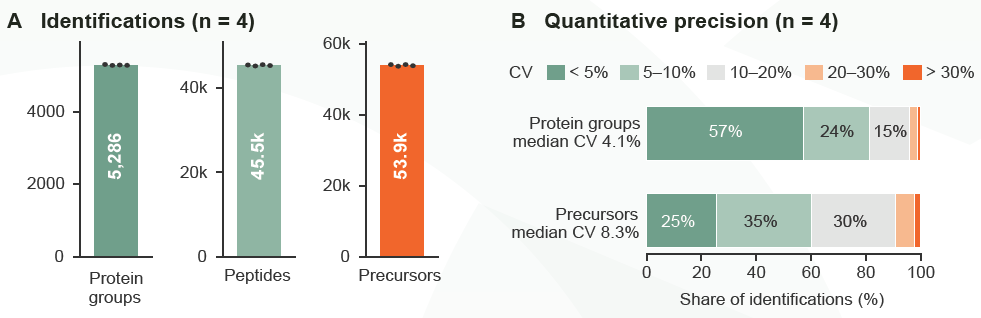
Figure 2. Discovery performance at 500 ng K562 protein input (30% loaded on Evotip, n = 4) on the SCIEX ZenoTOF 8600 with ZT Scan DIA at 200 SPD. (A) Median protein group, peptide and precursor identifications with individual replicates. (B) CV distributions at protein group and precursor levels. Image Credit: Evosep
Seamless transfer to targeted assays
Converting discovery results into quantitative assays appropriate for daily use is a significant hurdle in biomarker research.
Without altering the sample preparation, Evotip™ loading, or LC technique, peptides found in the discovery data were moved to a 16-peptide MRM assay on the SCIEX 7500+ and examined over a 1–500 ng K562 dilution series.
As demonstrated for two example targets (2.9 and 3.6 min; Figure 3), retention periods were maintained between platforms because the Evosep Eno supplies the same gradient to both mass spectrometers.
Both targets were found on both platforms with co-eluting transitions and clean baselines at 1 ng protein input. When converting candidate biomarkers into specific tests, consistent chromatography across platforms minimizes method-development work.
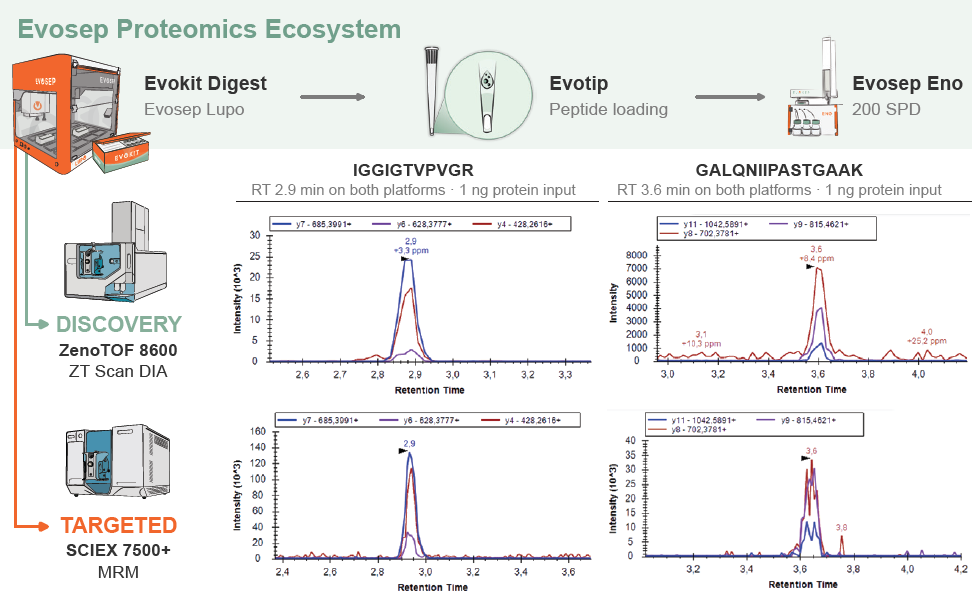
Figure 3. Extracted ion chromatograms (XICs) of two K562 peptides at 1 ng protein input by ZT Scan DIA on the SCIEX ZenoTOF 8600 (top) and MRM on the SCIEX 7500+ (bottom), using the same sample preparation and separation (Evosep Eno, 200 SPD, n=4). Image Credit: Evosep
Quantitative accuracy
Due to their low abundance and potential for very slight treatment-induced changes, many pharmacodynamic biomarkers necessitate sensitive and repeatable quantitative testing. The MRM assay's quantitative performance was assessed throughout the dilution series (Figure 4).
With an LLOQ of 15.6 ng protein input and an R2 of 0.9945-0.997, three K562 proteotypic peptides had linear responses. From 15.6 to 500 ng, accuracy ranged from 86 to 111%, within ± 15% of nominal at all levels. Peptides were still detectable below the LLOQ, with distinct peaks as low as 1 ng input.
Previous studies have demonstrated quantification on the Evosep Eno with 93–102% accuracy across the whole sample preparation procedure using stable isotope-labeled standards and matrix-matched calibration in plasma.1
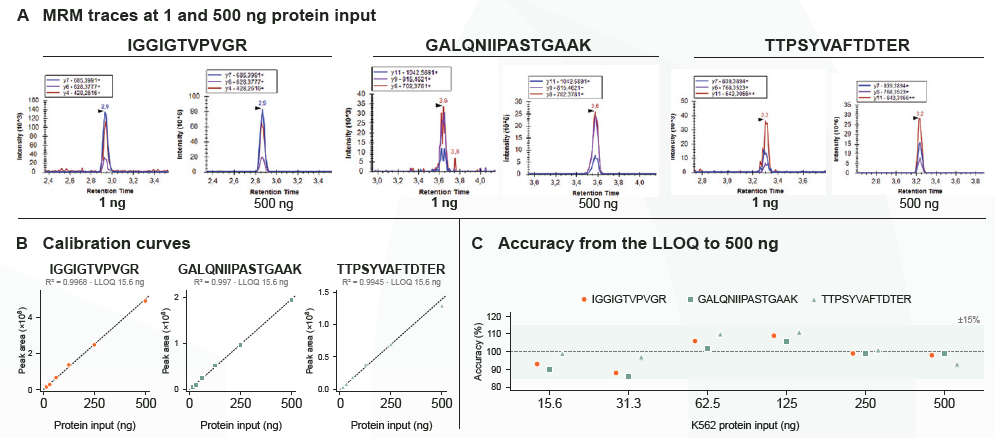
Figure 4. MRM quantification of three K562 peptides on the SCIEX 7500+ (Evosep Eno, 200 SPD, 30% of digest loaded on Evotip, n=4). (A) XICs at 1 and 500 ng protein input. (B) Calibration curves with R2 and LLOQ. (C) Accuracy from the LLOQ (15.6 ng) to 500 ng with the ± 15% range shaded. Image Credit: Evosep
Built-in quality control
Workflows that function consistently over time are necessary for large-cohort investigations. Dedicated PCD samples that go through the whole sample preparation process and SSC samples that just track LC-MS performance are included in every Evokit.2
Workflow variability is divided into contributions from sample preparation and LC-MS when comparing the two (Figure 5).
Workflow CV (PCD) maintained ≤ 11.5% for all three peptides and ≤ 8.2% from 31.3 ng upward over 1–500 ng protein input, with sample preparation contributing ≤ 6.4%. This helps differentiate biological change from analytical drift in longitudinal pharmacodynamic (PD) studies where samples are often processed weeks apart.
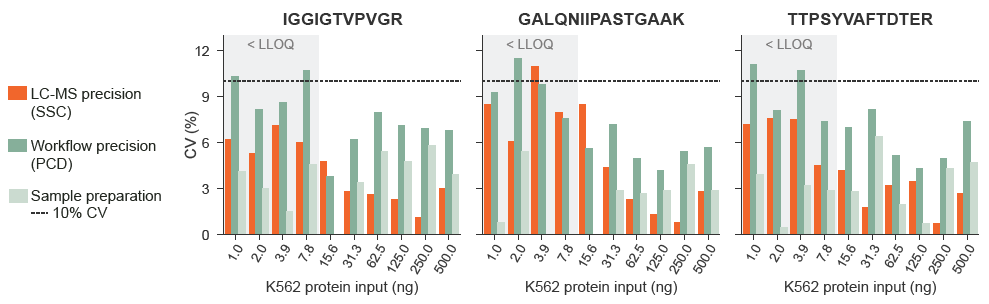
Figure 5. LC-MS precision (SSC), total precision (PCD), and sample preparation contribution for three K562 peptides across the dilution series (1–500 ng protein input). Grey area: below the LLOQ; dotted line: 10% CV. MRM on the SCIEX 7500+ at 200 SPD (n=4). Image Credit: Evosep
Conclusion
A key obstacle in the creation of biomarkers is still bridging the gap between quantitative PK/PD studies and discovery proteomics. This article presents a uniform approach from discovery to targeted, where sample preparation and separation are the same in both stages.
A median of 5,286 protein groups with a median protein-level CV of 4.1% were found using the SCIEX ZenoTOF 8600 at 200 SPD.
While built-in PCD and SSC samples isolated LC-MS from sample preparation variability, selected peptides were transported straight to MRM on the SCIEX 7500+ with preserved retention times, R2 > 0.99, and 86–111% accuracy from 15.6 to 500 ng.
These findings demonstrate that the Evosep Proteomics ecosystem offers a reliable, MS-independent basis for biomarker research in PK/PD programs at scale, when combined with earlier work on alternative MS platforms.1,2
References
- Evosep (2025). Evosep Eno - High sensitivity and quantitative accuracy for plasma proteome analysis at scale. Available at:https://www.evosep.com/wp-content/uploads/2025/06/AN-044F_Targeted-workflows_Eno.pdf.
- Evosep (2026). Standardized sample preparation at scale with Evokits and Evosep Lupo. Available at: https://www.evosep.com/wp-content/uploads/2026/05/AN-058A_Evosep-Lupo-performance-Digest-kit-web-2.pdf.
About Evosep
At Evosep we aim to improve quality of life and patient care by radically innovating how protein based clinical diagnostics are performed, initially through collaborations with world-leading scientists about developing new technologies and solutions to make sample separation 10 times faster and 100 times more robust than todays’ alternatives.
Proteomics is about the study of proteins in a biological mechanism, both their individual function and their combined interactions. For clinical proteomics the goal is to be able to quickly and efficiently compare a biological sample against a profile panel of selected proteins in order to deliver a diagnose / verdict of healthy or diseased (within given statistical margins). Such a profile is typically called a biomarker and for official approval, it must be demonstrated successfully on a large population.
This calls for fast sample processing and because such clinical samples, in the form of blood or biopsies, are much more crude that the relatively clean cell cultures used in basic research, very robust protocols and consumables are also required.
Sponsored Content Policy: News-Medical.net publishes articles and related content that may be derived from sources where we have existing commercial relationships, provided such content adds value to the core editorial ethos of News-Medical.net, which is to educate and inform site visitors interested in medical research, science, medical devices and treatments.